 By Iris
Otocyon megalotis | Bat-eared Fox
Species Profile · Canidae
Bat-eared Fox
A small fox walks through dry grass on stilt legs.
Least Concern
Length
Shoulder
Weight
Teeth
Ears
Rating
The Bat-eared Fox
Ears built for termites
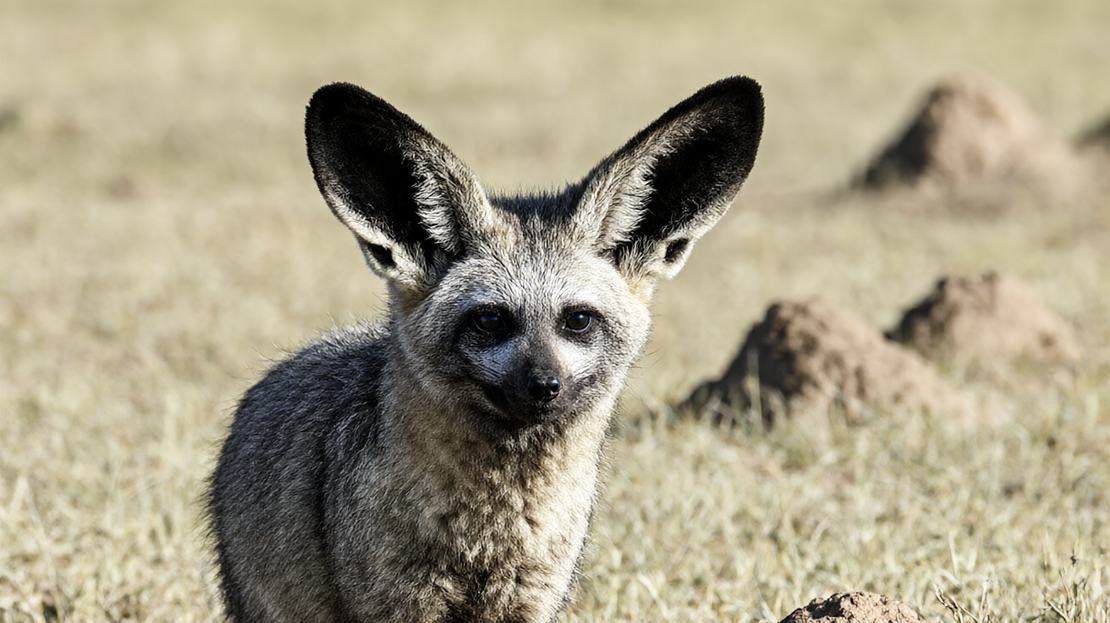
A small fox walks through dry grass on stilt legs. Its ears look far too large for the head. They are.
Each ear stands almost 13 cm tall, and it works like a satellite dish for every sound around it. Bat-eared foxes live in two separate patches of Africa. One lies in the east, the other in the south.
Because the animal eats termites, it needs the ears more than it needs speed. That trade shaped the whole body.
Family tree
Canidae, alone in its genus
Its proper name is Otocyon megalotis, and it stands alone in its genus. Canidae is the family, which puts it beside wolves and jackals. A Fennec Fox carries large ears too, though that animal lives in sand and hunts at night. Both ears do the same job, and both evolved the shape separately.
A Red Fox shows the ordinary canid plan, with small ears and a broad diet. Its teeth number 48 or more, which is high for a canid. Most foxes carry 42.
A mask and huge ears
How to tell one
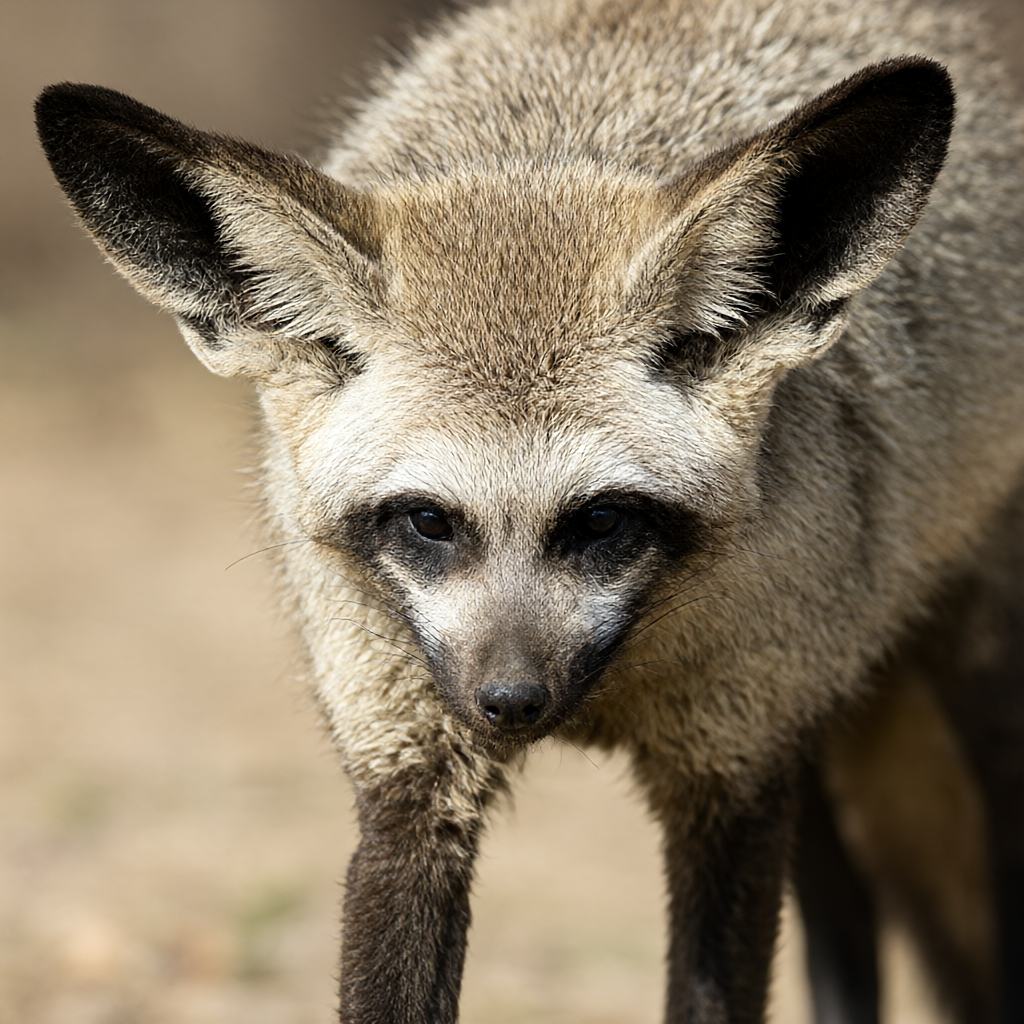
Adults run 46 to 66 cm from nose to tail. Shoulder height sits near 35 cm. Weight falls between 3 and 4.5 kg.
The coat is pale grey-brown with darker guards, and it lightens across the dry season in most of its range. A black mask covers each eye. Because the jaw is slender, the animal can snap termites one at a time instead of crushing a mouthful.
Its legs run thin, and the body stays light above them. The ears turn independently, and each one can face a different sound.
1
2
3
Short grass only
Where it lives
Dry grassland and savanna hold the species, from Ethiopia down to South Africa. Short grass matters most. Because the animal needs termites above ground, it stays where mounds dot the plain. Overgrazed ground suits it, and so does land that cattle have cleared of tall grass.
Two populations sit far apart, and no record links them. The eastern group holds Kenya and Tanzania. The southern group spreads from Namibia into Angola and South Africa.
Termites, mostly
What it eats
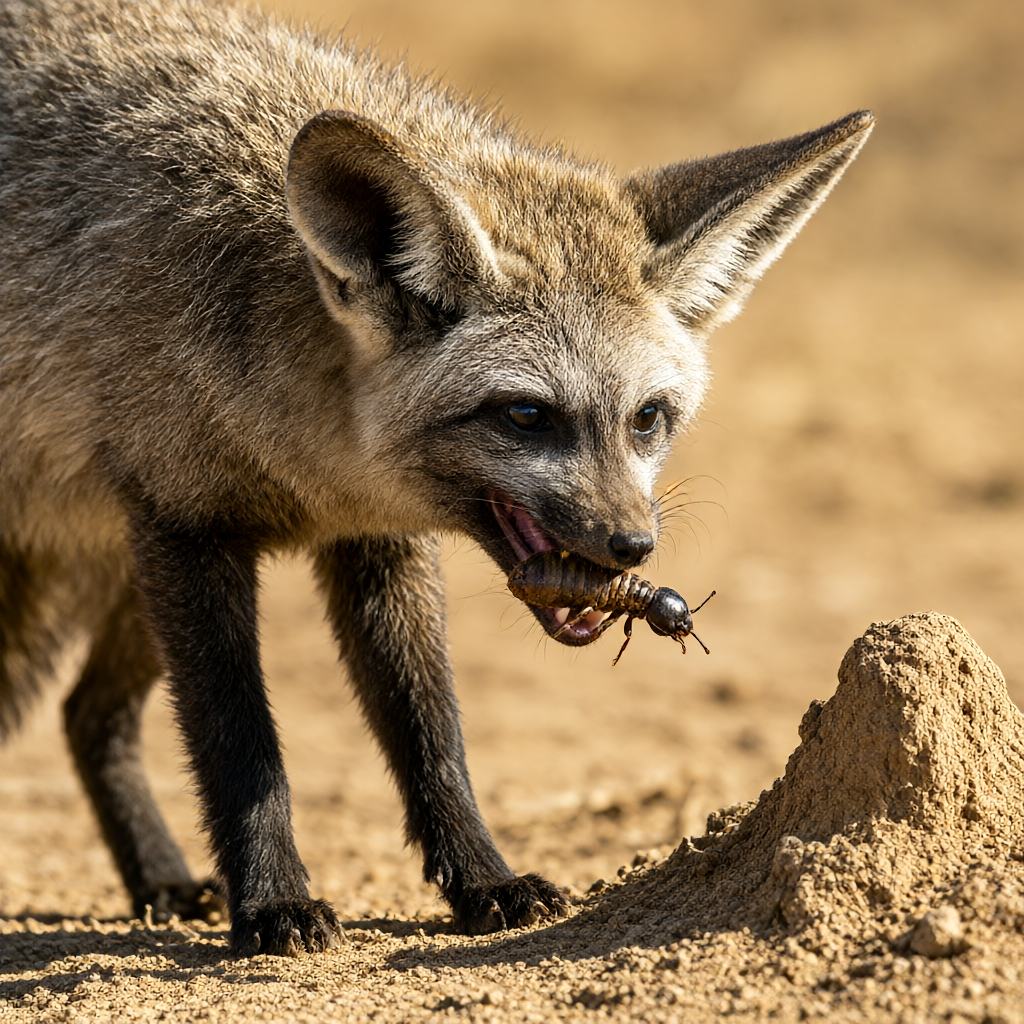
Harvester termites make up most of the food. Beetles, scorpions and small reptiles fill out the rest. Because the animal chews rather than tears, it dispatches prey in quick bites. One fox may eat a thousand termites in a night.
Its diet holds little plant matter. Fruit and berries appear now and then, mostly in the wet months. The animal needs no water, since the insects supply what it requires.
Two to five pups
The breeding cycle
A pair stays together, and both animals raise the litter. Births come after 60 to 75 days. Two to five pups arrive in a burrow that the pair digs or borrows. Because the male guards the den through the night, the female hunts alone for the first few weeks.
Pups start on termites within a month. They reach adult size by the end of their first year. The southern group often raises two litters in one season.
Least Concern
Conservation
Red List status is Least Concern. Its range still covers a large stretch of dry Africa. Because the animal tolerates cattle country, it holds on where other carnivores have already gone. Farmers do not target it, and the fur trade ignores it.
Road traffic kills a number each year. Drought matters more, since a failed termite hatch can starve a whole litter within days. Numbers appear stable, though surveys stay patchy.
Side by side
How It Compares
| Trait | Bat-eared Fox | Red Fox |
|---|---|---|
| Family | Canidae | Canidae |
| Ears | up to 13 cm | short and pointed |
| Diet | termites and beetles | birds, fruit, rodents |
| Teeth | 48 or more | 42 |
| Range | two blocks in Africa | most of the northern hemisphere |
| Rating | Least Concern | Least Concern |
Common misreadings
What People Get Wrong
- Not a big-eared desert fox. Grassland holds the range. The ears serve termite hearing rather than cooling, since the animal hunts insects on open ground where sound carries better than sight.
- Not a member of the fennec line. Its genus stands alone. Otocyon separated from every other canid long ago, and no living fox shares its flattened molars or its extra teeth.
- Not a solitary hunter at night. Pairs work one patch. Both animals raise the litter together, and the male guards the den while the female hunts termites through the dark.
Going further
Sources and Further Reading
Quick hits
Five things to remember
- The ears measure up to 13 cm, which is about a sixth of the animal’s total length.
- A bat-eared fox can hear a termite moving under an inch of soil.
- It has more teeth than any other canid, and the molars carry extra cusps for crushing insects.
- The species sometimes digs its own burrow, though it prefers an unused springhare hole.
- Unlike most foxes, it rarely caches food, since termites spoil within hours.
[…] Giant sequoias grow most vigorously in the fire-adapted ecosystems of the Sierra Nevada, where periodic low-intensity fires clear competing conifers and enrich the soil with nutrients. The trees are remarkably fire-adapted: their thick bark protects the living cambium layer from the intense heat of surface fires, and fire stimulates cone opening and seed release, while fire-created mineral soil beds provide ideal conditions for germination. Paradoxically, fire suppression – a standard forestry practice throughout the 20th century – actually threatened giant sequoia recruitment, demonstrating the importance of natural disturbance processes in maintaining healthy forest ecosystems. […]
[…] killer, and ultimately recognized as a keystone predator whose presence cascades through entire ecosystems to maintain biodiversity and ecological balance. Once ranging across virtually all of the Northern […]
[…] forests across the Northern Hemisphere, providing critical ecological functions that sustain forest ecosystems. The dense canopy of mature Sugar Maple and Red Maple forests creates the cool, shaded understory […]
[…] fast runner on land and a powerful swimmer. As a keystone species, it plays a unique role in its ecosystem by transferring nutrients between water and […]
[…] The zebra is an African equine mammal belonging to the genus Equus, the same group that includes horses and donkeys. Best known for their vivid black-and-white striped coats, zebras roam the grasslands and savannas of eastern and southern Africa. They are highly social animals whose herds contribute to the structure and resilience of their ecosystem. […]
[…] The snowy owl (Bubo scandiacus) is a large, white owl of the Arctic tundra, instantly recognizable by its pale plumage and brilliant yellow eyes. A powerful raptor built for cold, it is one of the few birds that remain on the tundra through the long northern winter and a striking presence in the circumpolar ecosystem. […]
[…] Within this range, the species exploits an extraordinary diversity of habitats, from tropical rainforest and cloud forest to dry deciduous forest, thorn scrub, semi-desert margins, and even agricultural […]
Most chameleon species are found in Africa south of the Sahara and on the island of Madagascar, which is a major center of chameleon diversity with over 70 species found nowhere else. Other species occur in the Middle East, India, Sri Lanka, and a few species have naturalized in Hawaii, California, and Florida. Their distribution is strongly linked to warm tropical and subtropical environments.
the cerrado ecosystem, the maned wolf plays an important role as both a predator and a seed disperser. By consuming large
as warming ocean temperatures and ocean acidification affect the coral reef and coastal marine habitats on which many pufferfish species depend. Conservation efforts focus on improving the
[…] human agriculture, sunflowers support diverse ecological communities and their ecosystem communities. Their pollen and nectar provide food for bees, butterflies, and other insects […]
[…] Penguins are a group of flightless seabirds belonging to the family Spheniscidae, almost exclusively found in the Southern Hemisphere. Ranging from the Galápagos Islands on the equator to the frozen shores of Antarctica, penguins have evolved streamlined bodies, flipper-like wings, and dense waterproof feathers for an aquatic lifestyle. They are a keystone presence in the polar and subpolar marine ecosystem. […]
[…] Parana, Essequibo, and Orinoco basins. Within these river systems, they occupy a wide range of aquatic habitats including main river channels, floodplain lakes, oxbows, marginal lagoons, swamps, and flooded […]
most species are docile, secretive creatures that play important roles as predators in their native ecosystems. Tarantulas are among the longest-lived spiders, with some females living 20-30 years or
[…] humpback whale belongs to the baleen whales, not to this family. Both animals live in the North Pacific, yet one […]