 By st20113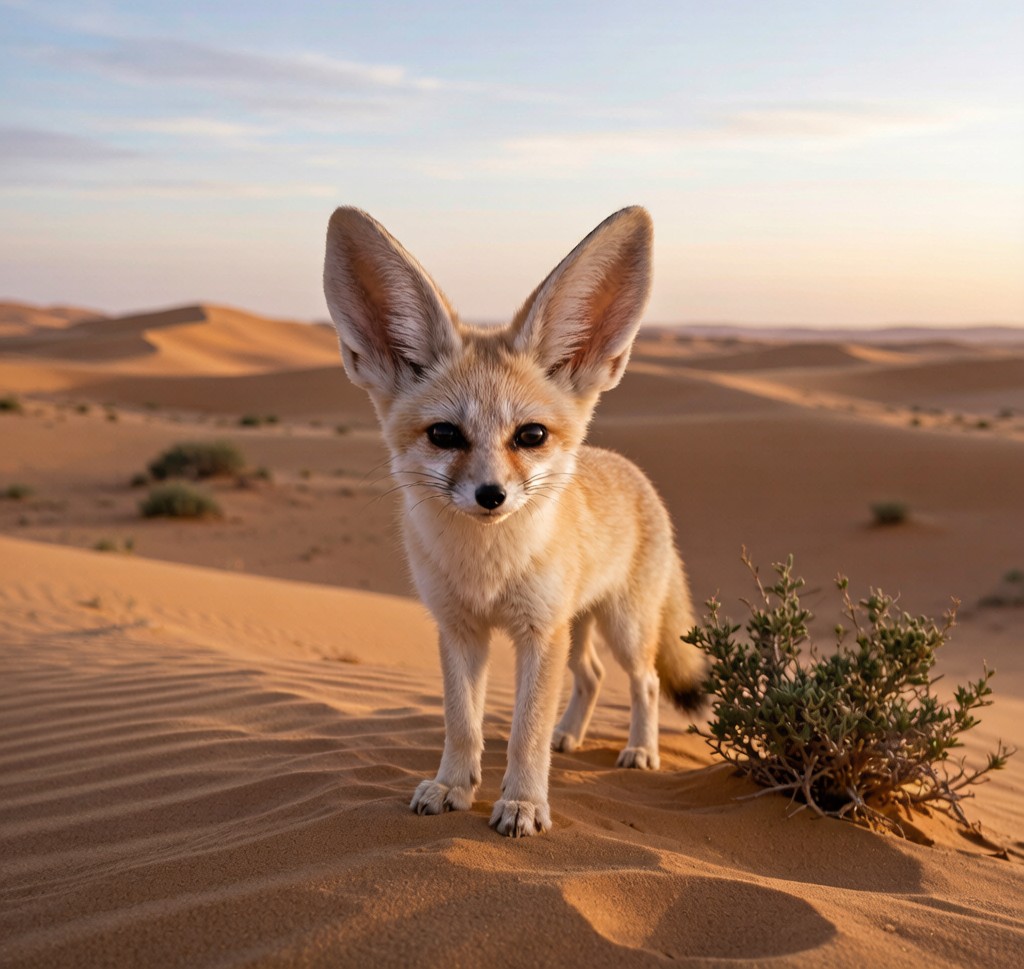
A Fennec Fox (Vulpes zerda) standing on Saharan sand dunes at dawn, with its enormous oversized ears and small body clearly visible
Overview
The Fennec Fox (Vulpes zerda) is the smallest species of fox in the world and one of the most distinctive small mammals on Earth. Found in the sandy deserts and semi-arid regions of North Africa, from Morocco and Western Sahara in the west to Egypt and the Sinai Peninsula in the east, and south to Niger and Sudan, the Fennec Fox is uniquely adapted to life in one of the most extreme environments on Earth. Its most immediately striking feature is its enormous ears – disproportionately large relative to its body, reaching up to 15 centimeters in length – which serve multiple critical functions in the desert environment: they radiate heat to help the fox regulate its body temperature in the scorching Saharan heat; they funnel sound to allow the fox to detect the faintest sounds of prey moving underground; and they are richly supplied with blood vessels that help the fox dissipate excess body heat.
Weighing only 0.8 to 1.5 kilograms and standing approximately 18 to 22 centimeters at the shoulder, the Fennec Fox is diminutive even by fox standards – approximately the size of a small kitten – making it one of the smallest canids in the world. Its coat is a creamy pale sandy color that provides excellent camouflage in the Saharan landscape, and its feet are covered in dense, fur-covered pads that protect against the hot sand and provide traction on loose dune surfaces. The Fennec Fox’s scientific name – Vulpes zerda – derives from the Arabic word for fox, and the species is the national animal of Algeria, appearing on the country’s coins.
Habitat and Desert Adaptation
The Fennec Fox occurs throughout the Sahara Desert and the adjacent semi-arid regions of North Africa, from the Atlantic coast of Morocco and Western Sahara eastward across Algeria, Tunisia, Libya, Egypt, and the Sinai Peninsula, and southward into Niger, Chad, Sudan, and the Arabian Peninsula. Within this vast range, the species is most commonly associated with stable sand dunes, sandy plains, and rocky desert valleys with sparse vegetation – habitats that provide the loose, deep sand required for burrow construction and the insect prey that constitutes the majority of its diet.
The Fennec Fox’s adaptations to the desert environment are remarkable. During the scorching daytime, when surface sand temperatures can exceed 60 degrees Celsius, Fennec Foxes retreat to their burrows – which can be up to 10 meters deep and include multiple chambers – where the temperature remains relatively constant. The burrow provides not only thermal refuge but also protection from predators and a safe environment for raising young. The Fennec Fox’s large ears – which can comprise up to one-quarter of the animal’s body surface area – are richly vascularized and function as radiators, actively dissipating excess body heat through the dilation of blood vessels near the ear surface. At night, when desert temperatures drop sharply, the fox emerges to forage in the relative cool, using its excellent hearing to locate prey moving on or beneath the sand.
Diet and Behavior
The Fennec Fox is an omnivore whose diet is dominated by insects and other small invertebrates, with supplementary plant material. Its primary prey includes desert locusts, beetles, termites, ants, and scorpions, which it locates using its exceptional hearing – the fox can detect the sound of an insect moving beneath several centimeters of sand. The Fennec Fox also eats small vertebrates including lizards, geckos, and small rodents, as well as a variety of desert plant materials including roots, fruits, and leaves, which provide moisture in the water-scarce desert environment. Remarkably, Fennec Foxes appear to be able to survive indefinitely without free water, obtaining all the moisture they need from their food and from the dew that condenses on plants during the cool nights.
Fennec Foxes are highly social animals that live in family groups consisting of a mated pair and their dependent offspring. Unlike many other fox species that are largely solitary, Fennec Foxes maintain stable pair bonds and both parents participate in raising the young. The family group lives in a complex burrow system with multiple chambers, and family members communicate using a variety of vocalizations including barks, growls, and high-pitched calls. Fennec Foxes are also highly playful – a behavioral trait that is thought to help develop hunting skills and strengthen social bonds – and are frequently observed playing with each other, with objects, and even with other species.
Conservation
The Fennec Fox is listed as Least Concern on the IUCN Red List, reflecting its relatively stable population and broad distribution across the Sahara and adjacent regions. However, the species faces several localized threats, including habitat degradation from desertification and climate change, hunting for the illegal pet trade (Fennec Foxes are prized as exotic pets due to their diminutive size and attractive appearance), and incidental trapping. The international pet trade is of particular concern: Fennec Foxes are exported from North Africa to markets in the Middle East, Europe, and the United States, where they are sold as exotic pets. While not yet a major driver of population decline, the pet trade removes individuals from wild populations and the conditions of captivity are often inappropriate for this specialized desert species.
Conservation efforts for the Fennec Fox focus on protecting its desert habitat from degradation, regulating the international trade in live specimens through CITES, and improving understanding of the species’ population status and ecological requirements through field surveys and camera trap studies. The Fennec Fox’s range includes several protected areas across North Africa, though enforcement of wildlife protection laws in these areas is often limited. The species is also protected under national wildlife laws in several range countries, and increasing awareness of the Fennec Fox’s ecological role as a predator of insects and scorpions – including agricultural pest species – is helping to build support for its conservation.