 By st20113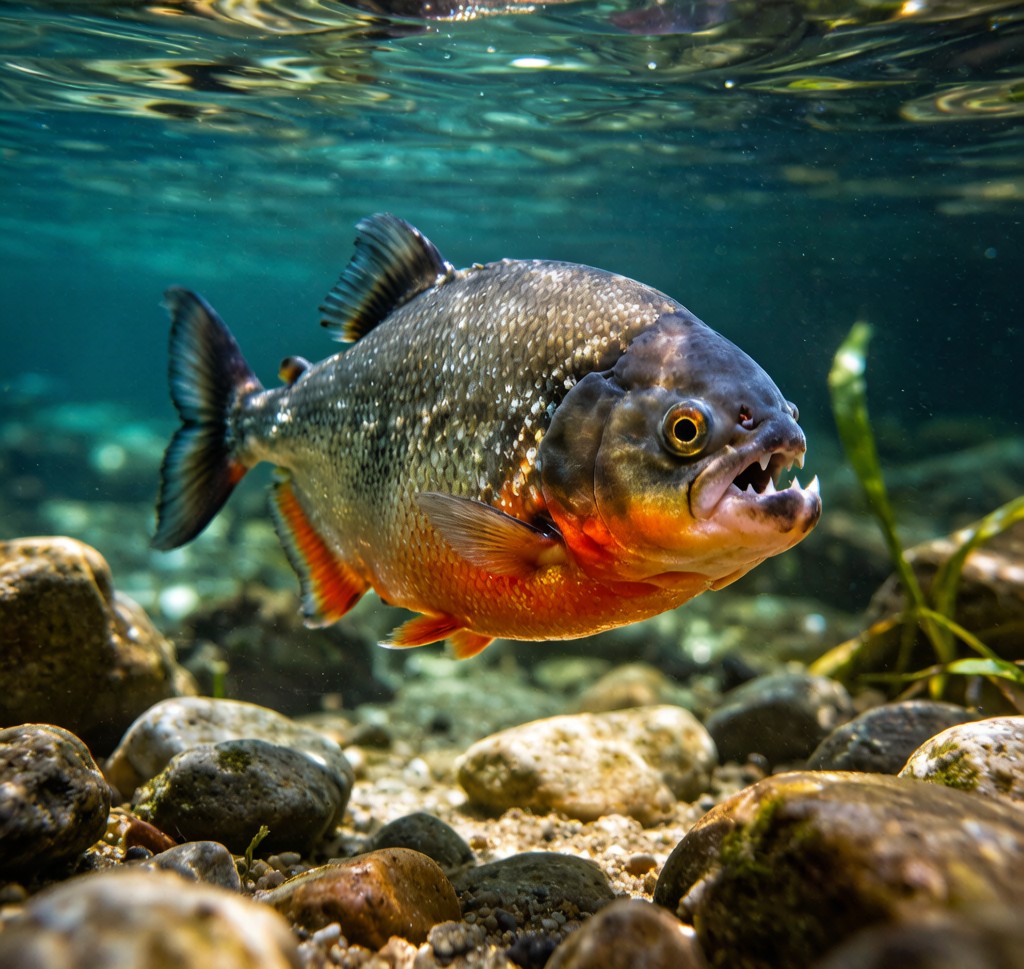
A Red-bellied Piranha (Pygocentrus nattereri) in clear Amazon river water, displaying its distinctive red underparts and sharp teeth
Overview
The Red-bellied Piranha (Pygocentrus nattereri) is the most widely distributed and arguably the most infamous piranha species in South America. Found throughout the Amazon and Orinoco basins and numerous other river systems across Brazil, Paraguay, Argentina, Bolivia, Peru, Ecuador, Colombia, Venezuela, Guyana, and Suriname, this small but formidable fish has captured human imagination for centuries with its reputation for razor-sharp teeth and coordinated group attacks. Yet the reality of the red-bellied piranha is far more nuanced – it is a shy, primarily nocturnal scavenger and hunter that plays a vital ecological role as a keystone predator in South American freshwater systems.
The red-bellied piranha has a deep, laterally compressed body with a blunt, bulldog-like head and a pronounced underbite that exposes sharp, triangular teeth in a interlocking pattern designed for shearing flesh. Adults are silvery-gray to olive-green on the back and sides, with distinctive reddish-orange to deep orange coloration on the belly, chest, and lower jaw – the feature that gives the species its common name. Adults typically measure 20 to 35 centimeters in length and weigh 1 to 3 kilograms.
Habitat and Distribution
The red-bellied piranha inhabits a vast range of freshwater environments across tropical South America, from the Amazon River and its numerous tributaries to the Paraguay, Parana, Essequibo, and Orinoco basins. Within these river systems, they occupy a wide range of aquatic habitats including main river channels, floodplain lakes, oxbows, marginal lagoons, swamps, and flooded forest (várzea). They are most abundant in lowland river floodplains where water levels fluctuate seasonally and prey is abundant.
The species is highly tolerant of variable water conditions and can survive in oxygen-poor waters, turbid conditions, and temperatures ranging from 18 to 30 degrees Celsius. During the dry season, as water levels fall and floodplain lakes shrink, piranhas become concentrated in increasingly small bodies of water, which is one reason why they appear most threatening during this period. During the wet season, they disperse widely through the flooded forest as waters rise, feeding on the abundance of prey items stranded in the new aquatic environments.
Diet and Feeding Behavior
Despite their fearsome reputation, red-bellied piranhas are primarily scavengers and opportunistic predators rather than aggressive hunters of large prey. Their diet consists primarily of fish, including smaller piranhas and fish of other species, insects, worms, crustaceans, and carrion. They are particularly attracted to injured, distressed, or dying prey – attracted not by the sight of blood per se but by the distress vibrations and chemical signals emitted by wounded animals.
Their teeth are their most remarkable adaptation. The upper jaw contains a single row of sharp, blade-like teeth, while the lower jaw holds a matching row that interlocks precisely when the mouth closes. This scissor-like arrangement allows piranhas to take neat circular bites from larger prey items – a behavior called “nipping” – and to shear through flesh, scales, and fins with devastating efficiency. They can also crush the shells of armored prey such as crabs and river mollusks. Research has shown that feeding events in piranhas are rarely the frenzied attacks depicted in popular media – instead, individuals typically feed cooperatively and somewhat cautiously, with larger, dominant fish displacing smaller ones from the most desirable feeding positions.
Social Behavior and Reproduction
Red-bellied piranhas exhibit complex social behavior, living in groups called shoals that can range from just a few individuals to over 100. This schooling behavior provides multiple advantages: it increases the likelihood of detecting predators, enhances foraging efficiency through collaborative hunting, and allows individuals to mob and overcome prey too large for any single fish to tackle. During the breeding season, which coincides with the onset of the rainy season, groups become more cohesive and display more synchronized behavior.
Nesting sites are excavated by both parents in sandy or gravel substrates, typically in shallow water less than one meter deep. The female lays 1,000 to 5,000 eggs, which are fertilized and immediately guarded by both parents. The parents guard the nest aggressively, attacking any potential predators – including much larger fish – with coordinated lunges and bites. Hatching occurs within 48 to 72 hours, and the fry remain in the nest for approximately 7 to 10 days, fed by a mucus secretion from the parents’ skin before dispersing into open water. Parental care significantly improves fry survival rates, which is critical given the enormous number of eggs laid.