 By st20113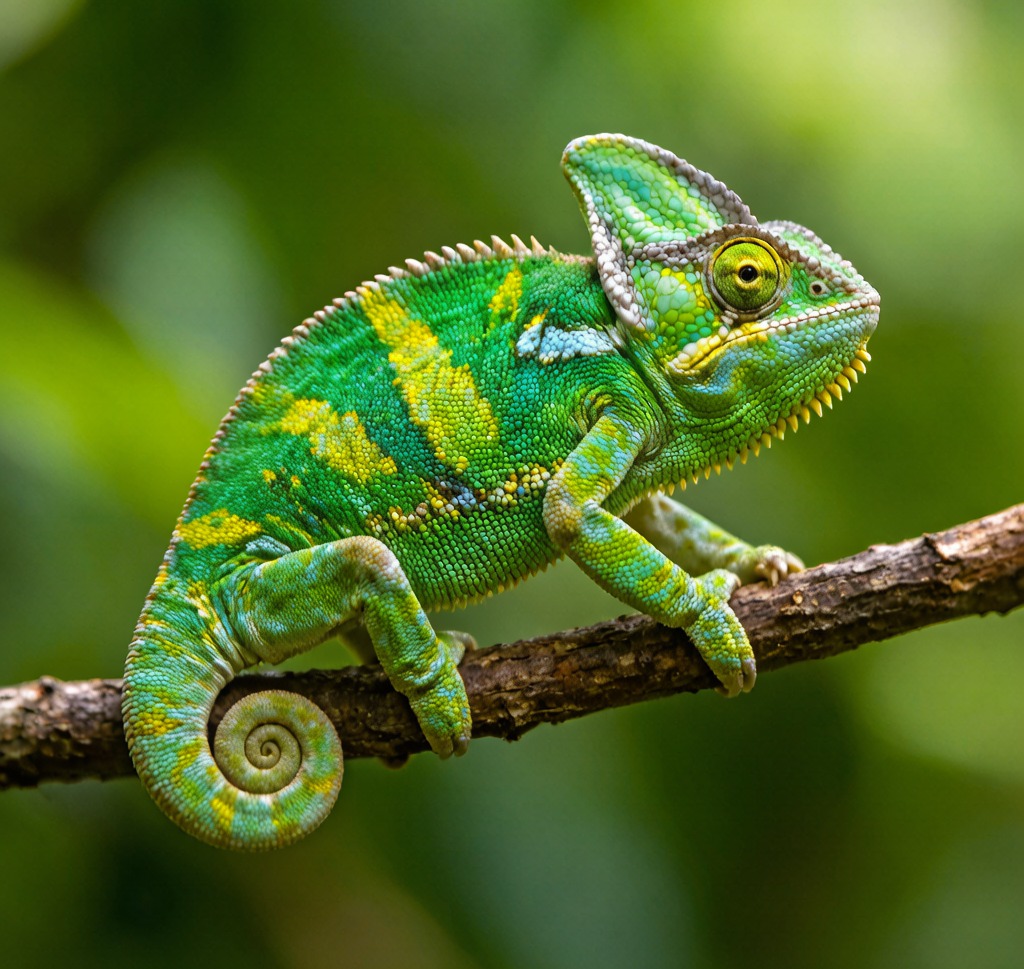
A Veiled Chameleon (Chamaeleo calyptratus) perched on a branch in a Yemeni desert garden
Overview
Chameleons are a distinctive family (Chamaeleonidae) of approximately 220 species of lizards adapted for an arboreal lifestyle. Best known for their ability to change color and their unusual turret eyes, chameleons are among the most specialized and remarkable reptiles on Earth. They range in size from tiny pygmy chameleons measuring just 15 millimeters in length to the Parson’s Chameleon, which can reach up to 70 centimeters.
Chameleons possess several extraordinary anatomical features that set them apart from other lizards. Their eyes are uniquely structured – each large eye is conical and turreted, capable of rotating nearly 180 degrees, and the two eyes can move independently of each other. This gives chameleons a near 360-degree field of view without moving their head, allowing them to watch for predators and prey simultaneously. Their tongues are extraordinarily long – often extending to 1.5 to 2 times their body length – and are tipped with a sticky, muscular pad used to capture prey with lightning speed.
Color Changing
The ability to change color is the chameleon’s most famous feature, and while all chameleons can change color to some degree, the popular belief that they match any background color is a myth. Color change in chameleons is primarily driven by: emotional state (aggression, fear, stress), environmental temperature and light conditions, communication with other chameleons (males display vivid colors to warn rivals, females display receptiveness to mating), and camouflage against predators.
The primary mechanism of color change is not pigmentation but rather the expansion and contraction of specialized cells called chromatophores in the skin. These cells contain different pigment granules in layers – melanophores (black/brown), xanthophores (yellow/red), and iridophores (blue/white/reflective). By dispersing or concentrating these pigment packages and reflecting light through structural arrangements, chameleons can produce a remarkable range of colors from green and yellow to orange, red, blue, and even black. Some species can change color in as little as 20 seconds.
Habitat and Distribution
Most chameleon species are found in Africa south of the Sahara and on the island of Madagascar, which is a major center of chameleon diversity with over 70 species found nowhere else. Other species occur in the Middle East, India, Sri Lanka, and a few species have naturalized in Hawaii, California, and Florida. Their distribution is strongly linked to warm tropical and subtropical environments.
The vast majority of chameleons are arboreal, spending most of their lives in trees and shrubs. They have evolved highly specialized feet with fused toes arranged in opposable groups (zygodactylous) that grip branches like a pair of tongs. Their tails are prehensile and can curl tightly around branches to provide additional grip and stability. Some larger species descend to the ground occasionally, but most feeding, sleeping, and social interactions take place in the canopy.
Diet and Hunting
Chameleons are insectivores, feeding on a wide variety of arthropods including crickets, grasshoppers, flies, moths, caterpillars, and beetles. Larger species such as the Veiled Chameleon and Parson’s Chameleon will also consume small vertebrates, including other lizards, birds, and rodents. Chameleons are ambush predators, remaining motionless for long periods before launching their projectile tongue at unsuspecting prey.
The hunting mechanism is remarkable: the tongue is accelerated by a specialized accelerator muscle that can project it from 0 to 20 kilometers per hour in a fraction of a second. The tip is a sticky, muscular pad covered in mucous that adheres to prey on contact. Larger chameleons require multiple tongue retractions to subdue large prey before swallowing. Chameleons do not drink water from a bowl; instead, they lap droplets from leaves after rain or dew.
Reproduction
Chameleons display a remarkable diversity of reproductive strategies. Most species are oviparous (egg-laying), with females laying 20 to 200 eggs depending on the species, buried in soil or rotting vegetation. The eggs of many tropical chameleons have extremely long incubation periods – some species incubate for over a year before hatching. Other species, particularly those in higher elevation or cooler environments, are ovoviviparous, giving birth to fully formed young that develop within eggs inside the mother’s body.
Pregnancy is visually dramatic in many chameleon species – females display striking color patterns when receptive to mating, and they undergo a rapid color change to darker, more contrasting patterns when they are pregnant and should not be approached by males. Newborn chameleons are independent from birth and receive no parental care. They begin hunting small insects within days of hatching and grow rapidly, reaching adult size within a few months in some species.