 By st20113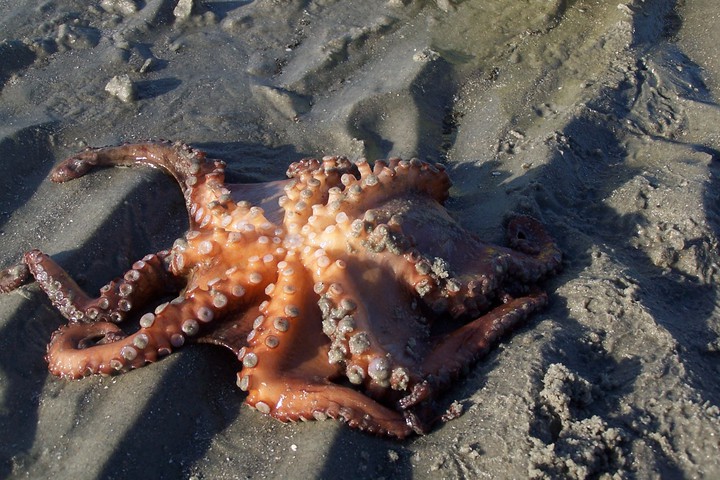
Introduction
The common octopus (Octopus vulgaris) is among the most well-known and studied cephalopod species in the world. Found in tropical, subtropical, and temperate waters worldwide, this highly intelligent creature has fascinated scientists, fishermen, and storytellers for centuries with its problem-solving ability, color-changing mastery, and complex behaviors. The common octopus is a master of camouflage, capable of mimicking the color, pattern, and even texture of its surroundings with remarkable speed. It inhabits coastal waters from the intertidal zone down to approximately 200 meters depth, favoring rocky reefs, seagrass beds, and sandy areas where it can shelter in crevices.
Taxonomy
The common octopus belongs to the family Octopodidae, order Octopoda, class Cephalopoda. Its scientific name Octopus vulgaris was assigned by Jean-Baptiste Lamarck in 1798 and translates as common eight-foot. The genus Octopus contains around 100 recognized species. The common octopus is distinguishable from related species by its round, sac-like mantle and eight distinct arms. Recent genetic research suggests that what was previously considered a single global species may actually comprise multiple distinct lineages with limited geographic ranges.
Physical Characteristics
The common octopus has a soft, bulbous mantle reaching about 25 centimeters (10 inches) in length, with eight long, flexible arms each bearing two rows of suction cups. Each arm is independently controlled by a distributed nervous system, allowing coordinated tasks even when detached from the brain. The total arm span can exceed 1 meter (3.3 feet), and each arm bears hundreds of suction cups that function not only for adhesion but also as chemosensory organs, enabling the octopus to taste and smell its environment. The skin contains specialized chromatophore cells that rapidly expand and contract to produce an extraordinary range of colors and patterns. Like the cuttlefish, the common octopus can change both color and skin texture simultaneously, enabling near-invisible camouflage against virtually any background.
Habitat
The common octopus is found throughout the world’s tropical, subtropical, and temperate oceans. It prefers shallow coastal waters and is most common on rocky reefs, in seagrass meadows, around coral formations, and over sandy or muddy bottoms where shelter is available. Individuals typically claim a den in a rock crevice or discarded object, which they defend aggressively. The species is generally solitary, coming together only to mate. Its wide distribution is partly attributed to a long planktonic larval stage during which juveniles drift with ocean currents before settling to the seafloor.
Diet
The common octopus is a carnivorous predator that feeds primarily on crustaceans such as crabs and lobsters, as well as mollusks including clams and snails, and occasionally small fish. Its hunting strategy combines stealth, speed, and remarkable problem-solving ability. The octopus stalks prey from behind, then lunges with its arms to capture the victim. For hard-shelled prey, it uses its sharp beak to drill a small hole and injects a paralytic toxin. Like the orca, the common octopus employs sophisticated techniques that vary with prey type and environmental conditions. Laboratory studies have shown that octopuses can solve puzzles and navigate mazes, indicating cognitive abilities that rival those of some vertebrates.
Reproduction
Reproduction in the common octopus involves a dramatic and typically fatal encounter. The male uses a specialized arm called a hectocotylus to transfer spermatophores into the female’s mantle cavity. After mating, the male typically dies within weeks, while the female retreats to her den to lay between 100,000 and 500,000 eggs over a period of up to 8 months. She tends the eggs continuously, blowing currents of water over them to keep them clean and oxygenated, and does not leave to feed. After the eggs hatch, the planktonic larvae drift in the water column for several weeks before settling to the seafloor. This semelparous strategy represents a dramatic investment in a single reproductive event and is characteristic of most octopus species.
Conservation
The common octopus supports significant fisheries in the Mediterranean, West Africa, East Asia, and South America. Global annual catches have increased substantially as fishing pressure and market demand have grown. The species is listed as Least Concern by the IUCN, but concerns exist about intensive fishing in certain regions leading to local population declines. Like many cephalopods, the common octopus has a short lifespan of typically 1 to 2 years, making its populations naturally variable and potentially vulnerable to overfishing. Sustainable management including size limits, seasonal closures, and catch quotas is essential to prevent the collapse of octopus stocks.
Fun Facts
The common octopus has three hearts: two pump blood to the gills, and the third pumps it to the rest of the body. Its blood is blue because it is copper-based (hemocyanin) rather than iron-based (hemoglobin).
[…] the top shells. It is a relative of garden snails and of more celebrated molluscs such as Octopus vulgaris, the common octopus, sharing the molluscan body plan of a muscular foot, a coiled shell, and a […]
[…] the typical land snails. It is a relative of garden snails and of more celebrated molluscs such as Octopus vulgaris, the common octopus, sharing the molluscan plan of a muscular foot, a coiled shell, and a rasping […]
[…] the common octopus, described in our article on Octopus vulgaris (Common Octopus), the great pond snail is a mollusc, but the contrast could hardly be greater: the octopus is a […]
[…] the common octopus, described in our article on Octopus vulgaris (Common Octopus), the periwinkle is a mollusc, but where the octopus is a soft-bodied cephalopod master of […]
[…] a muscular foot and a radula for rasping food, placing it in the great molluscan lineage alongside Octopus vulgaris, the common octopus, to which it is a distant […]
[…] cycle involving mammals and birds. Like all molluscs it is a cousin of the marine octopus, and the common octopus shares with this humble snail the same basic body plan of a soft body, a muscular foot and a mantle […]