 By st20113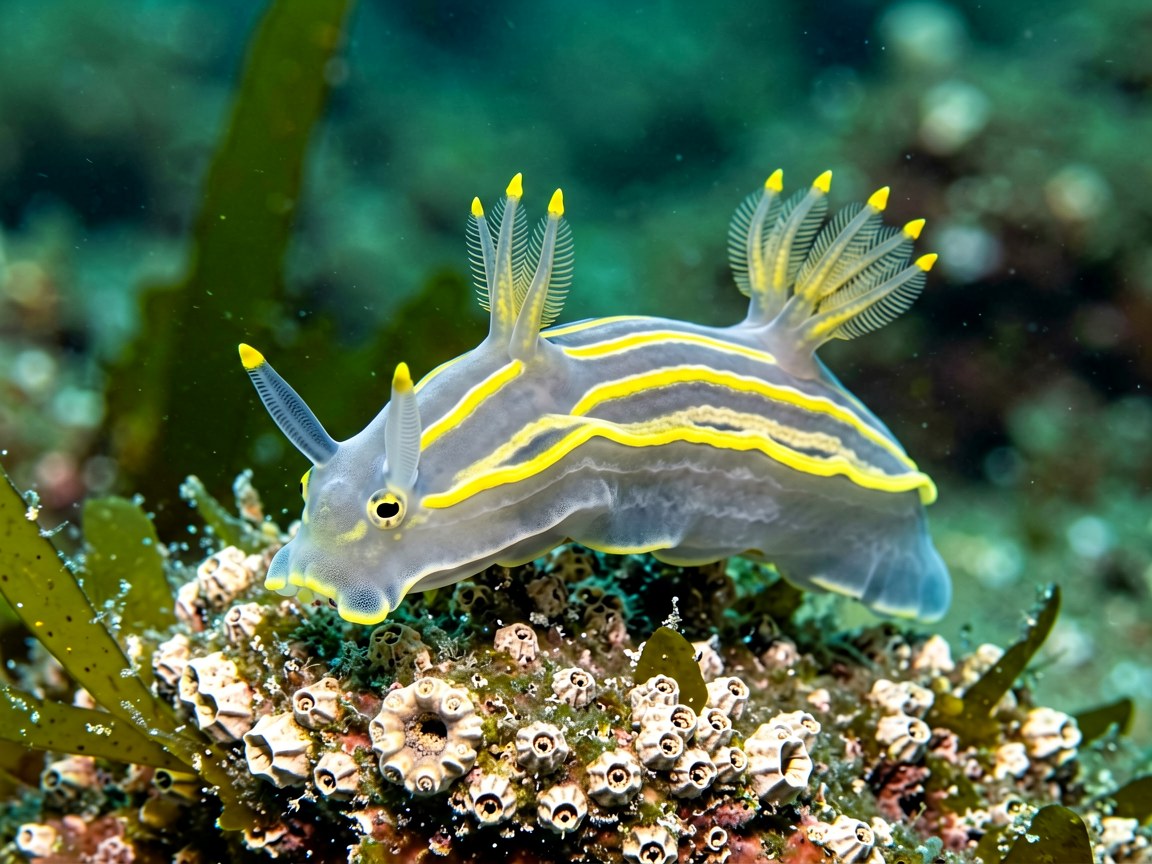
Polycera quadrilineata | Four-lined Polycera
Introduction
The four-lined polycera (Polycera quadrilineata) is a small, slim, elegant sea slug found on rocky shores and in shallow water, where it lives on and feeds upon the colonial animals that encrust rocks and seaweed. It is one of the more distinctive of the northern nudibranchs: a slender, tapering, semi-transparent body, usually white or pale grey, marked with longitudinal lines of bright yellow or orange, and carrying a crown of finger-like processes at the head and a cluster of feathery gills at the rear. The “four lines” of its name refer to the yellow stripes that run along the body, though the pattern is variable and the animal is often more richly marked than the name suggests. Small, active, and often surprisingly abundant where its food is plentiful, it is a favourite of anyone who searches rock pools and dives on weedy reefs.
Taxonomy
Polycera quadrilineata is a gastropod mollusc and a member of the order Nudibranchia, the sea slugs, within the superfamily Polyceroidea and the family Polyceridae. The nudibranchs are sea slugs that have lost the shell entirely as adults, and they are among the most colourful and heavily studied of all molluscs, both for their chemistry and for their remarkable defences. The genus name Polycera means “many horns”, referring to the several finger-like processes on the head, and the specific epithet quadrilineata means “four-lined”. Its relatives include the larger and much more heavily striped Polycera faeroensis and the various members of the genus Limacia. It is a mollusc in the same broad group as Octopus vulgaris, though the two could hardly look more different: the octopus is a large-brained, shell-less cephalopod, while this is a small, slow, shell-less snail that has gone its own way entirely.
Physical Characteristics
The body is slender, elongated, and tapering towards the rear, typically up to about three centimetres long, and it is soft and semi-translucent. The ground colour is usually translucent white or pale grey, sometimes with a faint bluish or pinkish tinge, and the patterning is its best feature: there are normally four, or sometimes more, longitudinal lines of bright yellow or orange running the length of the body and onto the tail, and these are often accompanied by additional yellow spots, streaks, or a yellow line along the edge of the foot. The head carries a pair of stout, tapering, finger-like oral tentacles and, above them, a pair of rhinophores — the club-shaped, ridged, lamellate chemosensory organs characteristic of nudibranchs — which are usually pale with a yellow or orange tip. At the front of the head, around the mouth, there is a series of four to six short, pointed, finger-like processes, the “horns” of the generic name. Towards the rear of the back stands a crown of five to seven simply pinnate, feathery gills, and behind them the tail is long and pointed. The whole animal is smooth, without the warts or tubercles seen in many other sea slugs.
Habitat
It lives on rocky shores and in shallow sublittoral water, down to depths of thirty metres or more, and it is found on rocks, on seaweed, on the stipes and fronds of kelp, on the underside of stones, and on any hard surface where its food organisms grow. It is particularly associated with the encrusting and erect bryozoans — the “sea mats” and “sea firs” that coat rock and weed — and it is often found directly on the colonies it is eating. It occurs in the north-eastern Atlantic from Scandinavia and the British Isles south to the Mediterranean and north-west Africa, and it is common all around the coasts of Britain and Ireland. It is present throughout the year but is most often noticed in spring and summer, when the bryozoan colonies are at their most luxuriant and the slugs themselves are large and conspicuous.
Diet
The four-lined polycera is a specialist predator of bryozoans, the colonial animals that form thin encrusting sheets or delicate branching tufts on rock, shell, and seaweed. It feeds by rasping at the colony with its radula, a ribbon of small, sharp teeth, breaking open the individual box-like chambers, or zooids, that make up the colony and drawing out the tiny feeding organisms inside. Different individuals and populations show preferences for different bryozoan species, and the slug is frequently found sitting on a single species of sea mat or sea fir, matching it closely and feeding on little else. Like most nudibranchs, it is thought to derive its chemical defences from its food, retaining the compounds or the stinging cells of its prey and using them to make itself distasteful to fish and other predators; the bright yellow and orange markings are generally interpreted as a warning to anything thinking of eating it.
Reproduction
Nudibranchs are hermaphrodites, and this species is no exception: each animal has both male and female organs, and two individuals mate reciprocally, exchanging sperm, which is stored internally until the eggs are ready to be laid. Spawning takes place in spring and summer, and the eggs are laid in a characteristic ribbon — a narrow, transparent, gelatinous band, usually laid in a neat spiral or a series of gentle curves, attached by one edge to the seaweed, stone, or bryozoan colony on which the adult is feeding. Each ribbon contains many thousands of very small eggs, and the larval stage that follows is a veliger which, in this species, spends some time in the plankton before settling. The planktonic phase is what allows the species to find and colonise new patches of suitable habitat, and it is also why the adults turn up in places where no population was present the year before. The adults are short-lived, and most probably live for less than a year.
Conservation
The species is common, widespread, and not considered threatened, and it is one of the more frequently recorded nudibranchs in British and Irish waters. Its fortunes follow those of the bryozoan colonies it depends on, which in turn depend on clean, well-lit, hard surfaces with enough water movement to keep them free of sediment. It is therefore affected by anything that smothers the shore: increased sedimentation from dredging, construction and run-off, nutrient enrichment that encourages fast-growing smothering algae, and oil spills and other forms of contamination. Because it is a specialist feeder, it cannot simply switch to another food source when its preferred colonies disappear, and this makes it a reasonably sensitive indicator of the condition of rocky and weedy seabed. Recreational divers and rock-pool naturalists contribute a great deal of the recording for this and similar species.
Fun Facts
- It feeds almost entirely on bryozoans, the colonial animals that encrust rock and seaweed.
- The bright yellow lines along its body are thought to warn predators that it tastes bad.
- It is a hermaphrodite, and pairs mate and exchange sperm rather than one acting only as male or female.
- The eggs are laid in a narrow, transparent ribbon wound in a neat spiral and stuck to the seaweed.
- The “many horns” of its generic name refer to the finger-like processes around its mouth.