 By st20113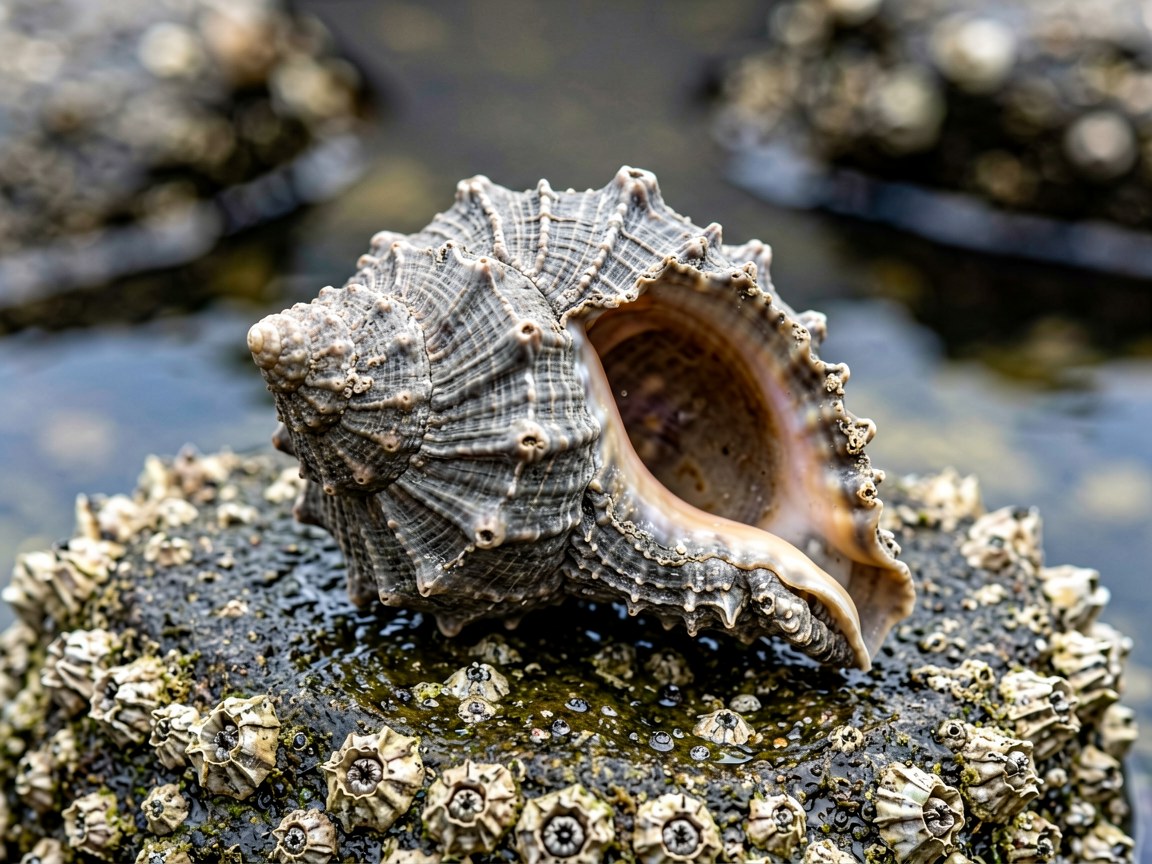
Ocenebra erinacea | Sting Winkle
Introduction
The sting winkle (Ocenebra erinacea) is a small, rough, predatory sea snail of rocky and stony shores, and it is the species that gave the “sting” to its name: the fleshy, tubular extension of the mantle at the front of the shell, through which the animal draws water into its mantle cavity, was long believed by fishermen and shellfish pickers to be a sting capable of inflicting a wound. It is not, of course, and the animal is entirely harmless to people. What it does have is a very effective radula, with which it drills neat round holes through the shells of barnacles and small bivalves in exactly the manner of the moon snails. Small, solid, and heavily sculptured, it is one of the commonest predatory snails of the lower shore and is frequently found in rock pools and among mussel beds, alongside the very animals it feeds on.
Taxonomy
Ocenebra erinacea is a gastropod mollusc in the family Muricidae, the rock shells or murexes, a large and widespread family of almost entirely predatory marine snails. The family includes the dye-producing murexes of the Mediterranean, from which the Tyrian purple of antiquity was obtained, as well as the dog whelk Nucella lapillus and the American oyster drill. It was formerly placed in the genus Ocinebrina or Murex, and older literature and shell collections may use any of these names. The genus name refers to the hook-like or barbed processes of the shell, and the specific epithet erinacea means “like a hedgehog”, a reference to the spiny, prickly sculpture. It is a snail rather than a sea slug, but it is a mollusc in the same broad group as Octopus vulgaris, and it shares with that animal a carnivorous habit and the use of a toothed radula, though the snail’s method is to bore rather than to pull apart.
Physical Characteristics
The shell is small, solid and heavy for its size, typically two and a half to five centimetres tall, with a moderately tall, pointed spire of about seven or eight whorls and a large, rounded body whorl. The sculpture is its most obvious character: each whorl carries a number of strong, raised, rounded spiral ridges crossed by equally strong, curved axial ribs, and where these cross they produce a regular pattern of small, sometimes slightly spiny knobs, giving the shell a distinctly rough, prickly, file-like texture. The colour is variable but usually dull: whitish, cream, grey, fawn, or pale brown, sometimes with darker brown spiral bands, and the aperture is oval with a short, open siphonal canal at the base and a thin, sharp outer lip that is finely toothed or ridged inside in mature animals. The operculum is horny, oval, and brown. The animal’s head carries a pair of slender tentacles with the eyes partway along their length, and the front of the mantle is drawn out into the prominent, fleshy, tubular siphon that gives the species its common name.
Habitat
It lives on rocky shores and on stony, shelly, and gravelly ground, from the middle of the shore down into the shallow sublittoral, and it is most often found in rock pools, in crevices, under stones, and among mussel beds, barnacle-covered rock, and the holdfasts of seaweed — precisely where its prey is most abundant. It tolerates a good deal of exposure to air and is one of the commoner animals of the mid and lower shore, and it does well in the sheltered conditions of a deep, weedy pool. It is distributed along the eastern Atlantic from Britain and Ireland south to the Mediterranean and north-west Africa, and it is common around the coasts of Britain and Ireland except in the coldest northern and eastern districts. It is frequently found with the empty shells of its prey gathered around it.
Diet
The sting winkle is a carnivore, feeding chiefly on barnacles and on small bivalves such as mussels, oysters, and the small clams of rocky and shelly ground. It attacks by boring: the animal grips the prey with its foot and uses its radula, assisted by a chemical secretion from an accessory boring organ, to cut a neat, circular hole with slightly countersunk edges through the calcareous shell, a process that may take several hours. Once the hole is complete it inserts the proboscis and rasps out the soft body within. Barnacles are dealt with by rasping at the opercular opening or by boring through the shell plates. The drilling technique is energetically expensive, so the snails choose their prey carefully and prefer smaller, thinner-shelled individuals, and they will also scavenge on damaged animals and on carrion when the opportunity offers. The snails are themselves eaten by crabs, by fish, and by larger molluscs.
Reproduction
The sexes are separate and fertilisation is internal. Mating takes place on the shore, and the female afterwards lays her eggs in small, stalked, vase-shaped or flask-shaped capsules, each a few millimetres high, attached in clusters to rock, shell, stones, or seaweed in crevices and under overhangs where they will not dry out. Each capsule contains a modest number of eggs, and as in several other muricids a proportion of them serve as nurse eggs, which are consumed by the developing young inside the capsule rather than hatching themselves. Development is direct: the young emerge from the capsules as small but fully formed crawling snails, with no free-swimming larval stage. This has important consequences, because it means that populations are relatively isolated from one another and that dispersal along the coast is slow, which makes local populations vulnerable to local extinction and slow to recolonise.
Conservation
The species is common and widespread and is not considered threatened, and it is a familiar and abundant member of rocky-shore communities throughout most of its range. Its main vulnerabilities are the standard ones for a shore animal: oil spills and the dispersants used on them, which are devastating to muricids in particular; chronic contamination of the shore by hydrocarbons and by tributyltin antifouling paints; and physical damage to rocky habitat from coastal defence works and heavy trampling. Because it has no planktonic larva, recovery after a local wipe-out depends on adults crawling in from neighbouring populations and is therefore slow, and this has been documented after major spills. Its abundance and its sensitivity to pollution make it a useful species in rocky-shore monitoring, and it is regularly recorded in shore surveys.
Fun Facts
- The “sting” that gives it its name is simply the fleshy tube through which it draws water, and it cannot sting at all.
- It drills neat circular holes through the shells of barnacles and small bivalves and eats the animal inside.
- The shell is heavily sculptured with crossing ridges and ribs, which gives it a prickly, file-like feel.
- Its young hatch as tiny crawling snails, with no swimming stage, so populations recover slowly after damage.
- It belongs to the same family as the murexes from which the famous Tyrian purple dye was made.