 By st20113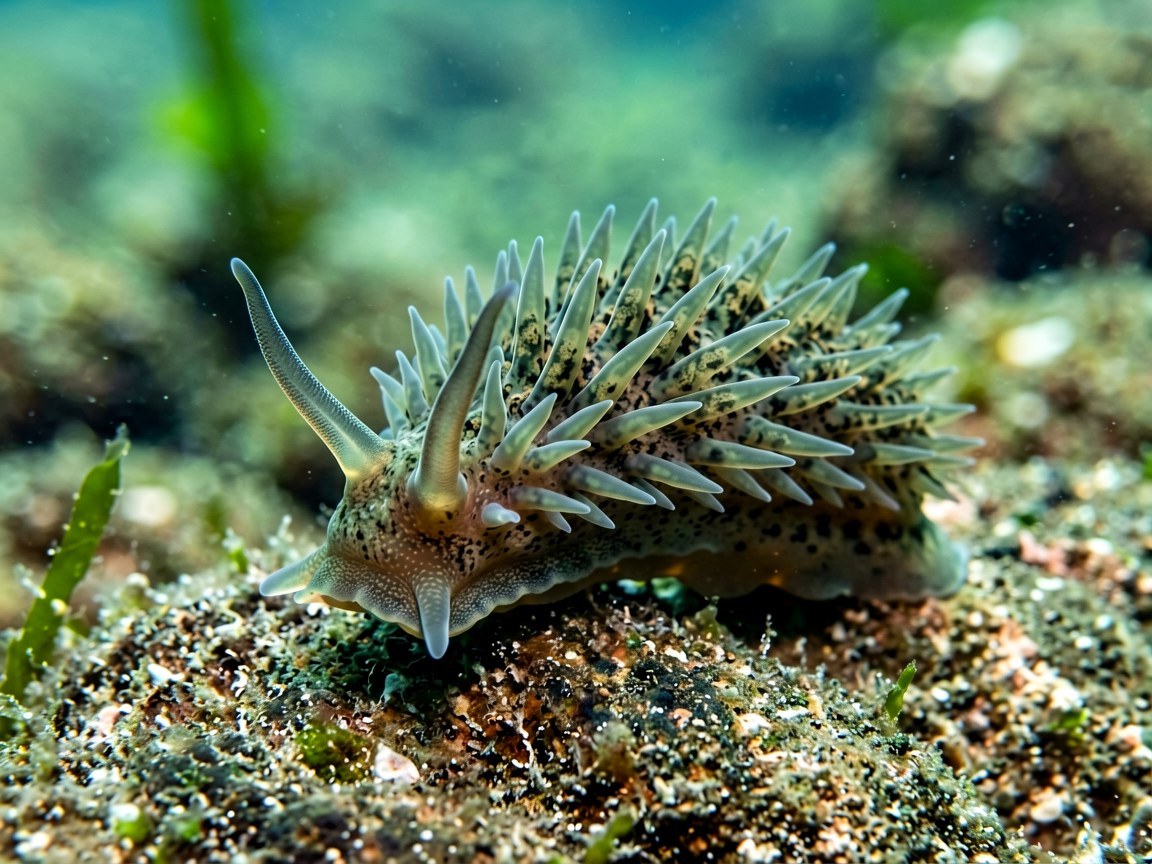
Acanthodoris pilosa | Plicate Aeolis
Introduction
Acanthodoris pilosa, the plicate aeolis, is a small, shaggy, endearing sea slug of the north Atlantic and adjoining waters, a nudibranch whose soft body is covered in a dense fur of finger-like papillae that give it a distinctly fuzzy, almost chenille appearance. It is a creature of the shallow subtidal and low shore, crawling over rock, kelp and the tufts of a particular bryozoan on which it feeds, and it is one of the commoner and more easily recognised British and Irish nudibranchs. The body is a translucent grey to greenish or brownish colour, often with darker markings, and the back is densely clothed in the soft papillae that are in fact outgrowths of the skin rather than gills, while the true gills are hidden. It is a shell-less mollusc, and although it looks very different from the familiar octopus, it shares the same basic body plan of a head with sensory organs, a muscular foot and a radula for rasping food, placing it in the great molluscan lineage alongside Octopus vulgaris, the common octopus, to which it is a distant relative.
Taxonomy
The plicate aeolis is a member of the Nudibranchia, the nudibranch sea slugs, and belongs to the family Onchidorididae, a group of dorid nudibranchs in which the usually exposed gills of the typical dorid are secondarily covered or reduced and the back is instead covered in papillae. The genus Acanthodoris is defined by this shaggy, papillate body, and the specific epithet pilosa means “hairy” or “shaggy,” a direct description of the fuzzy look. It was formerly placed in the genus Doris and is still encountered under older names in some literature. The family is part of the dorid nudibranchs, which as a rule graze on sessile prey such as sponges and bryozoans and defend themselves with chemicals or by housing the prey’s stinging cells. The plicate aeolis is a close relative of other papillate cold-water dorids, and it is distinguished from them by the density and uniformity of its papillae and by its choice of food. Like all nudibranchs it is a mollusc of the class Gastropoda, the snails, but it has lost the shell and the coiled body plan of its relatives, swimming and crawling as a free-living, bilateral adult.
Physical Characteristics
The adult is an elongate, slug-like animal up to about three to five centimetres long, with a broad, fleshy body that is rounded at the front and tapering to a point behind. The entire upper surface is covered in closely packed, soft, finger-like papillae, giving a velvety or furry texture and a colour that ranges from translucent grey or greenish to brown or reddish, often with darker mottling that helps it blend with the weed. The head carries a pair of long, tapering, grooved rhinophores used to smell the water, and at the rear the animal lacks the rosette of feathery gills seen in many dorids; instead the gills are small and lie beneath the skin or are represented by the papillae themselves. The foot is broad and flat, with a thin, often lighter coloured margin that the slug uses to grip the substrate as it crawls. The mouth is a small opening at the front bearing a radula, a ribbon of tiny teeth used to rasp food. The animal is soft, translucent at the edges, and slightly sticky to the touch, and its colour and texture vary with diet and with the background it lives on, a common trick among nudibranchs.
Habitat
The plicate aeolis is a cold-water species of the north Atlantic, ranging from the coasts of western Europe north to the Arctic and west to north-eastern North America, and it is common around the British Isles and Ireland. It lives in the shallow subtidal and on the lower shore, from a few metres down to perhaps thirty metres or more, on rocky ground, among kelp and other algae, and especially on the tufts of certain bryozoans that grow on rock and shells. It favours sites with some current and good water quality, and it is often found on the undersides of stones and in crevices where its food bryozoan thrives. It is a species of cooler waters and is less common in the warm south of its range, where it is replaced by related forms. Because it is tied to specific sessile prey, its distribution is patchy, turning up in numbers where the bryozoan is abundant and absent where it is not. It is encountered by divers, by snorkellers and by anyone turning stones in the right kind of locality, and it is one of the nudibranchs most likely to be shown in local seashore guides.
Diet
The plicate aeolis is a specialist feeder, taking its food almost entirely from a group of encrusting and tufted bryozoans, colonial animals that build lacy, mat-like or branching skeletons and filter food from the water. The slug rasps at the colonies with its radula, scraping up the tiny zooids, and it is so dependent on this diet that its colour often matches the bryozoan’s. Like many dorid nudibranchs it can sequester chemicals from its prey, and some related species store the prey’s defensive compounds in their own tissues, gaining protection from predators; the plicate aeolis is thought to do much the same, making itself unpalatable to fish. It does not eat large prey and is itself a small link in the food web, grazed upon by a few specialised predators. Because it feeds on stationary colonies rather than hunting, it spends its life crawling slowly across the substrate, and its fuzzy appearance may help to break up its outline among the weed. As a mollusc it shares with the octopus the basic plan of a rasping mouth and a muscular foot, though the octopus uses its foot as arms and the aeolis uses its as a creeping sole.
Reproduction
Nudibranchs are hermaphrodites, each individual carrying both male and female organs, and the plicate aeolis is no exception. Two animals mate by aligning their right sides and exchanging sperm, after which each can lay eggs; some species can also self-fertilise, but mating between two is the rule. The eggs are laid in a ribbon or coil of gelatinous material attached to the bryozoan or to rock near the food supply, and they develop into free-swimming larval veligers that drift in the plankton before settling and metamorphosing into the creeping adult. The larval stage lets the species spread to new colonies of its prey, which is important because the adult is a poor traveller. The adult lives for some months and may mate repeatedly through the breeding season. There is no care of the young, and the planktonic larva faces heavy mortality, so many eggs are produced. The life cycle, from planktonic larva to fuzzy benthic grazer, is typical of the group and ties the animal’s success to the abundance of its bryozoan food and to water conditions that suit the larva’s settlement.
Conservation
The plicate aeolis is common across its north Atlantic range and is not considered threatened; it is a familiar and regularly recorded species in shallow-water surveys and in the catch of small-scale sampling, and its populations are stable where water quality remains good. Its main sensitivity is to the degradation of rocky subtidal habitat and to the decline of the bryozoan colonies it feeds on, both of which can be affected by pollution, siltation and the physical disturbance of the seabed. Because it is small and inconspicuous it is not the subject of direct conservation action, but it is a useful indicator of healthy, unpolluted rocky ground with an intact fouling community. It is not legally protected, and there is no fishery for it. For the amateur naturalist it is a rewarding find, a small, fuzzy mollusc that demonstrates the extraordinary diversity of the sea slugs and the close link between a species and the particular prey it depends upon, a link that makes it, in effect, a living marker of a healthy bryozoan bed.
Fun Facts
- Its whole back is covered in soft, finger-like papillae that make it look furry, like a tiny sea caterpillar.
- It feeds almost entirely on bryozoans, colonial animals that build lacy skeletons, and its colour often matches its food.
- Like many nudibranchs it can steal its prey’s chemical defences, making itself taste bad to fish.
- It is a hermaphrodite and mates with another of its kind, then lays a ribbon of eggs on the prey colony.
- Though it looks nothing like an octopus, it is a mollusc cousin, sharing the rasping radula and muscular foot.