 By st20113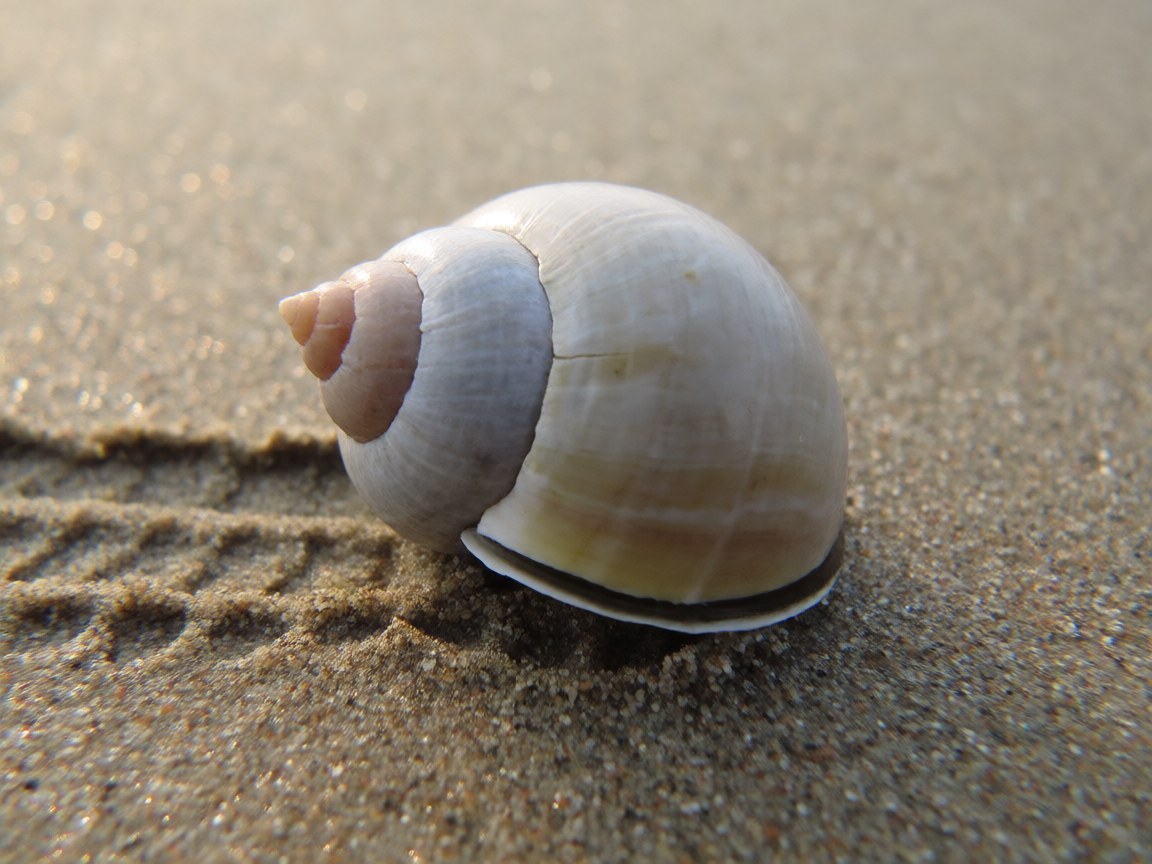
Euspira catena | Common Moon Snail
Introduction
The common moon snail (Euspira catena) is a smooth, glossy, globular snail of sandy seabeds and, in summer, the animal whose egg masses — floppy, sandy-coloured collars, buried just under the sand like a rigid bracelet — turn up on the strandline and puzzle most people who find them. The snail itself is a handsome creature: a pale, almost spherical shell a couple of centimetres across, and a body so large that the animal can withdraw only partly into it. It is a predator rather than a grazer, hunting other molluscs through the sand, and it belongs to the moon snails, a family whose members all share the same striking method of feeding: they bore a neat, countersunk, circular hole through the shell of their prey and then rasp out the flesh inside. Those drilled shells, common on any sandy beach, are the signature of the family and one of the most easily recognised traces of predation in the sea.
Taxonomy
Euspira catena is a gastropod mollusc in the family Naticidae, the moon snails or necklace shells, a worldwide group of smooth-shelled, sand-dwelling predatory snails whose English names refer to the shape of the egg collar and to the round, moon-like shell. It was long known as Polinices catena or Natica catena, and older literature and shell books will usually use one of those names; Euspira is now the accepted genus for this and a handful of related species. Its relatives in British waters include the similar Euspira pulchella and the larger, more southern Natica species of warmer seas. It is a snail rather than a cephalopod, but it is a mollusc in the same broad group as Octopus vulgaris, and it shares with that animal a thoroughly predatory way of life, hunting other molluscs and using a toothed ribbon to deal with them.
Physical Characteristics
The shell is globular, thin but strong, and distinctly wider than it is tall, up to about three centimetres across, with a short, pointed spire of five or six whorls and a very large, rounded body whorl that makes up almost the whole shell. The surface is smooth and highly glossy, marked only with fine growth lines, and it is pale: greyish-white, cream, fawn, or pale yellowish, often with a faint paler band around the top of the whorls and usually with a series of faint, irregular, paler or darker marks following the suture. The aperture is large and half-moon-shaped, the outer lip is thin and sharp, and the umbilicus — the open funnel on the underside of the shell — is deep and partly closed by a callus, which is one of the characters used to separate the species from its relatives. The operculum is calcareous, smooth, and ear-shaped in this genus. The animal’s foot is enormous and fleshy; when fully extended it envelops the shell almost completely, and the head is small and bears two flattened tentacles and a snout.
Habitat
It lives on and in clean sandy and gravelly seabeds, from the very low shore down to depths of a hundred metres or more, and it is most abundant in fine, clean sand where there are plenty of bivalves to hunt. The animal ploughs just beneath the surface, pushing forward with its great foot, and it leaves a characteristic raised trail in the sand; at low tide on the lowest spring tides it can occasionally be found half-buried in wet sand. It is distributed in the eastern Atlantic from Norway and Iceland south to Iberia and into the Mediterranean, and it is common all around the coasts of Britain and Ireland. The sandy egg collars, hardened by sand grains cemented into the jelly, wash ashore after storms and are frequently found by beachcombers with no idea what made them.
Diet
The common moon snail is a carnivore, feeding mainly on bivalves and other small molluscs buried in the sand. It detects its prey by smell and by touch, moves over it, and grips the shell with its foot. It then rasps at the shell with its radula while applying a chemical secretion from an accessory boring organ on the underside of the foot, and over a period of hours to days it cuts a neat, circular, slightly conical hole with countersunk edges straight through the shell — the bevel is wider on the outside, and this shape is the unmistakable calling card of the family. Once the hole is complete, the snail inserts its proboscis and rasps out the flesh, leaving an empty, cleanly drilled shell. The whole operation may take many hours, and the snail usually remains partly buried while it works, so the only evidence is the drilled shell left behind in the sand. Preferred prey includes small clams, tellins, and other shallow-burrowing bivalves, and the snail is itself eaten by fish, crabs, and larger predators. Because a single snail drills dozens of shells in a season, the accumulated evidence of its feeding is one of the most conspicuous features of any shell gravel.
Reproduction
The sexes are separate and fertilisation is internal. In spring and summer the female lays her eggs in the structure that gives the family most of its common names: a broad, ribbon-like collar or sand collar, made of a continuous band of jelly in which the eggs are embedded in many layers, and into which the animal cements sand grains so that the whole thing becomes firm, opaque, and sandy in colour. The female shapes this collar with her foot while it is being laid, and the finished ring is left buried in the sand with only its edge showing. The eggs develop inside, and the young emerge as free-swimming veliger larvae, which spend a period in the plankton before settling onto suitable sandy ground and metamorphosing. The planktonic stage is the main means of dispersal and is what allows the species to maintain populations on separated sandbanks. Growth is moderate, and the animals probably live for several years.
Conservation
The species is common, widespread, and not considered threatened, though like all animals of clean sandy sediment it is vulnerable to activities that disturb or remove that habitat. Aggregate extraction, scallop dredging, bottom trawling, and the smothering effects of sediment discharged from coastal works all degrade the sandbanks that the snail and its prey depend on, and because the prey species are themselves vulnerable, the effects are felt twice over. Oil spills and chemical contamination of sediment are damaging for the same reasons. Its value to naturalists and to scientists is considerable: moon snails are one of the few predators whose traces are abundant and identifiable in both modern and fossil sediments, and the frequency of drilled shells is used to study predation pressure through time.
Fun Facts
- The sandy “collars” that wash up on beaches are its egg masses, hardened with cemented sand grains.
- It drills a neat, circular, countersunk hole through the shell of its prey and eats the animal inside.
- Drilled shells on a beach are the calling card of the moon snail family.
- The animal’s foot is so large that it cannot fully withdraw into its shell.
- It ploughs just beneath the surface of the sand, leaving a raised trail behind it.