 By st20113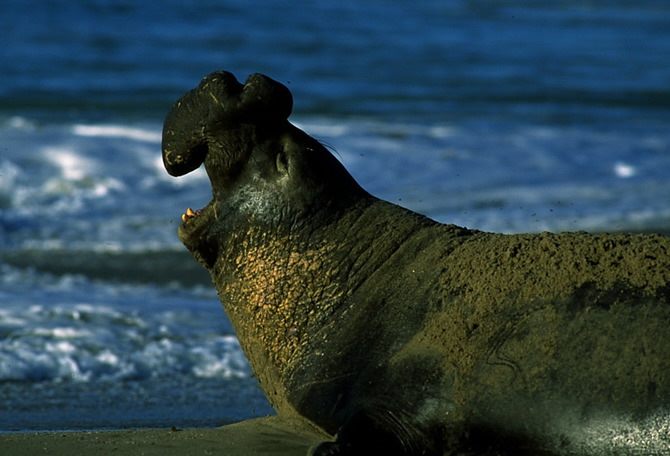
Introduction
The northern elephant seal (Mirounga angustirostris) is the largest carnivore in the Northern Hemisphere. Adult males can exceed 4 meters in length and weigh 2,300 kilograms, instantly recognized by their enormous pendulous proboscis, which serves as both a visual weapon and a resonating chamber for dramatic underwater vocalizations. The species breeds almost exclusively on offshore islands off California and Baja California, with major rookeries at the Channel Islands, Ano Nuevo, and Piedras Blancas. Northern elephant seals spend roughly 80 percent of their lives at sea, diving to extraordinary depths in pursuit of deep-sea prey. Their recovery from near-extinction in the 1890s to more than 100,000 individuals today stands as one of the most inspiring marine mammal conservation success stories in modern history.
Taxonomy
Mirounga angustirostris belongs to the family Phocidae, the true seals, and the order Carnivora, formally described by William Scripps in 1862. Its closest relative is the southern elephant seal (Mirounga leonina), which is substantially larger and inhabits the Southern Hemisphere. Both species share the characteristic proboscis and massive body that distinguish the genus Mirounga from all other pinnipeds. Genetic studies show the two species diverged approximately 2.5 million years ago. Northern elephant seals belong to the monachine seal subfamily, which also includes the leopard seal and California sea lion as more distant relatives.
Physical Characteristics
Northern elephant seals display extraordinary sexual dimorphism. Adult males reach 4 to 5 meters and 1,500 to 2,300 kilograms, with the largest approaching 3,700 kilograms, roughly 30 times the mass of females. The male’s large proboscis inflates into a resonating chamber during threat displays and underwater calls, and redirects moisture during exhalation. Adult females are considerably smaller at 2.5 to 3.5 meters and 400 to 900 kilograms, lacking the large proboscis. Both sexes have short, coarse fur ranging from gray to brown to nearly black, and both undergo a complete annual molt shedding their outer skin and hair over several weeks.
Habitat
Northern elephant seals range along the Pacific coast from the Gulf of Alaska to Baja California Sur, with major rookeries on California’s offshore islands. They spend approximately 80 percent of their lives at sea, foraging in the deep waters of the North Pacific and Gulf of Alaska. Diving depths regularly exceed 300 to 500 meters, with documented dives beyond 1,500 meters. Foraging grounds lie thousands of kilometers offshore, beyond the continental shelf. On land, they haul out on sandy and rocky beaches during the breeding season from December to March and during the annual molt from April to August.
Diet
Northern elephant seals are deep-sea foragers whose diet is dominated by fish and squid. Prey includes deep-sea species such as ratfish, lanternfish, and bottom-dwelling fish, as well as squid and octopuses. Elephant seals are suction feeders, creating negative pressure in the mouth to draw prey down the throat, typically swallowing it whole. Foraging occurs exclusively at depth, with individuals diving repeatedly from the surface to the ocean floor. Average dive duration is 20 to 25 minutes, though some dives extend to nearly two hours. Great white sharks are significant predators of elephant seals at the surface.
Reproduction
Northern elephant seals gather on beaches each winter, with peak pupping in January and February. The species is polygynous; dominant males control territories and harems of 30 to 50 females through vocalizations, shoving matches, and biting. After mating, females undergo delayed implantation of approximately three months, followed by an 11-month total gestation. A single pup weighing roughly 35 kilograms is born and nursed exclusively for 25 to 30 days, gaining more than 4 kilograms per day on fat-rich milk. Weaning is abrupt; the mother returns to sea and the pup must learn to swim and forage independently.
Conservation
Northern elephant seals have recovered dramatically from near-extinction in the 1890s, when fewer than 100 individuals survived on the Coronado Islands. Protection under the Marine Mammal Protection Act of 1972 allowed populations to rebound to more than 100,000, and the species was among the first marine mammals removed from the endangered species list. Current threats include entanglement in fishing gear, marine debris, oil spills, and climate-driven changes in prey availability.
Fun Facts
Northern elephant seal pups are born with a black, woolly coat called a lanugo, replaced within weeks by a silvery coat. During their annual molt, seals haul out for three to four weeks to shed and regrow their entire outer skin and fur layer. They are among the deepest-diving pinnipeds, with recorded dives reaching nearly 1,700 meters. A weaned pup will have increased its birth weight six-fold in just 30 days. Unlike dolphins and most other marine mammals, elephant seals have poor aerial hearing and are nearly deaf to airborne sounds.