 By st20113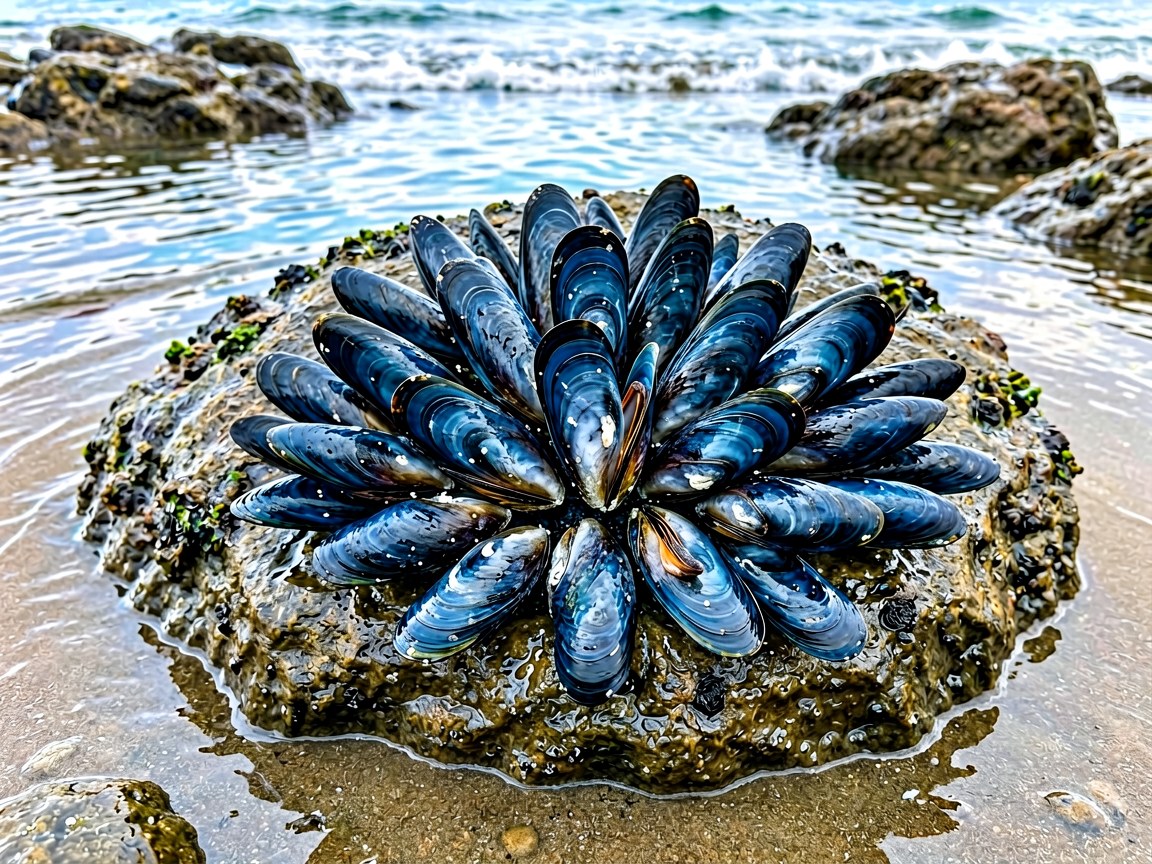
Mytilus edulis | Common Mussel
Introduction
The Common Mussel (Mytilus edulis), often called the blue mussel, is a small but hugely abundant bivalve mollusc of the northern shores of the Atlantic and adjacent seas. Clustered in dense, blue-black masses on rocks, piers, and in estuaries, it is a familiar sight of the intertidal zone and a keystone species of coastal ecosystems. Both a wild-harvested food and the basis of a major aquaculture industry, it has fed people for millennia.
A master of attachment, the mussel anchors itself with a bundle of tough protein threads and filters enormous volumes of seawater for food, quietly cleaning the water as it feeds. Though humble in appearance, it underpins food webs from shorebirds to starfish and helps buffer coastlines against wave energy.
Taxonomy
Mytilus edulis was described by Linnaeus in 1758; the genus name Mytilus is Greek for “mussel,” and edulis means “edible.” It belongs to the family Mytilidae within the class Bivalvia—the clams, oysters, and scallops—and the phylum Mollusca, the molluscs.
It is a close relative of the Common Octopus (Octopus vulgaris), both being molluscs that build a calcium-carbonate shell (in the octopus’s case, internally, as a vestigial “cuttlebone”-like plate), though the mussel is a sedentary filter-feeder while the octopus is a roving predator. The mussel’s foot and the octopus’s arms are homologous glimpses of the same soft-bodied body plan perfected in very different directions.
Physical Characteristics
The Common Mussel has an elongated, triangular shell 5–10 cm long, typically blue-black outside with a pearly, iridescent interior, though colour varies with habitat and age. The two valves are hinged at the narrow end and held shut by a strong adductor muscle; when open, the mussel extends a large, muscular foot and a pair of siphons.
The foot secretes the byssus—a tuft of tough, proteinaceous threads (“beard”) that cement the mussel to rock or to its neighbours. Inside, feathery gills do double duty: extracting oxygen and trapping food particles. The mantle edge lines the shell and, in life, the animal can clamp shut for hours to survive exposure between tides.
Habitat
The Common Mussel occupies the intertidal and shallow subtidal zone of rocky coasts, estuaries, and sheltered bays across the North Atlantic, from North America to Europe and into the Baltic and Mediterranean. It thrives where wave action brings a steady supply of oxygenated, plankton-rich water and where a firm surface allows attachment.
It forms dense mussel beds that create three-dimensional habitat for algae, small crustaceans, and juvenile fish, and that stabilise sediment. Mussel farms—lines or rafts hung in clean water—mimic these natural aggregations and now supply much of the global market. The species tolerates a wide salinity and temperature range, though extreme heat and pollution reduce survival.
Diet
The mussel is a filter feeder. It draws water in through its inhalant siphon, and its gills—lined with mucus and tiny beating hairs (cilia)—strain out phytoplankton, diatoms, and fine organic particles, which are then carried to the mouth. Cleared water is expelled through the exhalant siphon. A single mussel can filter several litres of seawater per hour.
This diet places the mussel low in the food web, converting microscopic plankton into nutritious tissue. In doing so it provides a free ecosystem service: by removing suspended particles, dense mussel populations improve water clarity and quality, benefiting seagrass and other filter-dependent life downstream.
Reproduction
Common Mussels are broadcast spawners: in spring and summer, adults release eggs and sperm directly into the water, where fertilisation occurs. A female can release millions of eggs in a season. The resulting larvae are planktonic for several weeks, drifting and developing before they settle—using a sticky thread—onto a suitable hard surface.
Settled juveniles, called “spat,” grow rapidly if conditions allow and soon begin producing their own byssus threads. Because dispersal depends on ocean currents, mussel populations are well connected along a coast, and recruitment can vary enormously from year to year with temperature and plankton supply.
Conservation
The Common Mussel is abundant and widely harvested, and is not considered threatened; however, wild beds are sensitive to over-harvesting, dredging, pollution, and the warming and acidification of coastal waters, which can thin shells and disrupt settlement. Managed wild fisheries and suspended aquaculture reduce pressure on natural beds.
Mussels are increasingly valued not just as food but as “ecosystem engineers”: restoration projects use mussel beds to filter excess nutrients from eutrophied bays and to protect shores. Because they accumulate contaminants, they are also used as biomonitoring organisms, signalling the health of the coastal environment they inhabit.
Fun Facts
- A single Common Mussel can filter more than 20 litres of seawater a day, quietly scrubbing the coast as it eats.
- Its anchoring “beard” is made of byssus threads stronger, weight for weight, than many synthetic fibres.
- Mussel spat can drift for weeks as plankton before choosing where to settle—a gamble that decides its whole adult life.
- Mussels have been eaten since the Stone Age and were farmed on stakes by Romans over 2,000 years ago.
- Blue mussel shells glow with an inner nacre that has inspired jewellery and mother-of-pearl imitations for centuries.
[…] it shares the broader ecological niche of seafloor-dwelling shellfish with species such as Mytilus edulis (Common Mussel), though the two occupy very different positions in the coastal food […]
[…] the common mussel (Mytilus edulis), described in our article on Mytilus edulis (Common Mussel), the Norway lobster is a staple of European shellfish fisheries, though a crustacean rather than a […]
[…] the common mussel, described in our article on Mytilus edulis (Common Mussel), the edible crab is a cornerstone of European shellfish harvesting, but the resemblance ends there: […]
[…] who digs or sieves a beach at low tide. It is a mollusc of the surf zone, and like the better-known Mytilus edulis, the common mussel, it is a filter-feeding bivalve, though it lives buried in sand rather than […]
[…] gill structure than the familiar mussels and oysters, and it is a close ecological cousin of Mytilus edulis, the common mussel, in that both are bivalve filter feeders, though the nut shell lives buried and […]
[…] matters where it is harvested heavily. As a bivalve mollusc it shares the basic body plan of the common mussel, filtering food from the sea rather than chasing it. Along the Atlantic and Mediterranean coasts it […]
[…] bivalve in its range. As a member of the scallop family it shares the filter-feeding lifestyle of the common mussel, drawing food from the water rather than hunting, but it is far more visually striking and […]