 By st20113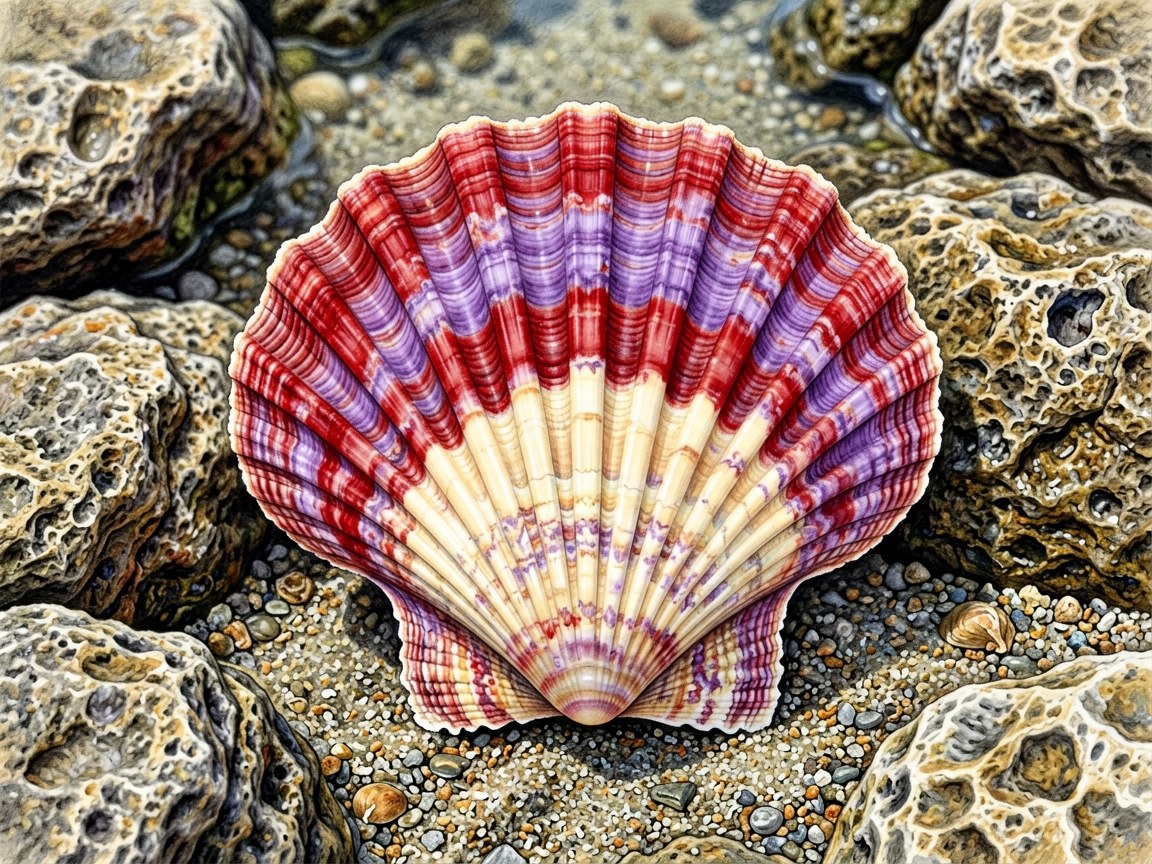
Chlamys varia | Variegated Scallop
Introduction
Chlamys varia, the variegated scallop, is a colourful, active bivalve of the north-east Atlantic that breaks the rule that clams are passive burrowers. A relative of the famous king scallop, it cements itself to rock by a tuft of threads, but when disturbed it can detach and swim by clapping its two shells together, jetting water and rocketing short distances off the seabed. Its shell is a small, ribbed fan painted in a variable mix of reds, purples, browns and creams — hence “variegated” — and its mantle edge is fringed with dozens of tiny, brightly coloured eyes. Found from the shallow sublittoral to moderate depths, it is a familiar sight to divers and a minor culinary bivalve in its range. As a member of the scallop family it shares the filter-feeding lifestyle of the common mussel, drawing food from the water rather than hunting, but it is far more visually striking and behaviourally lively than most of its kin. It ranges from Norway and the British Isles south through the Mediterranean to North Africa, most often on current-swept rock where plankton is abundant. Though smaller than the great scallop, it is collected locally for the table and valued by divers for its colour, and it is a common subject for underwater photographers who catch the flash of its mantle eyes. In some regions it is also reared on ropes, joining the long human history of scallop cultivation that began centuries ago in European bays.
Taxonomy
The variegated scallop belongs to the family Pectinidae, the scallops, a group of bivalves defined by a fan-shaped shell, a row of eyes on the mantle margin, and (in many) the ability to swim. Its genus Chlamys holds a number of similar ribbed scallops, and the species name varia refers to the endlessly variable shell colour. Pectinids are unusual among bivalves in having a well-developed pallial muscle band rather than a single large adductor, which lets them open and snap the valves rapidly for swimming. The animal lacks a true siphon, instead drawing water in around the mantle edge and expelling it through gaps near the hinge. Close relatives include the great scallop Pecten maximus and many small Atlantic and Mediterranean scallops, but the variegated’s cementing habit and colour chaos make it recognisable even to the casual collector.
Physical Characteristics
The shell is 3–7 cm across, a classic scallop fan with a straight hinge bearing small “ears” on either side of the apex and about fifteen to twenty broad radiating ribs. Colour is extraordinarily variable: each valve may be red, purple, orange, yellow or brown in streaks and blotches, though one valve is typically flatter than the other. The upper, free valve is often more colourful than the cemented lower one, which may be paler from shadow. The mantle that lines the shell is fringed with short tentacles and a ring of up to sixty tiny blue, red or black eyes that detect movement and shadow. Inside the shell the muscle scars are arranged in a crescent rather than a single central spot. The animal’s gills, stomach and gonads fill the space between the valves, and a bundle of byssal threads anchors the lower valve to rock or shell when it chooses to settle.
Habitat
The variegated scallop lives on hard substrates — rocks, boulders, cobbles and the shells of other animals — from the lower shore down to about a hundred metres, most abundantly in moderately exposed to sheltered coastal waters. It is found across the Mediterranean and along the Atlantic from Norway and the British Isles south to Morocco, favouring places where it can attach rather than sink into mud. Unlike burrowing clams it needs a firm footing, and it often settles in small groups on the underside of overhangs or among seaweed holdfasts where current brings a steady supply of plankton. Current-swept sites suit it best because its filter feeding depends on food-laden water passing by, and it avoids the still, silty bottoms where sedentary burrowers thrive.
Diet
Like all scallops, the variegated scallop is a suspension feeder. Water is drawn in across the mantle edge, passes over the gills where phytoplankton and fine organic particles are trapped in mucus and conveyed to the mouth, and the filtered water is expelled near the hinge. The gills also extract dissolved oxygen, so feeding and breathing are one continuous process. Because the animal is fixed or only briefly mobile, its nutrition depends on the richness of the plankton in the passing current; it grows fastest where tides and waves deliver fresh, food-rich water. By removing particles the scallop also clarifies the water around it, linking its own survival to the health of the microscopic food web and, in turn, to the clarity of the coastal sea.
Reproduction
Variegated scallops are broadcast spawners. In spring and early summer, warming water triggers adults to release eggs and sperm into the sea, where fertilisation occurs. The larvae are planktonic for one to two weeks, feeding and drifting with the currents before settling onto hard surfaces and metamorphosing into miniature scallops. Once settled they may first anchor by byssus threads and, if conditions suit, remain cemented for life, though they retain the option to detach and swim away if dislodged or threatened. Populations are replenished each year by this larval stage, which also lets the species spread along coasts. Individual growth is steady rather than rapid, and the scallops can live for several years, reproducing repeatedly once they reach maturity after their first year or two.
Conservation
The variegated scallop is common and widespread, and it is not considered threatened. It is collected locally for food and bait and taken incidentally in fisheries, but its productivity and broad range mean populations generally remain healthy. The main pressures are habitat change from scallop dredging that damages rocky bottoms, and local water-quality decline that reduces plankton or smothers attachment surfaces. Because it is a fixed, current-dependent filter feeder, clean, well-oxygenated, hard-bottom habitat is the key to its abundance, and marine protected areas that limit bottom trawling help it thrive. For the divers and foragers who value it, the simple rule of leaving enough attached individuals and avoiding over-collection in a single spot keeps local beds going.
Limiting bottom trawling on rocky ground is the easiest way to keep variegated scallop beds colourful and full.
Fun Facts
- Its shell comes in an almost endless mix of reds, purples and creams, which is why it is called “variegated”.
- The mantle edge carries up to sixty tiny eyes that spot movement and shadow.
- When alarmed it can detach and swim by clapping its shells like a pair of castanets.
- It anchors itself to rock with a tuft of byssus threads, yet stays ready to flee.
- It is a close relative of the king scallop, but far smaller and more colourful.