 By st20113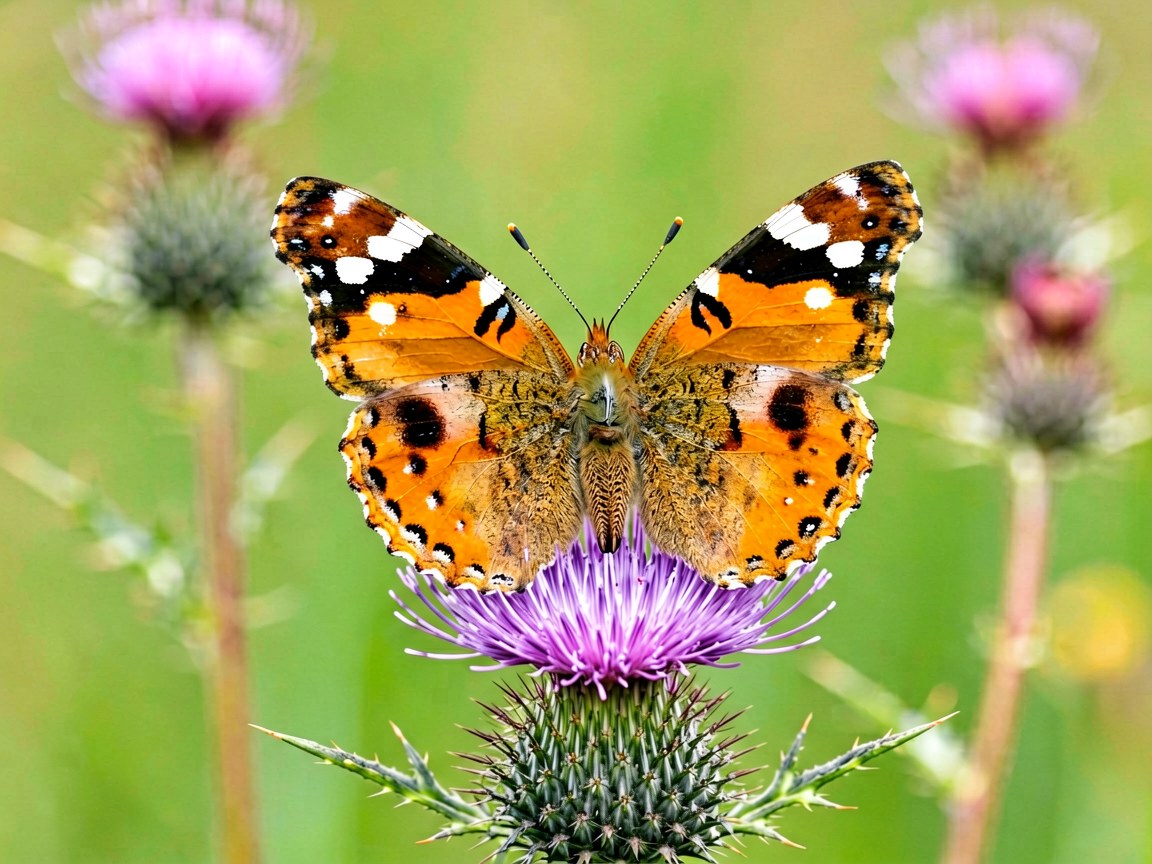
Vanessa cardui | Painted Lady
Introduction
The Painted Lady (Vanessa cardui) is one of the most widespread butterflies on Earth, found on every continent except Antarctica and Australia. A medium-sized, fast-flying orange, black, and white butterfly, it is famous above all for its enormous migratory journeys, which in some years carry millions of individuals thousands of kilometres between breeding and wintering grounds. Few insects are so thoroughly global.
Though individual butterflies are short-lived, the species is a perpetual traveller: each generation advances the migration a little further, so that Painted Ladies seem to appear suddenly in gardens and field margins across Europe every spring. Its adaptability to a vast range of flowers and host plants underpins its near-universal success.
Taxonomy
Vanessa cardui was described by Linnaeus in 1758; the genus Vanessa honours a common given name, and cardui means “of thistles,” referring to its caterpillars’ favourite food. It belongs to the family Nymphalidae, the brush-footed butterflies, within the order Lepidoptera—the butterflies and moths.
It is a close relative of the Large White (Pieris brassicae), another familiar European butterfly; both are strong, migratory flower-visitors, though the Large White is a pierid (cabbage-white) while the Painted Lady is a nymphalid with eyespots and a more powerful, wandering flight. The two often share the same nectar sources in summer meadows.
Physical Characteristics
The Painted Lady has a wingspan of about 5–6 cm. The upper wings are orange-brown with black tips marked by white spots, and the lower wings bear a row of small blue-centred eyespots and a black margin. The underside is mottled grey-brown with cryptic markings that make a resting butterfly nearly invisible against bark or bare ground.
Like all butterflies it has a coiled proboscis for sipping nectar, large compound eyes, and four scaled wings. The body is slender and furry, helping retain heat during flight. Males and females look similar, though females are slightly larger and paler; both are built for sustained, directional flight rather than the flitting of many garden species.
Habitat
The Painted Lady is a creature of open, sunny places: meadows, grasslands, gardens, roadside verges, farmland, and scrub from sea level to high mountains. It breeds wherever its larval host plants—chiefly thistles, mallows, and nettles—grow, and adults nectar in almost any flower-rich habitat.
Its true habitat is effectively the whole temperate and tropical world, shifting with the seasons. In Europe it is a seasonal migrant, absent in winter and arriving in spring from North Africa and the Mediterranean, then spreading north and east as generations breed through the summer. This nomadic lifestyle lets it exploit transient blooms across a continent.
Diet
Adults feed on nectar from a wide variety of flowers, favouring thistles, knapweeds, buddleia, and asters, and they are important pollinators of many open-ground plants. They also visit rotten fruit and, occasionally, damp soil for minerals. Their broad nectar diet is a key to their cosmopolitan range.
Caterpillars are more specialized, spinning loose silk nests on the leaves of host plants—thistles (Carduus, Cirsium), mallow (Malva), and stinging nettle (Urtica) among them—and eating the foliage. The larval diet is rich in the compounds that make the adult both well-fed and, to some predators, unpalatable, channelling the plant’s defences into the butterfly.
Reproduction
Painted Ladies breed continuously through the warm season, with females laying single green eggs on the leaves of host plants. The caterpillars hatch in days, weave a silken retreat, and pass through several instars before forming a chrysalis (pupa) attached to the plant. Adults emerge roughly one to two weeks later, ready to feed, mate, and migrate.
Because the species migrates, reproduction is staggered across the landscape: southern populations breed early and their offspring fly north to found new colonies, so that by midsummer Painted Ladies are appearing far beyond where any overwintered individual could have reached. Several generations may complete the loop in a single year.
Conservation
The Painted Lady is globally abundant and not threatened, and its migrations are a celebrated natural spectacle monitored by citizen scientists across Europe. Numbers fluctuate dramatically year to year with weather and rainfall in the African staging grounds, producing occasional “invasion” years of extraordinary abundance.
Its main vulnerabilities are habitat simplification—loss of flower-rich margins and of thistle and nettle host plants to intensive agriculture—and pesticide use that reduces both nectar and caterpillars. Gardeners can help simply by tolerating a patch of nettles or thistles and by planting late-season nectar sources that fuel the southward return migration of the autumn generation.
Fun Facts
- Painted Ladies migrate up to several thousand kilometres, with some North American populations flying south to Mexico and back—one of the longest insect migrations known.
- A single “invasion year” can see millions arrive in northern Europe within weeks, apparently from nowhere.
- The caterpillars make a silk tent on their food plant and can be surprisingly aggressive, flicking when disturbed.
- Despite the epic journey, no individual completes the full round trip; the migration is a relay passed across generations.
- The Painted Lady is so widespread it has been recorded on every continent except Antarctica and mainland Australia.