 By st20113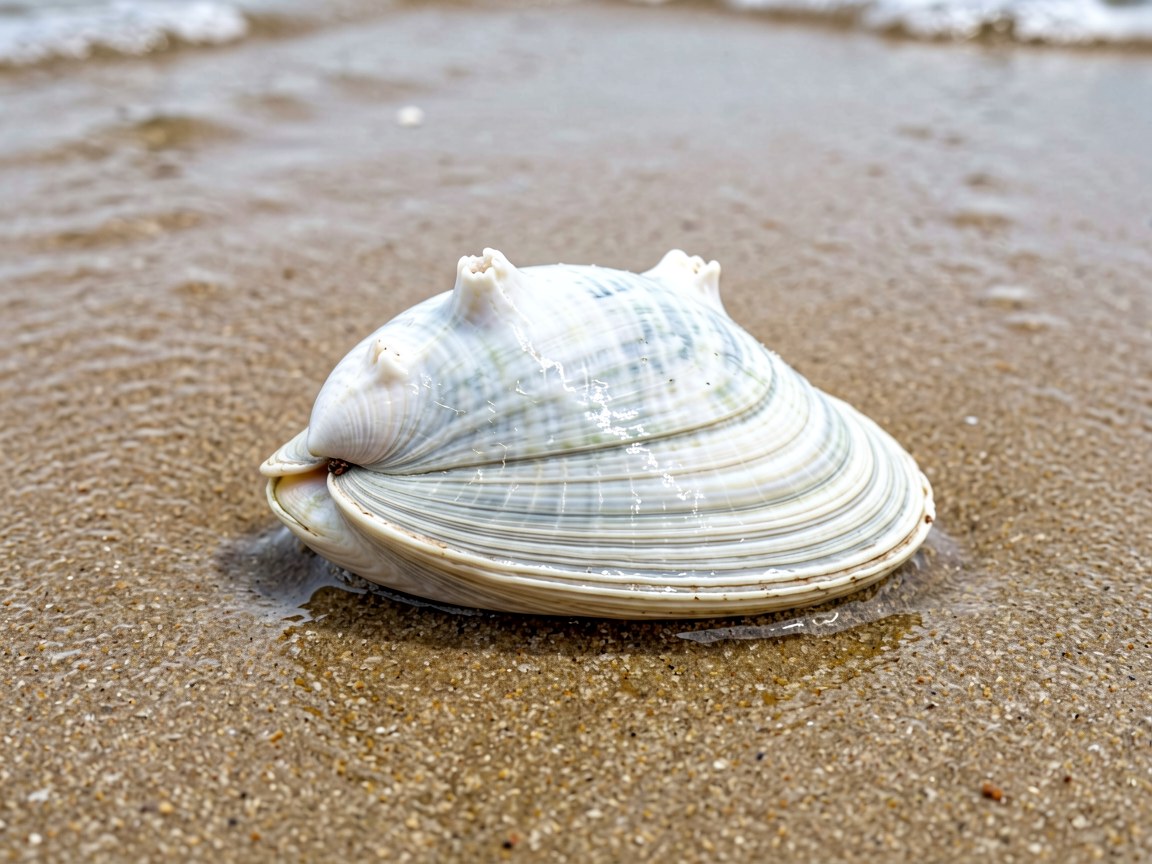
Spisula solida | Solid Surf Clam
Introduction
The solid surf clam (Spisula solida) is a thick, heavy, triangular bivalve of clean sandy beaches, and one of the most heavily fished shellfish of the eastern Atlantic. It is the “spisule” and “amêijoa branca” of French and Portuguese cooking, the clam that supports a substantial dredge fishery along the Atlantic coasts of Iberia and France, and it lives exactly where its name suggests: in the surf zone, in clean, firm, wave-washed sand on open, exposed beaches. Its shell is a solid, smooth, almost porcellaneous white or cream wedge, heavy enough to feel like a stone in the hand, and empty valves are among the commonest larger shells on Atlantic beaches. Fast-growing and short-lived by clam standards, it can form dense beds that are renewed quickly when conditions are right, and equally can collapse abruptly when they are not.
Taxonomy
Spisula solida is a bivalve mollusc in the family Mactridae, the trough shells or surf clams, a group of burrowing, siphonate clams found in sandy sediments worldwide. The genus name Spisula refers to the thick, solid shell, and the specific epithet solida means the same thing. Its relatives in north-west European waters include the trough shell Spisula elliptica and the otter shell Lutraria lutraria, and further afield the Atlantic surf clam Spisula solidissima of North America, which is a very similar and equally important commercial species. It is readily confused with the rather thinner and more oval Spisula elliptica, and the two are best separated by the shape of the shell and by details of the hinge. Like other suspension-feeding bivalves such as Mytilus edulis, it feeds by pumping water over its gills, though the mussel lives attached to rock while this clam is a burrower in shifting sand.
Physical Characteristics
The shell is solid, thick, and heavy, roughly triangular in outline with a rounded front end and a somewhat pointed, slightly gaping rear, typically three to five centimetres long and sometimes rather more. The two valves are equal in size and shape, and they are inflated, giving the shell a distinctly plump, wedge-like profile. The umbones, or beaks, are prominent, turned slightly forwards, and set well towards the front of the shell. The surface is smooth and almost glossy, marked only with fine concentric growth lines and occasional faint ridges marking pauses in growth, and it is covered in life by a thin, pale brownish or greyish periostracum that quickly rubs off the exposed parts. The colour is a clean, opaque, porcelain white or cream, sometimes with faint paler rays, and the inside is smooth and white, often faintly tinged with blue or purple near the hinge. The hinge carries the characteristic mactrid teeth, with a small, spoon-shaped pit for the internal ligament — a distinctive feature of the family. The animal has two short, separate siphons, and a large, strong, muscular foot.
Habitat
It lives buried in clean, firm, coarse to medium sand on open, exposed beaches and in shallow sublittoral water, from the very low tide mark down to depths of around thirty metres, and it is most abundant in the surf zone where wave action keeps the sand loose, clean, and well oxygenated. It burrows rapidly and deeply — ten to twenty centimetres or more — using its powerful foot, and it extends its short siphons up to the surface to feed. It cannot tolerate muddy, silty, or stagnant sediment, and it is absent from sheltered estuaries and from ground with a high proportion of fine material. The species is distributed in the eastern Atlantic from Norway and the North Sea south to Iberia and into the Mediterranean, and it is found all around the coasts of Britain and Ireland where there are suitable sandy beaches. Dense beds are a characteristic feature of exposed Atlantic coasts.
Diet
It is a suspension feeder, drawing water in through the inhalant siphon and passing it over the gills, where cilia and mucus trap suspended particles and sort them by size and weight. The edible fraction is carried by ciliary tracts to the labial palps and then to the mouth, and rejected material is bound into mucus and ejected as pseudofaeces. The diet consists principally of phytoplankton — diatoms, dinoflagellates, and other microscopic algae — together with bacteria, organic detritus, and the larvae and other small particles suspended in the churned water of the surf zone. Feeding is interrupted whenever the sediment is disturbed, since a heavy surf stirs up sand that clogs the gills, and the animal closes its valves and waits for the water to clear. Growth is fast for a bivalve, and individuals in good conditions reach a reasonable size within two or three years.
Reproduction
The sexes are separate, with males and females looking alike, and reproduction is by broadcast spawning into the open water. Spawning is seasonal, usually in spring and summer, and is triggered largely by rising sea temperature; populations often spawn in synchronised episodes, which maximises the chances of fertilisation in the turbulent water of the surf zone. Fertilisation takes place in the plankton. Development follows the standard bivalve course: a trochophore larva, then a veliger that swims and feeds in the plankton for several weeks, and finally a pediveliger that tests the sediment before settling and metamorphosing into a tiny clam. Settlement is heavily influenced by wave action and by the stability of the sand, and the strength of a year class can vary enormously from year to year. The animals are relatively short-lived for a clam, and few survive beyond five or six years, which makes populations dependent on regular successful recruitment.
Conservation
The species is widespread and abundant and is not considered globally threatened, but it is heavily exploited, and the management of the fishery is a significant issue along the Atlantic coasts of Iberia and France, where it is taken by dredge and by hand-gathering. The concerns are the familiar ones for a sedentary, dense, slow-maturing shellfish: local depletion of beds, growth overfishing, and the incidental damage caused by dredging to the sediment and to the other animals living in it. Because the species is fast-growing and relatively short-lived, and because its beds are naturally patchy and variable, it is more resilient than a long-lived clam would be, but it is not infinitely so, and several fisheries are now managed with minimum landing sizes, closed seasons, and area restrictions. Its dependence on clean, wave-washed sand also makes it vulnerable to coastal engineering that alters sediment movement, to sand extraction, and to the effects of pollution and nutrient enrichment.
Fun Facts
- Its shell is so thick and heavy that it feels like a piece of porcelain in the hand.
- It lives in the surf zone of exposed sandy beaches, where the waves keep the sand clean and oxygenated.
- It can burrow ten to twenty centimetres into firm sand in a few minutes.
- Empty valves are among the commonest larger shells on Atlantic beaches.
- It is one of the most important commercial clams of the eastern Atlantic, taken by dredge in large numbers.