 By st20113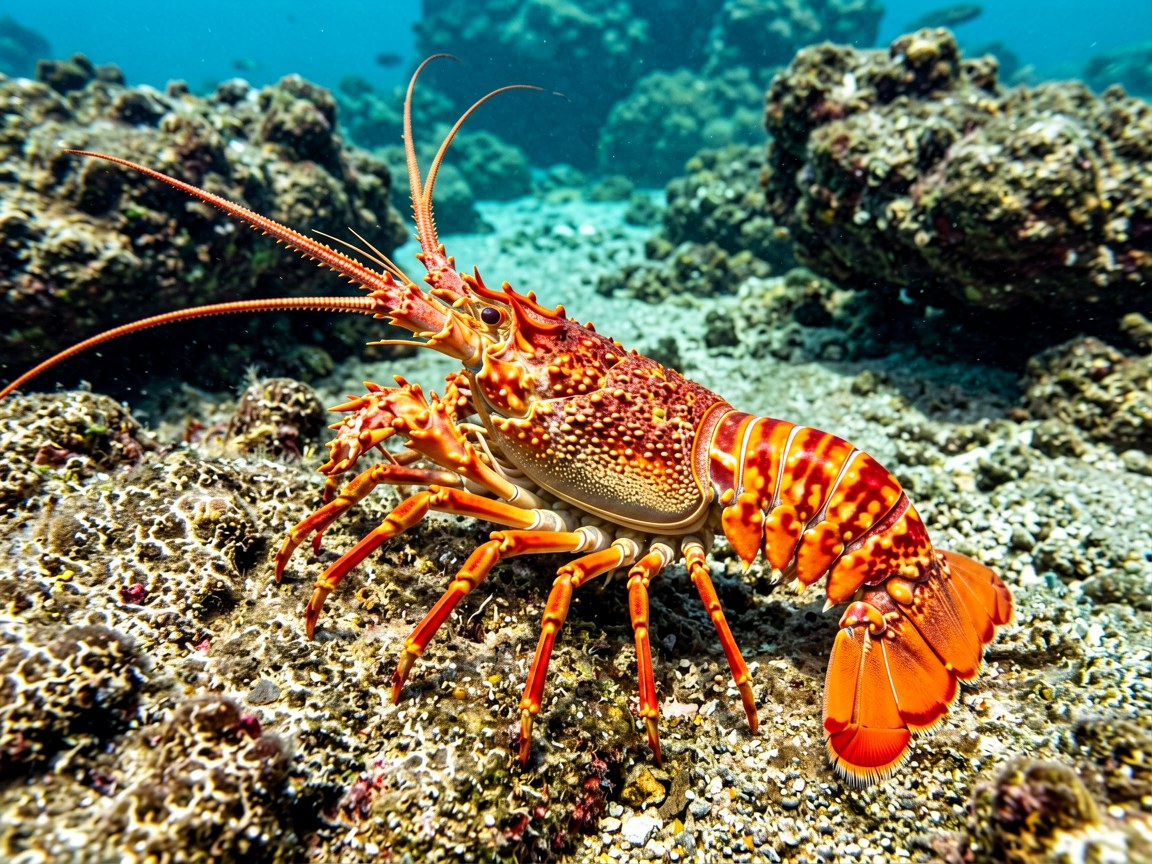
Palinurus elephas | European Spiny Lobster
Introduction
The European spiny lobster (Palinurus elephas) is a large, nocturnal crustacean found along the rocky coasts of the northeastern Atlantic and the Mediterranean Sea. Unlike true clawed lobsters, it lacks the familiar pincer claws and instead relies on a pair of long, spiny antennae for defense and sensing its surroundings. Highly prized in Mediterranean cuisine and vulnerable to overfishing, this species has become a focus of marine conservation efforts across its range. Its striking orange-and-cream banded body makes it one of the most recognizable invertebrates of European coastal waters.
Taxonomy
Palinurus elephas belongs to the family Palinuridae within the order Decapoda, the same broad group of ten-legged crustaceans that includes crabs, shrimp, and lobsters. It is a member of the infraorder Achelata, which unites the spiny and slipper lobsters distinguished by their enlarged antennae and absent claws. As a benthic marine arthropod, it shares the broader ecological niche of seafloor-dwelling shellfish with species such as Mytilus edulis (Common Mussel), though the two occupy very different positions in the coastal food web.
Physical Characteristics
Adult European spiny lobsters can reach a body length of up to 60 centimeters and weigh more than 8 kilograms, though most individuals caught are considerably smaller. Their exoskeleton is a vivid orange-red marked with pale cream or yellowish transverse bands across the carapace and tail segments. Two robust, forward-pointing antennae armed with rows of sharp spines give the animal both its common name and a formidable deterrent against predators. Six pairs of small walking legs and five pairs of swimmerets (pleopods) underneath the abdomen power its movement, while a pair of compound eyes on short stalks provides wide peripheral vision in dim light.
Habitat
This species inhabits rocky substrates, reefs, and seagrass meadows at depths ranging from a few meters down to about 150 meters. It favors crevices, caves, and overhangs where it can shelter during daylight hours and emerge to forage at night. Populations are concentrated along the Atlantic coasts of Portugal, France, Ireland, and the United Kingdom, as well as throughout the western and central Mediterranean. Clean, well-oxygenated water and the availability of refuge structures are key requirements, which makes the species sensitive to habitat degradation and trawl fishing that destroys reef complexity.
Diet
The European spiny lobster is an opportunistic omnivore and scavenger. Its diet includes mollusks, small crustaceans, sea urchins, worms, and detritus, supplemented by the occasional fragment of carrion it locates with its keen sense of smell. Using the small appendages around its mouth, it tears food apart and passes it inward. Because it consumes a wide variety of bottom-dwelling organisms, it plays a useful role in recycling organic material on the seafloor and helping regulate populations of slower-moving prey such as urchins.
Reproduction
Breeding takes place in warmer months, typically in late summer and autumn. Females carry the fertilized eggs externally on their pleopods, brooding a single mass that can contain tens of thousands of eggs for several months until they hatch into free-swimming larval stages. The larvae, known as phyllosoma, drift in the plankton for an extended period—sometimes more than a year—before settling to the bottom and metamorphosing into miniature benthic lobsters. This long, dispersal-dependent larval phase makes recruitment highly variable and especially vulnerable to changes in ocean temperature and currents.
Conservation
Palinurus elephas is assessed as Data Deficient or regionally declining by conservation authorities, with local depletion documented where fishing pressure is intense. Because it grows slowly, matures late, and has a protracted larval stage, populations recover poorly from overexploitation. Many countries have introduced minimum size limits, seasonal closures, and protected no-take zones over reef habitats to aid recovery. The species is also listed under various regional fisheries agreements that encourage selective gear and the release of berried (egg-bearing) females to sustain breeding stock.
Fun Facts
- The European spiny lobster can live for more than 15 years in the wild, with some individuals estimated to exceed two decades.
- It produces a loud, rasping defensive sound by rubbing parts of its antennae against the carapace to startle predators.
- Unlike clawed lobsters, it cannot regenerate lost claws—but it can regrow damaged antennae and leg segments.
- Its larvae may travel hundreds of kilometers on ocean currents before ever settling on the seabed.
- Historically, Mediterranean fishers prized it so highly that “spiny lobster” became a symbol of coastal festive cuisine across southern Europe.