 By st20113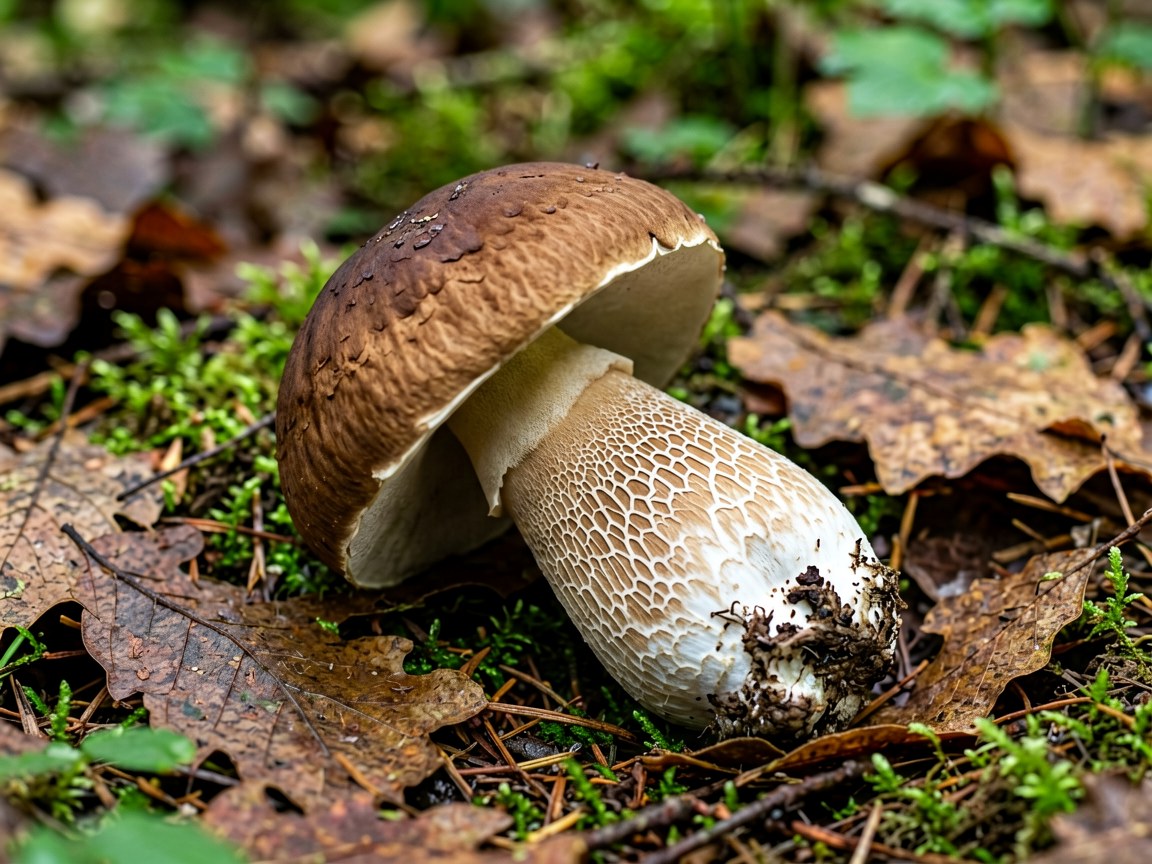
Boletus edulis | Cep
Introduction
The Cep (Boletus edulis), also known as the penny bun, porcino, or king bolete, is one of the world’s most prized edible fungi. A robust, meaty mushroom with a bun-like brown cap and a bulbous, net-patterned stem, it is celebrated by foragers and chefs across Europe for its rich, nutty flavour and versatile texture. It forms in woodlands from late summer into autumn, often in association with broadleaved and coniferous trees.
Unlike many mushrooms, the Cep is remarkably easy to identify and seldom confused with dangerous species, which has made it a favourite of novice and expert foragers alike. When dried, its flavour intensifies into the deeply savoury note underpinning classic dishes from risotto and pasta to soups and sauces throughout European and Asian cuisine.
Taxonomy
Boletus edulis was described by the French naturalist Jean Baptiste François Pierre Bulliard in 1782. The genus name Boletus is an old term for a lump or knob, and edulis is simply Latin for “edible.” It sits in the family Boletaceae, within the phylum Basidiomycota—the club-fungi—which also encompasses the familiar gilled mushrooms.
It is a fellow ectomycorrhizal woodland fungus to the Fly Agaric (Amanita muscaria), both forming mutually beneficial partnerships with tree roots in which the fungus receives sugars and returns water and minerals; though the fly agaric is toxic, the two share the same fundamental lifestyle on the forest floor. Other close relatives include the summer and bay boletes, all valued in the kitchen.
Physical Characteristics
The Cep’s cap is 7–30 cm across, initially domed and bun-like, later flattening, with a smooth, finely velvety surface in shades of chestnut, reddish-brown, or dirty white. Underneath, instead of gills, it bears a sponge of pale, fineled pores that turn yellow-green with age—a key feature separating boletes from typical mushrooms. The stem is thick, barrel-shaped or club-like, white to brown, and marked with a fine raised reticulum (net) toward the top.
The flesh is white, firm, and does not blue when cut, distinguishing it from several less desirable boletes. Mature specimens can be heavy and substantial, with a pleasant, slightly fruity smell. The whole mushroom is built for a short, productive fruiting season, after which it decays or is consumed by insects and mammals.
Habitat
The Cep is mycorrhizal, living in a close root association with trees, and is found in both deciduous and coniferous woodlands—especially beneath oak, beech, pine, spruce, and chestnut. It favours well-drained, acidic to neutral soils and is widespread across Europe, North America, and temperate Asia, often fruitin g in the same spots year after year.
It appears from summer through late autumn, with abundance tied to warm, damp conditions after rain. In managed forests and orchards it can be remarkably abundant, and it has been successfully cultivated only with great difficulty because of its strict dependence on living tree partners. Foragers prize old, established woodlands and woodland edges, where the mycelium threads through the soil unseen until the caps push through the leaf litter.
Diet
As a mycorrhizal fungus, the Cep does not decompose dead matter; instead it trades with its tree partner. Its underground mycelium draws sugars and carbohydrates manufactured by the tree’s photosynthesis, while supplying the tree with water and scarce minerals such as phosphorus and nitrogen gathered from the soil—a textbook mutualism.
This dependence means the Cep cannot be grown on simple compost like the button mushroom; it must have a living host root. The mushroom itself is the brief, visible fruiting body whose sole job is to produce and release spores, drawing on the stored products of the fungus’s long, hidden partnership with the forest.
Reproduction
Reproduction is by spores, produced in their millions within the pores under the cap. When mature, the spores drop and are dispersed by wind and rain splash through the leaf litter. On finding suitable soil near an appropriate tree root, a germinating spore grows into the mycelium that will, over years, establish the mycorrhizal relationship.
Because the fruiting body is ephemeral, the Cep’s strategy is to produce a large, nutritious, animal-attractive mushroom that is spread and partially eaten, while the durable mycelium persists underground for decades. In many regions a single productive “patch” can be harvested responsibly across successive seasons without depleting the underlying fungus.
Conservation
The Cep is common and not threatened, and is collected widely for both domestic use and international commerce; dried and canned porcini are traded globally. Sustainable harvesting is encouraged—cutting rather than pulling, and leaving smaller caps to spore—so that the mycelium and future crops are preserved.
Its principal sensitivity is habitat loss: the conversion of mixed woodland to monoculture plantations, and the acidification or compaction of forest soils, can reduce both abundance and the diversity of mycorrhizal partners. As climate shifts alter rainfall and temperature regimes, fruiting times are becoming less predictable, a reminder that even abundant fungi are tied to the health of the whole forest system.
Fun Facts
- Dried Cep develops such intense savoury depth that a small amount can flavour an entire pot—the secret behind many restaurant “umami” broths.
- The Cep’s reticulated stem and pore underside make it one of the safest wild mushrooms for beginners to recognise.
- It has been eaten since antiquity; Romans prized “suillus” and traded it across the empire.
- In Italy a single top-grade “porcino” can fetch a premium at market, with the best reserved for drying.
- The mycelium of a single Cep can persist underground for decades, fruiting only when conditions are just right.