 By st20113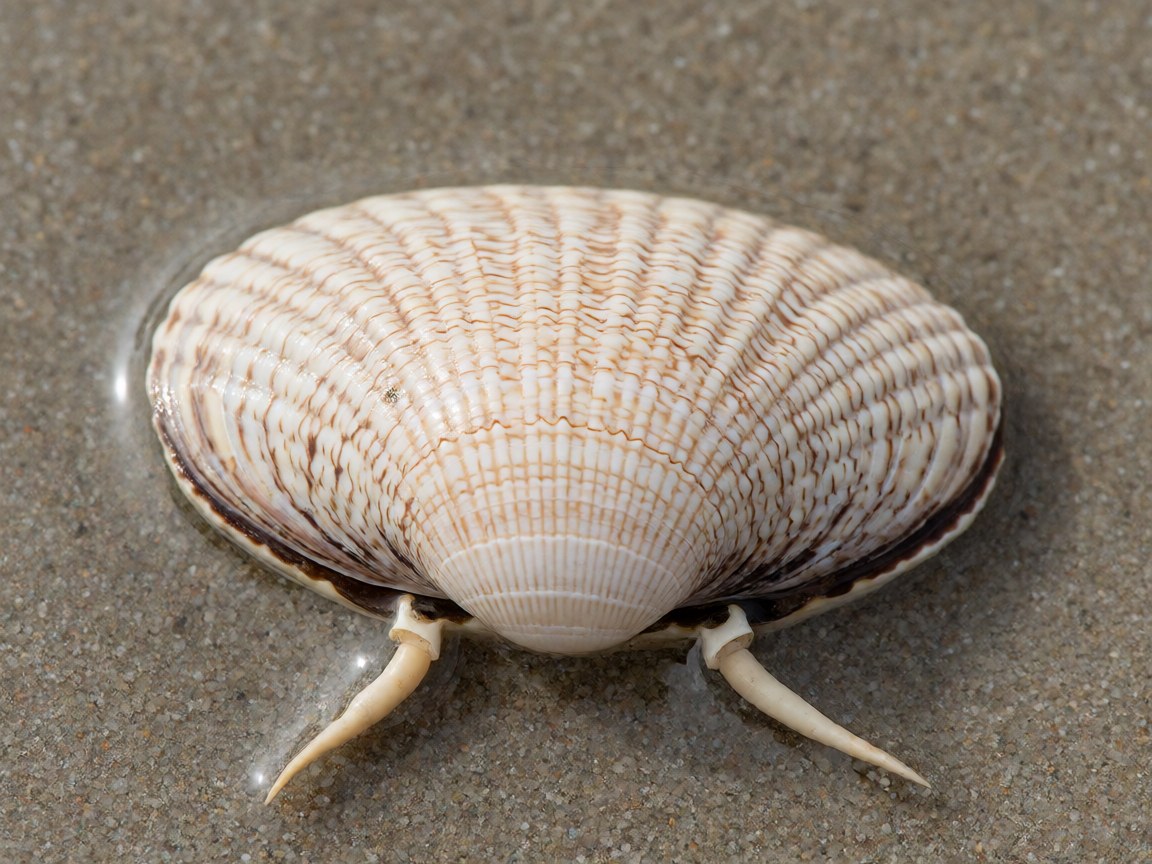
Ruditapes decussatus | Grooved Carpet Shell
Introduction
The grooved carpet shell (Ruditapes decussatus) is a robust, oval clam of sandy and muddy shores, and one of the most valuable commercial shellfish in southern Europe. It is the “almeja fina” of Spanish cooking, the “vongola verace” of Italian kitchens, and the clam that supports a large aquaculture industry in Portugal, Spain, France, and Italy, along with a substantial wild fishery in estuaries and lagoons. Its shell is a solid, slightly rectangular oval, cream to grey-brown in colour, marked with a fine lattice of radiating and concentric lines that gives it both its English and its scientific names: carpet for the pattern, decussatus for the crossing of the lines. It lives buried in sand and gravel in sheltered, often brackish water, and it is one of the few bivalves that tolerate the low and fluctuating salinities of lagoons and estuarine flats.
Taxonomy
Ruditapes decussatus is a bivalve mollusc in the family Veneridae, the venus clams, a large and economically important family of burrowing, suspension-feeding clams found in seas worldwide. It was formerly known as Tapes decussatus and as Venerupis decussata, and these names still appear in older literature and in trade. Its closest and most confusing relative is the manila clam Ruditapes philippinarum, a native of the western Pacific that was introduced to Europe deliberately for aquaculture and has since naturalised widely; the two are very similar and are routinely confused, and they are best separated by the pattern of the sculpture and by the shape of the pallial sinus inside the shell. Like other suspension-feeding bivalves such as Mytilus edulis, it feeds by pumping water over its gills, though the mussel lives attached to rock while the carpet shell is a burrower in sediment.
Physical Characteristics
The shell is solid, oval and slightly angular, up to about seven centimetres long, with the two valves equal in size and closing completely. The umbones, or beaks, are set distinctly towards the front end. The sculpture is the identifying feature: a dense pattern of fine, radiating ribs crossed by fine concentric ridges, producing a regularly latticed or “decussate” surface that feels slightly rough to the touch and looks rather like a woven fabric. The colour is extremely variable, from whitish or cream through grey, fawn, and pale brown, often with darker blotches, rays, or zigzag markings, and the inside of the shell is smooth, white, and usually flushed with yellow or purple near the hinge, particularly at the muscle scars. The hinge carries three small cardinal teeth in each valve. The animal has two short but separate siphons, fused for much of their length and tipped with small tentacles, which is the standard arrangement for a burrowing clam of this kind, and a large, powerful, hatchet-shaped foot.
Habitat
It lives buried in sand, muddy sand, gravel, and shelly mud in sheltered places, from the middle of the shore down to shallow sublittoral depths, and it is particularly characteristic of estuaries, coastal lagoons, and enclosed bays where conditions are calm and the sediment is stable and rich. It burrows to a depth of a few centimetres to fifteen centimetres or more, extending its short siphons to the surface to feed, and it leaves a pair of small holes or a shallow depression in the sediment above it. It tolerates a wide range of salinities, from full seawater down to around fifteen parts per thousand or less, and a fairly wide range of temperatures, which is why it thrives in lagoons and estuarine flats where less tolerant species fail. Native to the eastern Atlantic from the British Isles south to Iberia and into the Mediterranean, it is in Britain at the northern edge of its range and is restricted to a few sheltered southern and western localities.
Diet
It is a suspension feeder. Water is drawn in through the inhalant siphon, passed over the gills, and expelled through the exhalant one; the gills trap particles in mucus and sort them, and cilia carry the edible fraction to the labial palps and the mouth while the rejected material is bundled up and ejected as pseudofaeces. The diet consists of phytoplankton — diatoms, dinoflagellates, and other microscopic algae — together with bacteria, organic detritus, and the small zooplankton and larvae that drift with the water. Feeding rate is strongly influenced by temperature, salinity, and the concentration of suspended sediment, all of which is well understood because the species has been studied intensively for aquaculture. Growth and condition depend on how long the animal can keep pumping, and in the sheltered, food-rich conditions of a good lagoon a clam may be filtering for most of the tidal cycle. High turbidity can clog the gills and reduce growth, and the animals stop pumping altogether during prolonged exposure to fresh water or to very low oxygen, sealing the valves and relying on reserves until conditions improve.
Reproduction
The sexes are separate, with males and females looking alike, and reproduction is by broadcast spawning into the water. Spawning is triggered mainly by rising water temperature, typically in late spring and summer, and in good conditions a population may release gametes in one or two concentrated episodes, though partial spawning through the season is normal in warmer areas. Fertilisation occurs in open water, and development follows the standard bivalve sequence: trochophore, then a feeding veliger larva that spends two to three weeks in the plankton, then a pediveliger that begins to test the sediment before settling and metamorphosing into a tiny clam. Settlement is a critical period, and the availability of suitable sediment and the timing of the plankton bloom are the main determinants of the strength of a year class. Growth is relatively fast for a clam, and the animals reach market size in around two to three years.
Conservation
The species is not globally threatened, and in the Mediterranean and southern Europe it is abundant and heavily exploited. In Britain it is at the northern edge of its range, scarce, and largely restricted to a handful of estuaries and coastal lagoons, and it is protected in some sites, where collection is prohibited. The main pressures are overfishing and the mechanical harvesting of sediment, which disturbs the whole community, along with the degradation of estuaries and lagoons by pollution, nutrient enrichment, and coastal development. The spread of the introduced manila clam is a further complicating factor: it competes for the same habitat and has replaced the native species in parts of its range, and the two are so similar that they are frequently confused in the trade. Aquaculture of both species is now a major industry and has taken much of the pressure off wild populations.
Fun Facts
- The “carpet” of its name refers to the fine lattice pattern on the shell, and decussatus means the same thing.
- It is the prized “almeja fina” and “vongola verace” of Spanish and Italian cooking.
- It tolerates brackish water well, which is why it thrives in lagoons and estuaries.
- The introduced manila clam looks so similar that the two are routinely confused, even in markets.
- It feeds by pumping water through a pair of short siphons while buried in the sand.