 By st20113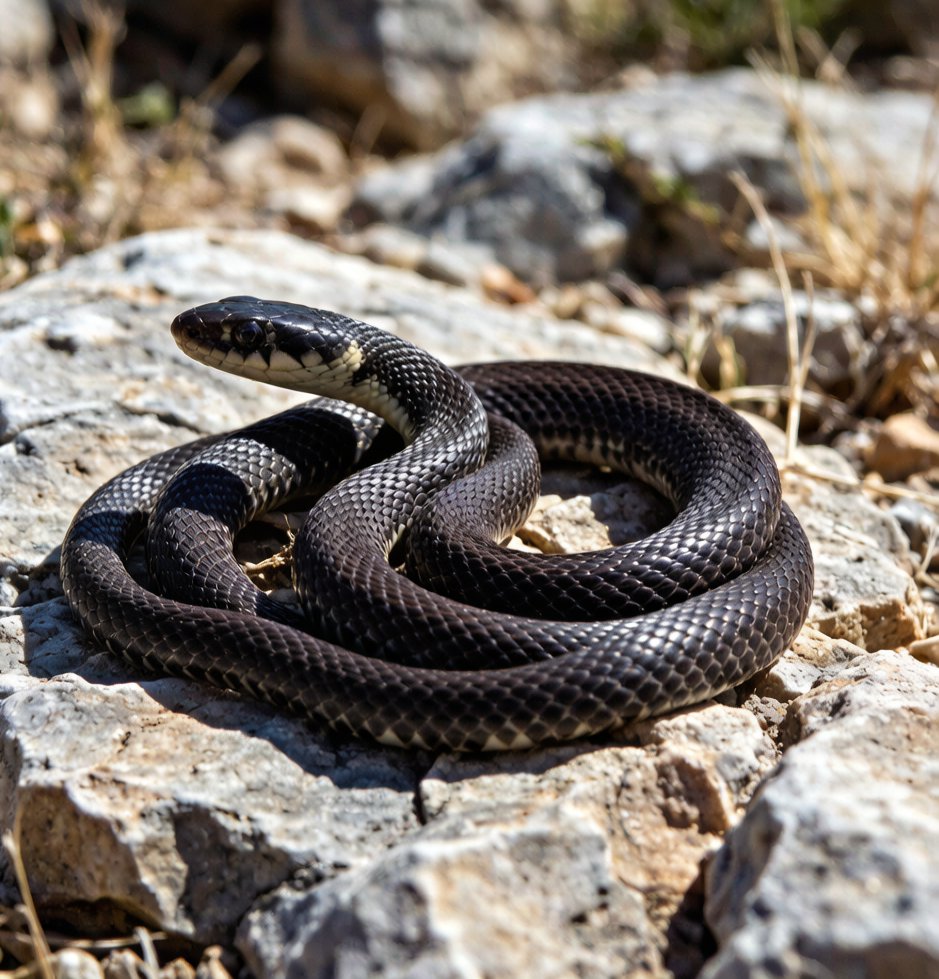
Introduction
The Grass Snake (Natrix natrix) is the largest and most aquatic of the three native British snakes, ranging from the British Isles and Iberia east to Lake Baikal in Siberia. It is a non-venomous, entirely harmless colubrid snake famous for its dramatic death-feigning display and its preference for ponds and marshes where it hunts amphibians and fish. Distinguished by its large size, olive-green coloration, and the distinctive yellow or cream collar behind the head, it is a familiar sight in garden ponds and reedbeds across its range.
Taxonomy and Evolution
The Grass Snake is classified as Natrix natrix within the family Colubridae, the largest snake family. Linnaeus described it in 1758. The species complex comprises several subspecies across its enormous range, with genetic studies revealing significant diversity in the Balkans and Eastern Europe that may warrant species-level splitting. Its closest relatives include the viperine snake and the dice snake with which it shares an aquatic ecology. Within the genus Natrix are some 11 species distributed across Europe, Asia, and North Africa, all non-venomous and primarily amphibian-feeding.
Physical Characteristics
Grass snakes are Europes largest natricine snakes, typically 90 to 120 cm long with exceptional specimens reaching 200 cm. They have a slender elongated body with a somewhat flattened head. Coloration is usually olive-green, gray-brown, or dark green with a row of darker spots along the back. The most distinctive feature is the bright yellow or cream collar behind the head, often edged with black. The belly is pale with a dark checkerboard pattern. Females are significantly larger than males. As a non-venomous constrictor they lack the triangular head shape of vipers and have round pupils.
Habitat and Distribution
Grass snakes are strongly associated with marshes, ponds, lakes, slow rivers, canals, and damp meadows where amphibian prey is abundant. They are excellent swimmers and spend long periods in water hunting fish and amphibians below the surface. They range from sea level to about 2,700 m in the Alps and Pyrenees. In northern parts of the range they brumate through winter in rodent burrows, rock crevices, or compost heaps, sometimes in large communal aggregations. Garden compost heaps are a favored hibernation site in Britain.
Diet and Feeding Behavior
Amphibians, especially frogs, toads, and newts, are the primary prey with fish taken opportunistically. Grass snakes hunt by active searching and ambush, locating prey by scent and sight, then seizing and swallowing alive. Because they lack venom they do not kill prey before swallowing though they may use a body coil to help subdue larger items. After feeding they require several days to digest and often rest in warm sunny locations to speed digestion. In areas where amphibians are scarce they also take small mammals, nestling birds, and earthworms.
Reproduction and Life Cycle
Mating occurs in spring shortly after emergence from brumation. Males engage in ritualized combat dances with other males before females are located. Females lay 10 to 40 elongated eggs in rotting vegetation, compost heaps, or manure piles where decomposition generates warmth to incubate them. The eggs incubate for 6 to 10 weeks depending on temperature and hatchlings of 15 to 20 cm emerge in late summer or early autumn. Sexual maturity is reached at 3 to 5 years. Predators include the red fox, hedgehogs, and birds of prey. When threatened, grass snakes perform a dramatic death-feigning display rolling onto their back, gaping the mouth, and emitting foul-smelling secretions.
Conservation Status
Listed as Least Concern across its large range though populations have declined in parts of Western Europe particularly Britain where the species is declining due to habitat loss, pond drainage, and fragmentation of marsh corridors. In Britain it is a Priority Species under the UK biodiversity action plan and is protected under the Wildlife and Countryside Act making it illegal to kill or injure them. Conservation actions include the creation and restoration of ponds, management of road verges adjacent to marsh habitat, and public education to reduce persecution.
Fun Facts
Grass snakes are the only British snake that regularly lays eggs, the adder and smooth snake both giving birth to live young. The yellow collar that gives them their alternative name is more prominent in young snakes and can fade with age making older individuals harder to identify. They have a remarkable ability to recover from near-starvation: a grass snake that has lost up to 30 percent of its body weight through winter starvation can recover fully within a few weeks of feeding. In warm summers a single grass snake territory may contain several dozen frogs all consumed over the course of the active season.
[…] being the larger individual. The sand lizard frequently shares its heathland habitat with the grass snake, and the adder is also found in similar dry, open […]
[…] often come into contact with domestic pets and vehicles. Hedgehogs may share their habitat with the grass snake, which also frequents garden ponds and compost […]
[…] declines inspired the creation of conservation programs across Britain and northern Europe. The grass snake also hunts in wetland habitats where water voles live. Water voles play a significant role in […]
[…] and a unique flared lip at the rear. Males are larger with a concave plastron and longer tail. The grass snake shares Mediterranean habitats but is a […]
[…] slightly hooked upper jaw. Males are generally smaller with a longer tail and concave plastron. The grass snake shares some Mediterranean habitats but is quite […]
[…] grass snake is the most closely related species to the viperine snake, and both are nonvenomous aquatic […]
[…] to challenging environments, from high-altitude foraging to seasonal hibernation or migration. the grass snake, the adder, and the common frog frequently coexist with the podarcis muralis across shared […]
[…] observers for centuries, featuring in folklore, art, and scientific illustration across Europe.the grass snake, the common frog, and the smooth newt frequently coexist with the water vole across shared […]