 By st20113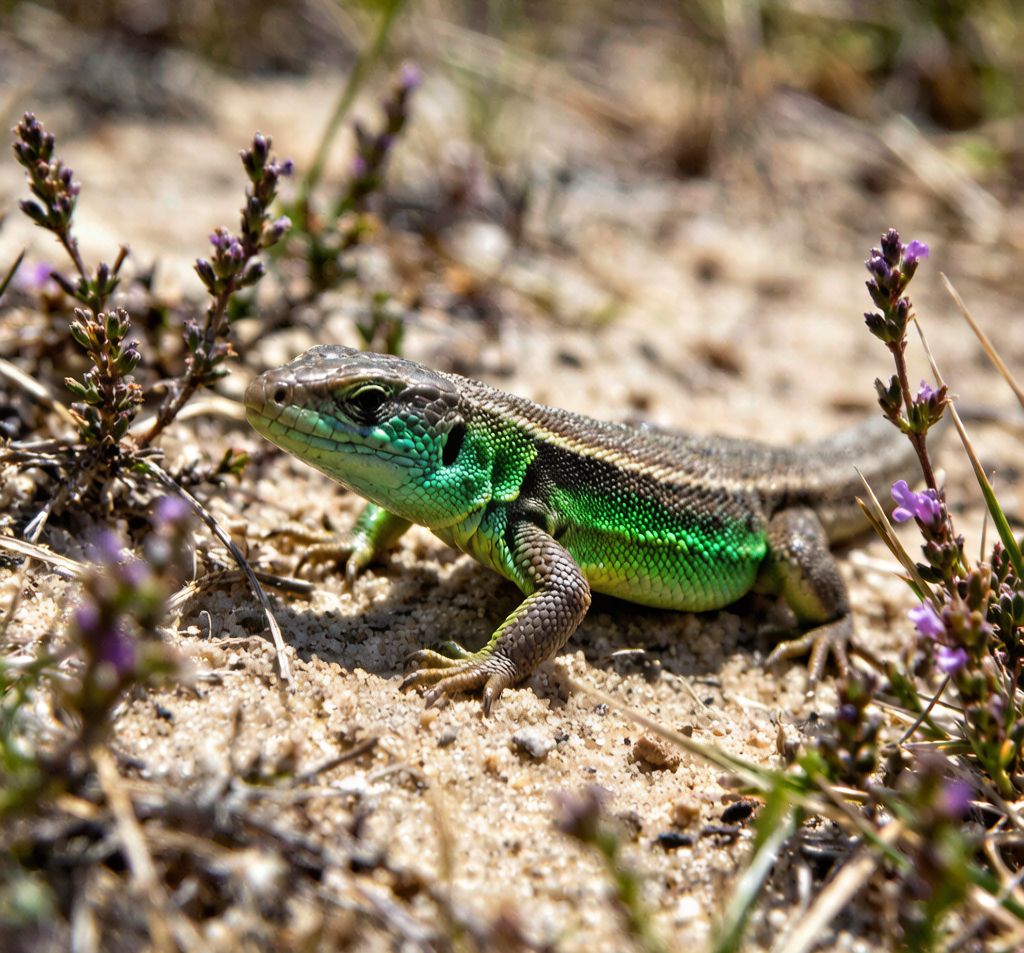
The sand lizard is a robust, medium-sized lacertid reptile distributed across central and eastern Europe, from France and northern Spain eastwards to western Russia. It prefers heathland, sandy coastal dunes, and dry grassland with scattered scrub, habitats that have been steadily lost to agriculture and urbanisation over the past century. Males develop vivid emerald-green flanks during the breeding season, making them one of Europe’s most visually striking lizards. During male combat, sand lizards lock jaws and perform circular pushing contests similar to arm-wrestling, with the victor typically being the larger individual. The sand lizard frequently shares its heathland habitat with the grass snake, and the adder is also found in similar dry, open terrain..
Taxonomy
The sand lizard (Lacerta agilis) belongs to the family Lacertidae, order Squamata. The genus Lacerta contains approximately 25 species of wall lizards distributed across Europe, North Africa, and temperate Asia. Within the species, eight subspecies are recognised, reflecting substantial geographic variation in size, colouration, and ecology. Phylogenetic analyses using mitochondrial DNA have revealed deep genetic divergence between western and eastern lineages, suggesting that the species may warrant future taxonomic splitting. The species was formally described by Carl Linnaeus in 1758.
Physical Characteristics
Adult males measure 18-22 cm in total length, females 16-20 cm, with a robust, stocky build. The background dorsal colour is brown, grey, or olive, overlaid with paired dark spots along the back. The most spectacular feature of breeding males is the development of vivid emerald-green or turquoise flanks, belly, and occasionally the entire dorsal surface. Males also develop a broader head and larger femoral pores than females. The tail is relatively short, an unusual trait for a lacertid that may reduce vulnerability to predation in open habitats.
Habitat
The sand lizard occupies dry, open, semi-open habitats with a mosaic of short vegetation for thermoregulation and denser cover for shelter and oviposition sites. Core habitats include lowland heathland, coastal dunes with marram grass and scrub, dry acid grassland, railway embankments, and south-facing woodland clearings. The species requires loose, well-drained, sandy or gritty soil for egg burial. Range contraction across western Europe has been severe, with heathland loss being the primary driver of local extinctions in Britain, Belgium, and the Netherlands.
Diet
The sand lizard is a generalist invertebrate predator, feeding primarily on larger insects and arthropods. Prey items include beetles, caterpillars, grasshoppers, crickets, spiders, and snails, with the proportion of hard-bodied prey increasing in adults compared to juveniles. Plant material is consumed occasionally, particularly in late summer when invertebrate prey is less active. Adults defend discrete feeding territories within their home range and will aggressively displace conspecifics and competitors for prey resources.
Reproduction
Sand lizards emerge from hibernation in March to April, and males engage in combat bouts involving biting and wrestling. Females lay a single clutch of four to 18 eggs in late May to July, buried in loose sandy soil at a depth of 5-15 cm. The eggs incubate for approximately 6-12 weeks depending on temperature. In northern parts of the range, particularly in the UK and northern Germany, some populations are viviparous, retaining eggs internally and giving birth to live young. Sexual maturity is reached at two to three years. Maximum recorded lifespan in the wild is approximately 12 years.
Conservation
The sand lizard is classified as a species of Least Concern in Europe overall by the IUCN, though population trends are declining in western parts of its range. It is considered Endangered or Critically Endangered in several western European countries where heathland habitat has been severely fragmented. In the UK, the sand lizard is a priority species under the Biodiversity Action Plan, and targeted reintroduction programmes have re-established populations on protected heathland reserves. Key measures include habitat management to maintain open sandy patches and legal protection from collection.
Fun Facts
Some eastern subspecies of sand lizard exhibit particularly intense turquoise dorsal colouration that has earned them the local name emerald lizard in parts of Russia. A population of sand lizards on the island of Ruegen in Germany includes both oviparous and viviparous individuals, providing a natural laboratory for studying the evolution of reproductive modes in reptiles. The vivid green breeding colouration of male sand lizards is among the most spectacular in European reptiles and develops rapidly over just a few weeks in spring.