 By st20113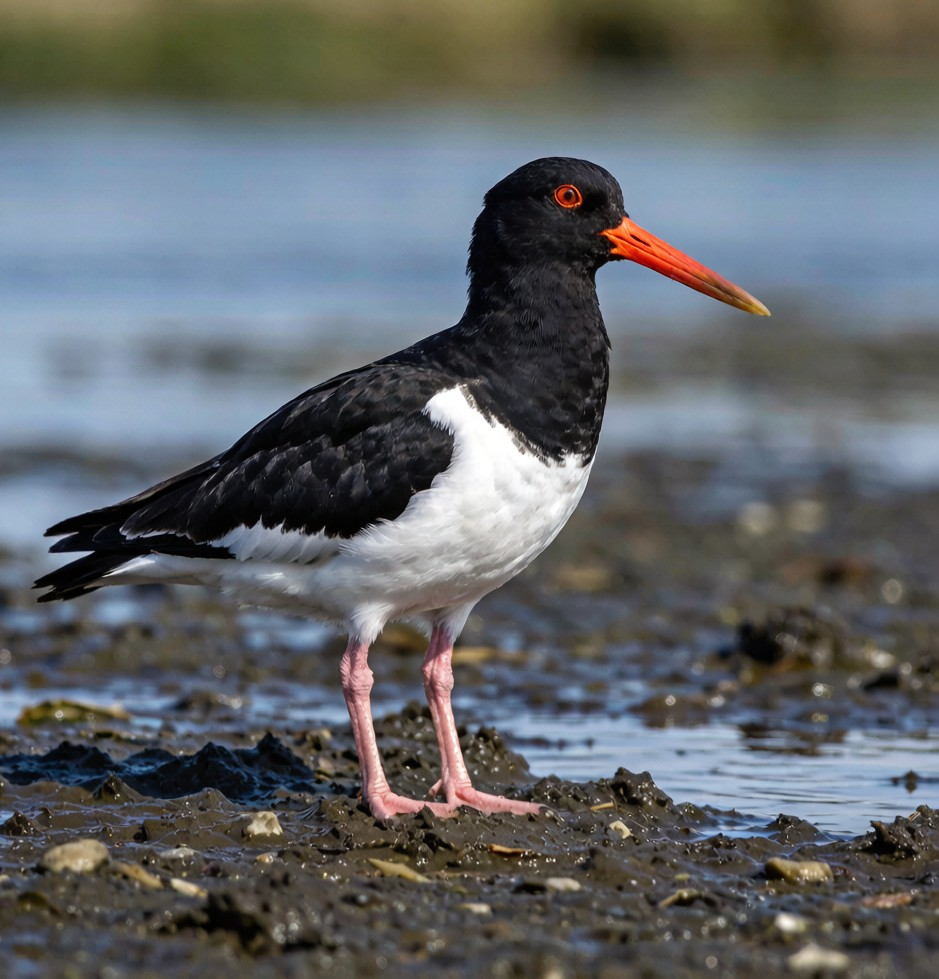
Introduction
The Eurasian Oystercatcher (Haematopus ostralegus) is one of the most recognizable wading birds of European coasts, instantly identified by its bold black-and-white plumage, long orange-red bill, and loud distinctive calls. With a breeding population of over 1 million pairs spanning from Iceland and Scandinavia to China, it is among the most abundant and successful shorebirds in the world. On European estuaries its high-pitched piping calls and dramatic aerial chases are a staple of the coastal soundscape.
Taxonomy and Evolution
The Eurasian Oystercatcher is classified in the family Haematopodidae within the order Charadriiformes. Three subspecies are recognized: H. o. ostralegus in Europe, H. o. longirostris from the Yellow Sea to Japan, and H. o. buturensis in Central Asia. The species was described by Linnaeus in 1758. Phylogenetic analysis shows it is most closely related to the African Oystercatcher with which it diverged during the Pleistocene. Its large range and varied diet have produced subtle morphological differences between eastern and western populations particularly in bill length.
Physical Characteristics
Eurasian oystercatchers are large waders, 42 to 48 cm long with a wingspan of 80 to 86 cm and a weight of 420 to 820 g. The plumage is boldly pied: jet black on the head, neck, upper breast, and upperparts in adults with white underparts, a white wing bar, and a white rump visible in flight. The bill is exceptionally long, 7 to 11 cm, and bright orange-red, flattened at the tip to pry open shellfish. The eye is crimson-red surrounded by a red orbital ring, and the legs are pinkish-white.
Habitat and Distribution
This species breeds on coastal beaches, shingle banks, saltmarshes, and rocky shores across Europe, and inland on river gravel bars, lake shores, and farmland in some regions. Wintering grounds include the same coastal habitats as well as muddy estuaries and harbors from Britain and Ireland south to West Africa. In Britain some populations have shifted from coastal shingle to inland breeding sites on farmland particularly in East Anglia where they nest on bare ground in silage fields. They are strongly territorial during the breeding season and return to the same nesting sites year after year.
Diet and Feeding Behavior
Oystercatchers feed primarily on bivalve mollusks such as mussels, cockles, and oysters, using their specialized bill to either stab into the shell and sever the adductor muscle or hammer the shell open. They also eat marine worms, crabs, limpets, and sea urchins, and in inland breeding areas earthworms and leatherjacket larvae. Individual oystercatchers specialize in particular techniques and this skill is passed from parent to chick. They are active day and night on estuaries with peak feeding in the 2 hours around low tide.
Reproduction and Life Cycle
Oystercatchers form monogamous pairs that can last for many years and return to the same territory each spring. The nest is a simple scrape in gravel, sand, or shingle sometimes lined with shell fragments or vegetation. The clutch of 2 to 4 eggs is laid from April to June and incubated by both parents for 24 to 27 days. Chicks are precocial and leave the nest within a day of hatching. They fledge at 28 to 35 days and are fed by parents for several weeks more. Predation of eggs and chicks by the red fox is a significant cause of breeding failure on lowland coastal sites.
Conservation Status
Listed as Near Threatened globally with European populations stable but the overall population in long-term decline. In Britain the breeding population is Amber-listed due to modest declines over recent decades. Primary threats include habitat loss at coastal breeding sites from coastal development and sea-level rise, disturbance by humans and dogs on beaches during breeding, and impacts of shellfish fishery management on food availability. The species is protected under the EU Birds Directive.
Fun Facts
The oystercatchers bill is not born fully formed: chicks hatch with a small soft bill that gradually lengthens and hardens reaching adult proportions by fledging. Individual oystercatchers develop personal techniques for opening shells and these learned skills can be recognized by researchers, effectively giving each bird a cultural signature. During aggressive territorial disputes they adopt a distinctive upright display posture showing the full extent of the white underparts and vocalizing loudly. Some oystercatchers are long-distance migrants with Scandinavian birds wintering as far south as West Africa.
[…] have a long bill. The avocet is the close relative of the Eurasian Oystercatcher (Haematopus ostralegus). That heavy shorebird shares the same order. Its stout, flat bill prises open shellfish. The avocet […]