 By st20113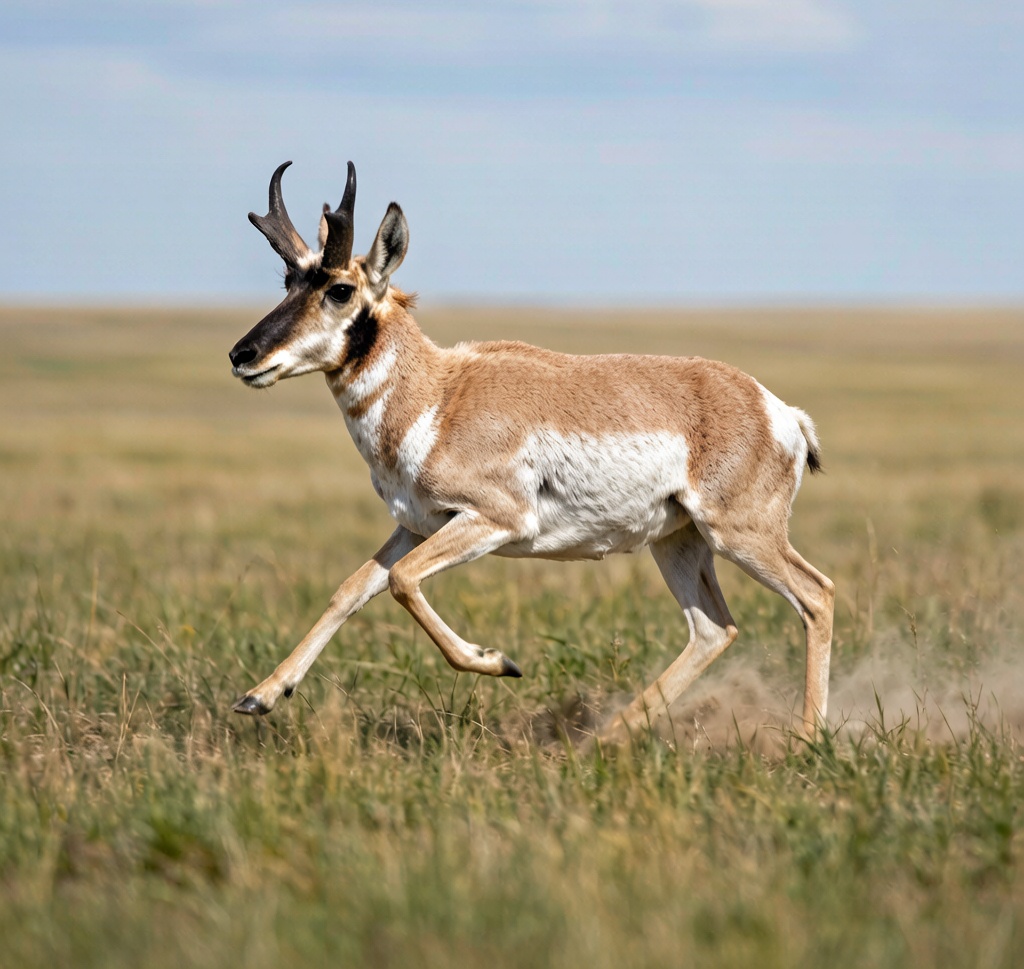
Introduction
The pronghorn (Antilocapra americana) is a unique North American mammal often called the American antelope, though it is not a true antelope. It is the fastest land animal in the Western Hemisphere, capable of sustained speeds over 80 kilometers per hour, and it evolved to outrun extinct Pleistocene predators. Found across the grasslands and deserts of western North America, the pronghorn is admired for its endurance, keen eyesight, and distinctive forward-curving horns. It remains the sole surviving member of its ancient family.
Taxonomy
The pronghorn is the only living species in the genus Antilocapra and the family Antilocapridae, a group that was once diverse across North America. Unlike true antelopes of the family Bovidae, pronghorns are more closely related to giraffes and okapis. Their nearest living relatives among bovids include the Saiga Antelope and various caprines, but the pronghorn’s lineage is distinct and isolated. This evolutionary uniqueness makes the species especially important to conserve as a one-of-a-kind survivor.
Physical Characteristics
Pronghorns stand 80 to 100 centimeters at the shoulder and weigh 40 to 65 kilograms. Both sexes usually bear horns, though male horns are longer and more prominently pronged; uniquely among horned mammals, the outer sheath is shed and regrown each year. Their reddish-tan coat features white underside, rump patch, and facial markings that flash as alarm signals. Built like long-distance runners, they have enlarged lungs, hearts, and tracheae, plus large eyes set high for a wide field of view, rivaling the vigilance of the Alpine Ibex on cliff edges.
Habitat
Pronghorns inhabit open grasslands, sagebrush steppe, and desert basins across western North America, from Canada to northern Mexico. They prefer wide, unobstructed landscapes where their speed and eyesight provide defense. They are well adapted to the Desert Ecosystem margins and cold high plains alike, migrating seasonally between summer and winter ranges where corridors remain intact. Their survival depends on open space, and fencing and development are major modern obstacles to their movement.
Diet
Pronghorns are mixed feeders, browsing and grazing on forbs, shrubs, and grasses, with a strong preference for nutrient-rich plants such as sagebrush, juniper, and various wildflowers. Their split upper lip helps them selectively nip tender shoots. Like the grazing Blue Wildebeest of Africa, pronghorns migrate to follow seasonal forage, though their migrations are among the longest of any land mammal in North America. They obtain much of their water from food and can go days without drinking.
Reproduction
Breeding occurs in late summer and early autumn. After a gestation of about seven to eight months, females give birth to one or two camouflaged fawns in early summer, often hiding them separately in vegetation for the first weeks. The fawns are remarkably precocious, able to run within days, an adaptation to open-country predators. Mothers nurse and defend their young, and family groups may join larger herds outside the breeding season. Males establish small territories and use scent marking and displays to attract females.
Conservation
Once numbering in the millions, pronghorns were reduced to fewer than 20,000 by the early 1900s due to overhunting and habitat loss, but conservation and regulated hunting have recovered populations to roughly 500,000 to 1 million today. They remain dependent on intact migration corridors, which are increasingly fragmented by roads and fences. While not as imperiled as some relatives, continued protection of open range is essential. Their top-speed lifestyle is comparable only to the Cheetah, the fastest land animal overall, which evolved similar adaptations on another continent.
Fun Facts
The pronghorn is the second-fastest land animal on Earth, after the cheetah, but unlike the cheetah it can maintain high speeds for miles rather than just seconds. Its eyes are among the largest of any North American ungulate, giving it vision sharp enough to spot predators kilometers away. The pronghorn sheds the outer sheath of its horns annually, a trait shared with no other horned animal. It evolved its incredible speed to escape the now-extinct American cheetah, a predator that disappeared about 12,000 years ago, leaving the pronghorn faster than anything that hunts it today.
[…] may use dozens of burrow openings across its territory. Today they share the open plains with the pronghorn and other grassland […]