 By st20113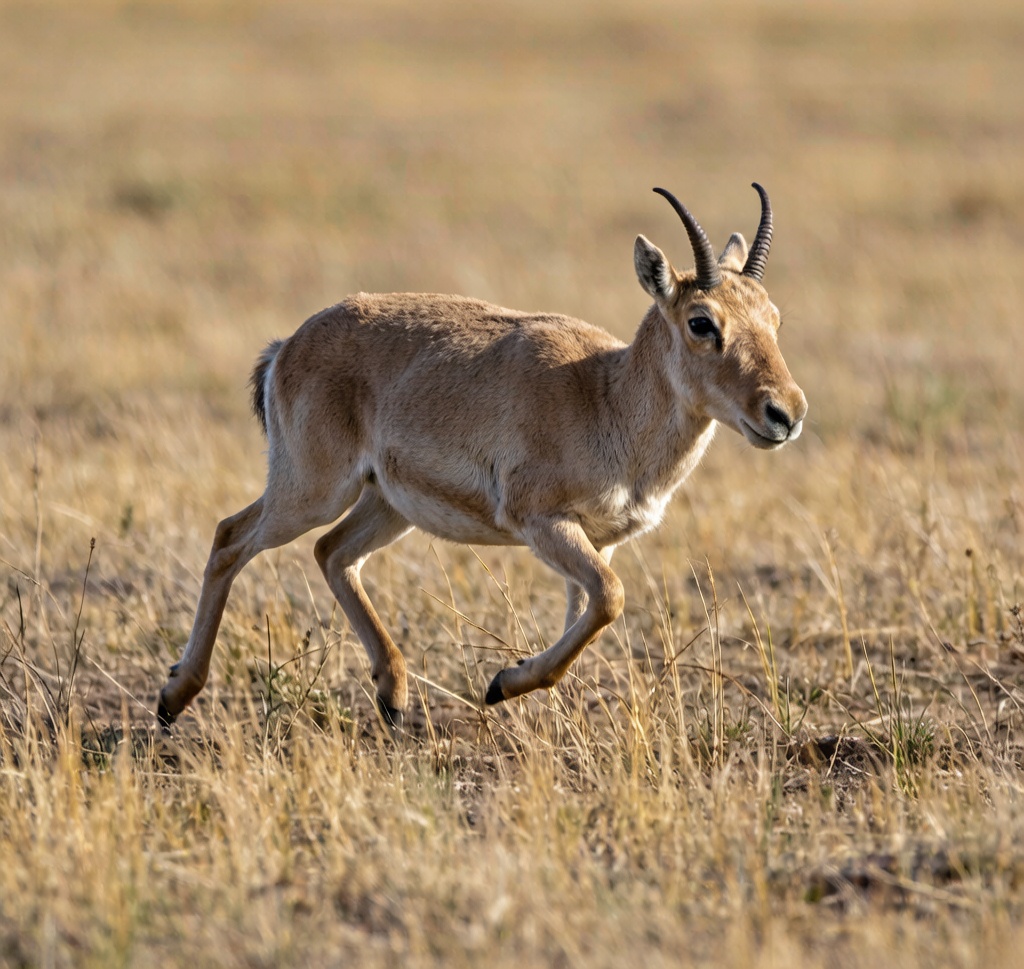
The saiga antelope (Saiga tatarica) is one of the most distinctive and ancient-looking mammals on Earth — a medium-sized antelope instantly recognizable by its extraordinary bulbous nose, an adaptation to the harsh, cold, and dusty environment of the Central Asian steppes. The saiga’s large, convoluted nasal passages warm and humidify inhaled air during winter and filter out dust during summer, enabling the animal to survive in extreme temperature ranges from minus 40 degrees Celsius in winter to plus 40 degrees in summer. Once roaming in vast herds across the Eurasian steppes from the Carpathian Mountains to Mongolia and China, the saiga suffered one of the most catastrophic population collapses in mammalian history during the late 20th century, declining from over one million individuals to fewer than 50,000 in little more than a decade. Conservation efforts have enabled partial recovery, but the species remains critically endangered.
## Physical Characteristics
The saiga is a relatively small antelope, standing 60 to 80 centimeters at the shoulder and weighing 26 to 69 kilograms, with males larger than females. The body is compact and robust, covered in short, coarse fur that is light brownish-yellow in summer and almost pure white in winter. The underbelly is lighter in both seasons. The saiga’s most distinctive feature is its enlarged, flexible, proboscis-like nose — a large, convex, downward-pointing structure with wide, hairy nostrils. This remarkable nose contains a complex system of convoluted bones, scroll-like turbinates, and mucus-lined passages that warm and humidify cold air in winter and filter dust in summer. Males possess semi-translucent, wax-colored horns that are long (up to 30 centimeters), ringed, and slightly lyre-shaped, curving backward and then slightly inward at the tips. Females lack horns. The eyes are large and dark, and the ears are relatively small. The legs are long and slender, adapted for sustained running across open terrain.
## Habitat and Distribution
The saiga inhabits the open, arid grasslands, semi-deserts, and steppes of Central Asia. Two subspecies are recognized: the nominate form, Saiga tatarica tatarica, found in Russia (Kalmykia and the northern Caspian region), Kazakhstan, Uzbekistan, and Turkmenistan; and the Mongolian saiga, Saiga tatarica mongolica, restricted to a small area in western Mongolia. The species is migratory, undertaking long-distance seasonal movements in search of forage and water. Summer ranges are typically in northern, more productive steppe areas, while winter ranges are in southern, warmer semi-desert regions where snow cover is shallower and forage more accessible. Saigas avoid rugged terrain, dense vegetation, and deep snow, favoring flat, open landscapes where they can detect predators from a distance and flee at high speed.
## Behavior and Diet
Saigas are highly social, forming large aggregations — sometimes numbering in the thousands — particularly during migration and the rut. They are primarily diurnal, feeding in the early morning and late afternoon, and resting during the heat of midday in summer. Their diet consists of a wide variety of grasses, herbs, shrubs, and lichens, with over 150 plant species recorded as food items. Saigas are exceptionally fast runners, capable of sustained speeds exceeding 80 kilometers per hour, which they use to escape predators such as wolves. Their migrations, historically covering hundreds of kilometers, are among the most spectacular wildlife movements in Asia, though many migration routes have been disrupted by fences, roads, and agricultural development.
## Reproduction
The saiga rut occurs in late November to early December, when males gather harems of females and defend them vigorously from rival males, engaging in intense horn-clashing battles. A single male may control a harem of up to 30 females. After a gestation period of approximately 140 to 150 days, females give birth in late spring (April to May), typically to one or two fawns — twins being common in healthy populations. Newborn saiga fawns are precocial, able to stand and follow their mother within hours of birth. They nurse for approximately three to four months and become independent at eight to ten months. Sexual maturity is reached at eight months for females and two years for males. Wild saigas typically live six to ten years.
## Conservation
The saiga is classified as Critically Endangered on the IUCN Red List. The population collapsed by more than 95 percent in the 1990s due to uncontrolled poaching for meat and horns — the latter valued in traditional Chinese medicine — following the collapse of the Soviet Union. In 2015, a catastrophic mass die-off killed over 200,000 saigas in central Kazakhstan — more than 80 percent of the global population at the time — caused by a bacterial infection triggered by unusually warm and humid weather conditions. Conservation efforts, including anti-poaching patrols, protected areas, and international cooperation under the Convention on Migratory Species, have enabled partial recovery. The global population was estimated at approximately 300,000 individuals in 2022, up from the low of fewer than 50,000 in the early 2000s.
[…] walleri walleri and the larger Litocranius walleri sclateri. It is most closely related to the Saiga Antelope and other slender antelopes within its tribe, though its distinctive form sets it apart from every […]
[…] closely related to giraffes and okapis. Their nearest living relatives among bovids include the Saiga Antelope and various caprines, but the pronghorn’s lineage is distinct and isolated. This evolutionary […]