 By st20113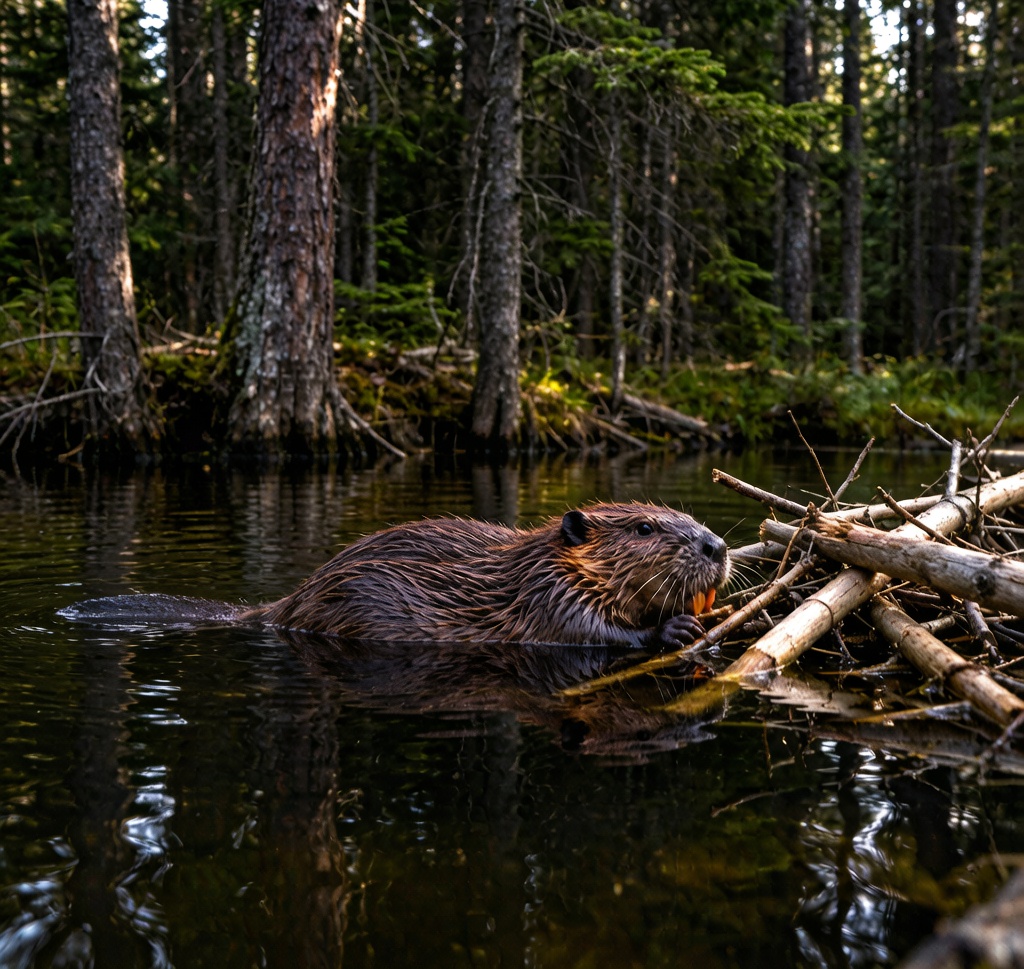
Introduction
The North American beaver (Castor canadensis) is the continent’s largest rodent, a semiaquatic engineer whose dam-building has reshaped the North American landscape. Weighing 15 to 32 kilograms, the beaver is built for a life spent largely in and around water. Its most iconic feature—a broad, flat, scaly tail—serves as a rudder, a fat reserve, a prop, and a warning device. Beavers played a pivotal role in early colonial history: the hunger for beaver pelts drove much of the exploration and settlement of the continent’s interior during the 17th and 18th centuries. Nearly driven to extinction by the fur trade, the beaver has made a dramatic comeback, with populations now numbering in the tens of millions. As a keystone species, beaver wetlands support hundreds of other species, making it one of the most ecologically important animals in North America.
Taxonomy
The North American beaver belongs to the genus Castor within the family Castoridae. The genus contains only two living species: Castor canadensis and Castor fiber, the Eurasian beaver. These species diverged from a common ancestor approximately 7.5 million years ago and do not interbreed successfully. The genus name Castor is the Greek word for beaver and also the name of one of the Gemini twins in mythology. The beaver family was once far more diverse, containing numerous extinct species across North America, Europe, and Asia. Like the Capybara of South America, the beaver is a large rodent that has evolved sophisticated adaptations for semiaquatic life.
Physical Characteristics
The beaver’s dense, waterproof coat consists of two layers: a fine woolly undercoat that traps air and insulates in cold water, and a coarser outer layer of long guard hairs that shed water. The fur is dark brown to reddish-brown. The broad, paddle-shaped tail—up to 30 centimeters long—functions as a rudder, a support when sitting upright to gnaw, a counterweight during feeding, a fat storage organ, and a warning device that can be slammed against water to alert nearby beavers of danger. The beaver’s teeth are among its most remarkable features: large, bright orange incisors reinforced with iron that never stop growing and must be worn down through constant use.
Habitat
Beavers inhabit most forested regions of North America, from Alaska and northern Canada southward through the continental United States and into northern Mexico. The species requires only a source of permanent water surrounded by trees. Beavers are absent from desert regions of the American Southwest and the tundra of the far north, where trees are too scarce. The beaver’s dam-building is among the most spectacular examples of animal architecture in the world. Using branches, mud, rocks, and vegetation, beavers construct dams to raise water levels, creating the deep, calm ponds they need for protection and food storage. The largest beaver dams can stretch hundreds of meters and are visible from space.
Diet
The beaver is primarily a herbivore, feeding on the bark, twigs, leaves, and roots of trees and shrubs, with a preference for the inner bark of aspens, poplars, willows, birch, and alder. In summer, it supplements with aquatic plants, grasses, and roots. A beaver colony’s food cache—a pile of branches stored underwater near the lodge—serves as a critical winter food supply, since the pond surface freezes solid but water beneath remains unfrozen. Beavers do not hibernate and remain active throughout winter, feeding on cached branches through the frozen surface. The Gray Wolf is another keystone species that, like the beaver, fundamentally reshapes its ecosystem through its activities.
Reproduction
Beavers are monogamous and form long-term pair bonds, with both parents raising the young and maintaining the dam and lodge. Breeding occurs in January or February in northern regions, with a gestation of approximately 105 to 107 days, after which 2 to 4 kits are born in April or May. Newborn beavers are fully furred and can swim within a day or two. Kits remain in the lodge for the first several weeks, nursing for 6 to 10 weeks before being weaned. Young beavers remain with their parents through the first winter, helping maintain the dam and care for the next litter before dispersing at around two years of age to establish their own territory.
Conservation
The North American beaver is listed as a species of Least Concern by the IUCN, with populations in the millions. By the mid-19th century, trapping had reduced beaver populations to a small fraction of their historical numbers, essentially eliminating the species from most of its range east of the Mississippi. Thanks to protections, trapping regulations, and reintroduction programs, beaver populations have rebounded spectacularly. Beavers are now recognized as a keystone species whose dam-building creates entire wetland ecosystems benefiting dozens of other species—from fish and amphibians to waterfowl and songbirds. Beaver ponds also recharge groundwater aquifers, reduce downstream flooding, and improve water quality by trapping sediment and nutrients.
Fun Facts
Beaver incisors grow continuously throughout their lives at a rate of approximately 10 centimeters per year, with iron-rich enamel giving them their distinctive orange color and exceptional hardness. Beavers can remain submerged for up to 15 minutes while working underwater, plugging their mouth behind their incisors to use their teeth like chisels. Like the Sea Otter, the beaver has evolved specialized teeth and jaw structures perfectly suited to its ecological niche. The beaver’s flat tail comprises up to half of the animal’s total body fat and provides crucial energy during long winter months.
[…] during the harsh winter months. Snowshoe Hares may compete with other herbivores like the Beaver for bark and twigs in shared […]
[…] lands, and ranchlands managed with non-lethal methods. The species is strongly associated with beaver habitats in riparian zones where moisture supports the grasses that form the bulk of its […]
[…] during cold spells and shelter for many other alpine species. The species is often associated with beaver habitats near alpine lakes and […]