 By st20113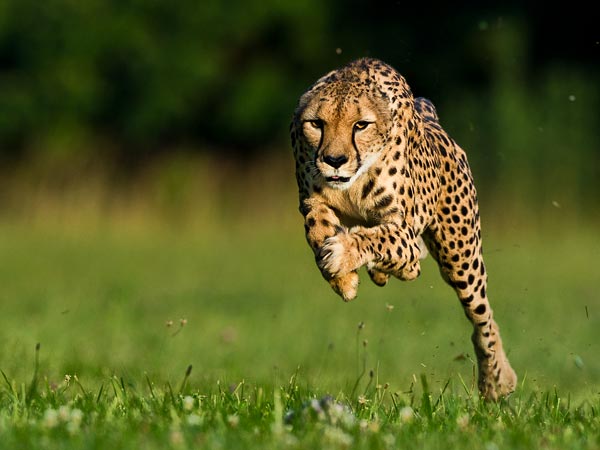
The Cheetah (Acinonyx jubatus), the fastest land animal on Earth, is one of the most iconic predators of the African savanna. With its slender, aerodynamic body, distinctive black “tear marks” running from the eyes to the mouth, and a coat covered in solid black spots, the cheetah is instantly recognizable and uniquely adapted for high-speed pursuit hunting. Unlike other big cats, the cheetah cannot roar; instead, it communicates through a variety of chirping and purring vocalizations.
Physical Characteristics
The cheetah’s body is a masterpiece of evolutionary engineering for speed. Adults stand approximately 70–90 cm (28–35 inches) at the shoulder and weigh between 35–72 kg (77–159 lbs), with males typically larger than females. Its spine is unusually long and flexible, acting like a spring that flexes and extends during a sprint. The legs are also elongated, with a unique semi-retractable claw structure that provides exceptional traction on the ground — a feature found in no other living cat species.
The cheetah’s spotted coat serves as excellent camouflage in the dry grass and scrubland of its habitat. The characteristic black “tear lines” running from the inner corners of the eyes down to the mouth are believed to help reduce glare during daytime hunts, improving focus on prey. Unlike leopards and jaguars, cheetahs have a simpler spot pattern with no rosettes — only evenly distributed solid black spots approximately 2–3 cm in diameter.
Speed and Hunting Behavior
The cheetah’s claim to fame is its extraordinary speed. Capable of accelerating from 0 to 96 km/h (60 mph) in just three seconds — faster than most sports cars — it can reach top speeds of 80–120 km/h (50–75 mph) during a chase. However, this speed comes at a significant physiological cost. After a high-speed chase, a cheetah must rest for up to 30 minutes to regulate its body temperature and recover from extreme exertion.
Cheetahs are primarily diurnal hunters, preferring the cooler hours of early morning and late afternoon. They employ a distinctive hunting strategy: first stalking prey from a relatively close distance (often within 100 meters), then launching into a explosive sprint to close the gap. Unlike wolves or wild dogs that chase prey to exhaustion over long distances, cheetahs rely on sheer speed over short distances — typically 200–500 meters — to overtake and trip their prey before delivering a suffocating throat bite.
Habitat and Diet
Cheetahs are found primarily in sub-Saharan Africa, with a small population of Asiatic cheetahs surviving in Iran. They inhabit a variety of open environments including savannas, grasslands, shrublands, and semi-desert regions where their speed is an advantage. Historically, cheetahs ranged widely across Africa, the Middle East, and Central Asia, but their range has contracted dramatically due to habitat loss and human conflict.
Their diet consists almost exclusively of small to medium-sized ungulates, with gazelles, impalas, springboks, and Thomson’s gazelles being preferred prey. Smaller animals such as hares and ground birds are also taken, particularly by female cheetahs hunting alone to feed their cubs. An adult cheetah consumes approximately 2–4 kg (4–9 lbs) of meat per day, and despite their hunting success, they frequently lose kills to larger predators such as lions, leopards, and hyenas.
Social Structure
Unlike most cats, cheetahs display fascinating social behaviors. Male cheetahs often form coalitions — groups of two to three brothers or unrelated males that stay together for life. These coalitions are highly cooperative and significantly improve the males’ chances of securing and defending territory against larger competitors. Female cheetahs, by contrast, are solitary hunters and raise their cubs alone, typically caring for 2–5 cubs in each litter. Cubs remain with their mother for 13–20 months, learning essential hunting and survival skills before dispersing.
Conservation Status
The cheetah is classified as Vulnerable by the International Union for Conservation of Nature (IUCN), with an estimated wild population of only 6,500–7,000 individuals — a dramatic decline from historical numbers estimated at over 100,000 a century ago. The primary threats facing cheetahs include habitat loss, human-wildlife conflict (farmers often kill cheetahs to protect livestock), the illegal wildlife trade in cheetah cubs (particularly for the exotic pet market in the Middle East), and genetic inbreeding due to a severe population bottleneck thousands of years ago.
Conservation efforts focus on protecting key habitats, establishing wildlife corridors, reducing human-cheetah conflict through community-based programs, and cracking down on the illegal cheetah trade. Several African nations have established cheetah conservation programs that combine ecological research with community engagement and eco-tourism development.
Cultural Significance
Cheetahs have captured human imagination for millennia. Ancient Egyptians kept cheetahs as hunting companions as early as 3000 BCE, and Mughal Emperor Akbar was famously devoted to his hundreds of pet cheetahs. In contemporary culture, cheetahs remain beloved symbols of speed, grace, and the wild beauty of Africa. They are featured prominently in conservation branding, educational programs, and wildlife documentaries, serving as ambassadors for the broader cause of African wildlife conservation.
The cheetah’s remarkable speed and elegant form have also inspired scientific research into biomechanics, robotics, and sustainable engineering — demonstrating how even the most specialized biological structures can inform human innovation and deepen our appreciation for the natural world.
hunting success rate exceeding 80% — dramatically higher than the Lion (approximately 30%) or the Cheetah (approximately 50%). This efficiency is entirely dependent on the pack; cooperative hunting
[…] of that genus. Its closest living relatives are the jaguarundi of Central and South America and the Cheetah of Africa and Iran. Despite its large size, the cougar purrs like a domestic cat and cannot […]
[…] suede,” and for bushmeat in some regions. Natural predators include the African lion, cheetah, and African wild dog. Protected areas such as Tanzania’s Ruaha National Park and […]
[…] so fast that fish have little chance to escape, a hunting efficiency comparable to the sprint of a cheetah on land. Like brown bears, which catch fish in mountain streams, kingfishers are specialists of the […]