 By Iris
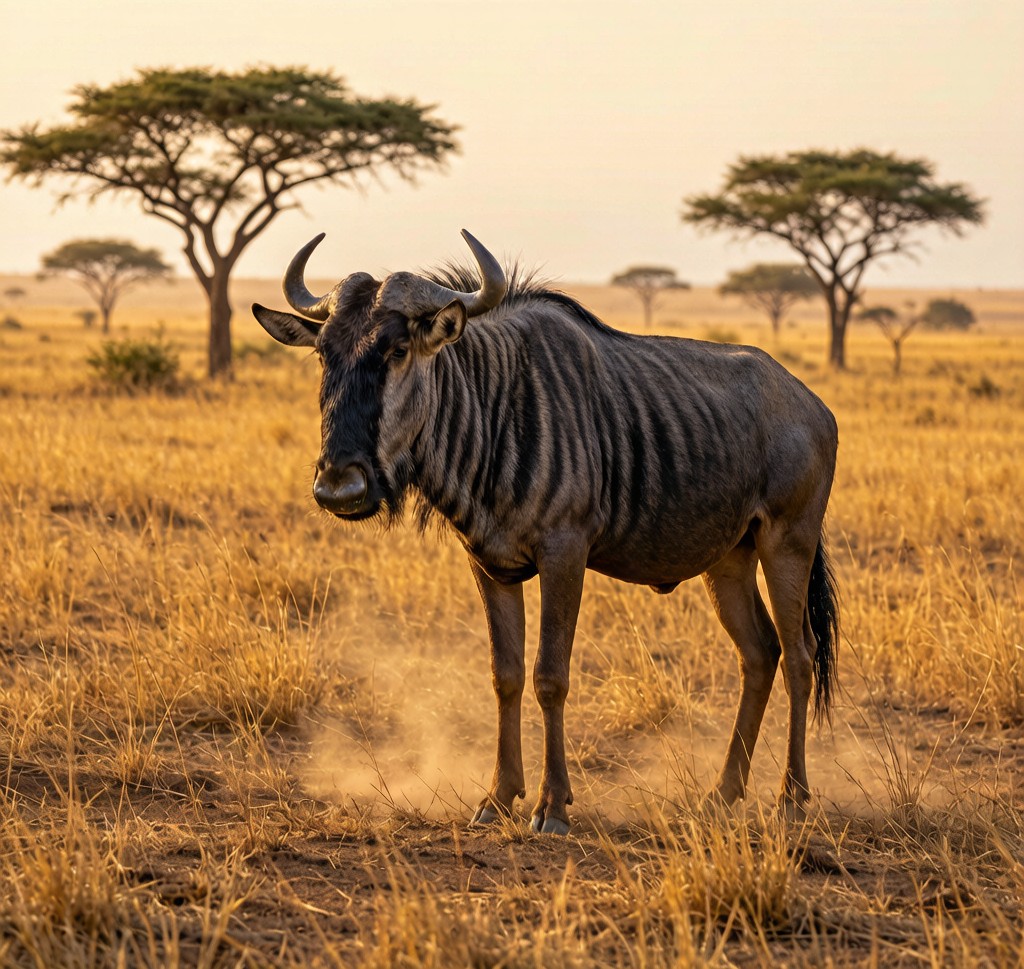
Connochaetes taurinus | Blue Wildebeest
Species Profile · Bovidae
Blue Wildebeest
Two million animals can still be in trouble, because one fence across a dry season route ends the walk.
Least Concern
Weight
Females
Speed
Migration
Calves
Rating
Dust, noise and water
The animal that moves in a million and a half
A million and a half animals walk across East Africa in one herd each year, and most people never see it. Blue wildebeest are the engine of that herd. They are antelope, though they look like cattle with a ragged coat. Their shoulders sit high, the muzzle is broad, and the horns curl out and up.
Few wild mammals remain so numerous. That number hides a fragile arrangement, because the herd needs open grass and a road that no fence blocks. Fences and farms cut both. Serengeti plains still carry the species, and its future there depends on one corridor.
People cross the world to watch the crossing at the Mara River. What they remember afterwards is dust, noise and water.
Two names, one genus
Where the brindled gnu sits
Its scientific name is Connochaetes taurinus, and the genus holds the African gnus. Two common names travel with the animal, common wildebeest and brindled gnu. That second name points at the dark bands across the flanks. Wildebeest sit among the antelope, in the cattle family.
Biologists have named several subspecies, although the exact boundaries between those forms are still argued over today. One of these forms lives in Zambia, far west of the main herds. That form is few in number and listed as Vulnerable. Unlike the African Wild Dog, which hunts in short relays, this animal survives by walking all day.
Such a contrast shows how a hunter and a grazer can share one plain. Each takes a different share.
Horns, boss and stripes
Reading a wildebeest at close range
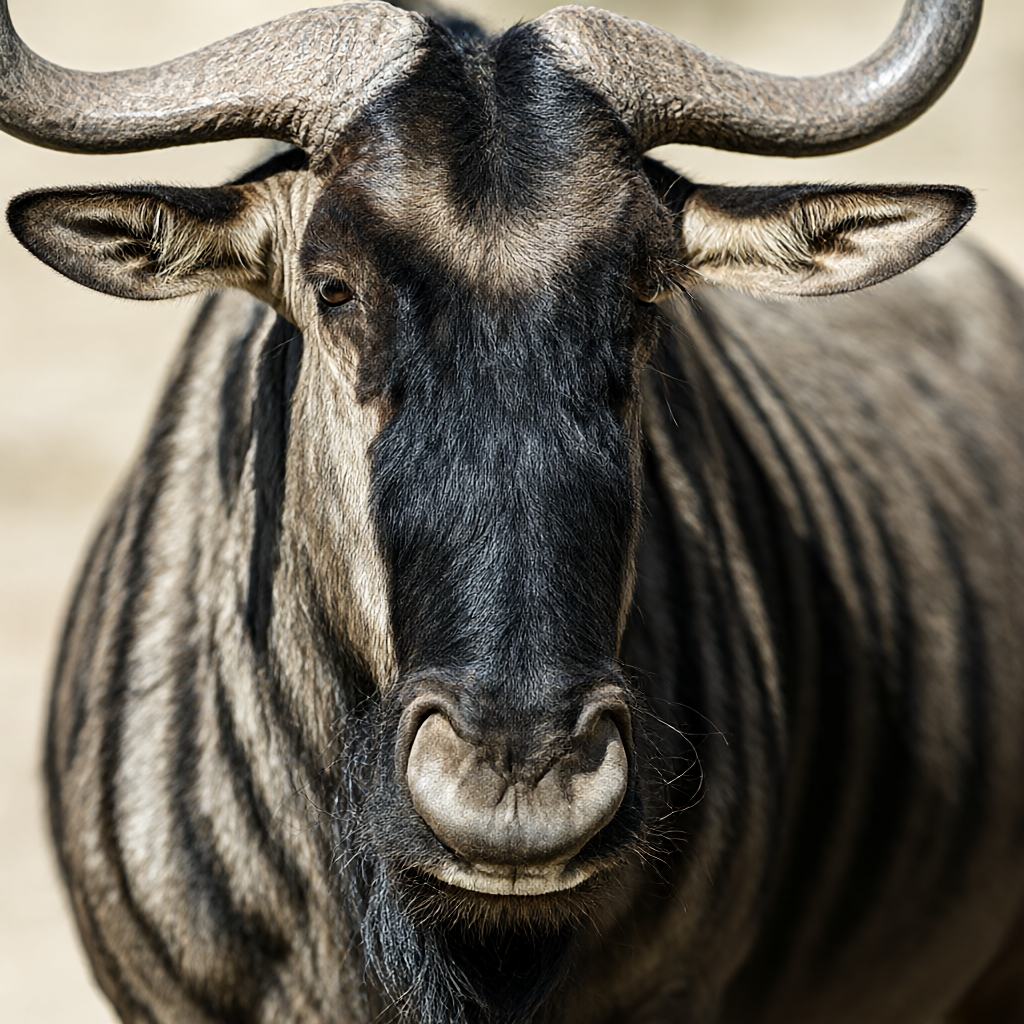
Males weigh 140 to 290 kg, and females 110 to 180 kg. Males also run darker than females and carry heavier horns. Its coat reads blue grey in cold light, brown grey in dust. Dark stripes cross the shoulders and fade along the ribs.
Those bands may help one animal read another at close range. A long ox like head carries a broad muzzle, and the jaw is built for cropping short grass. Both sexes grow horns that drop, sweep outward and then turn up. At the base the two horns meet in a heavy boss, which takes the shock of a butt.
A sprint can reach 80 km per hour, yet the herd prefers a tireless walk. Muscle sits forward, over the neck and shoulder, and that weight drives the horns.
1
2
3
Grass and a free road
Where the herd can still walk
Open grassland with short grass makes the core of the range, and the herd stays where that turf holds. The Serengeti and the Mara together hold the largest herd. Rain decides where that herd stands in any month. Because the plains dry northward, the animals follow the green flush.
The round trip runs 800 to 1,000 km each year. Water shapes the route as much as grass does. Rivers block the herd, and the Mara is the worst of them, because the banks are steep and the current fast. Each year the herd must swim, and crocodiles wait in the current.
Some drown there, and many calves never reach the far bank. Herds in southern Africa live in drier bush, where the grass comes in patches.
Cropped turf, nothing else
What it eats, and what follows it
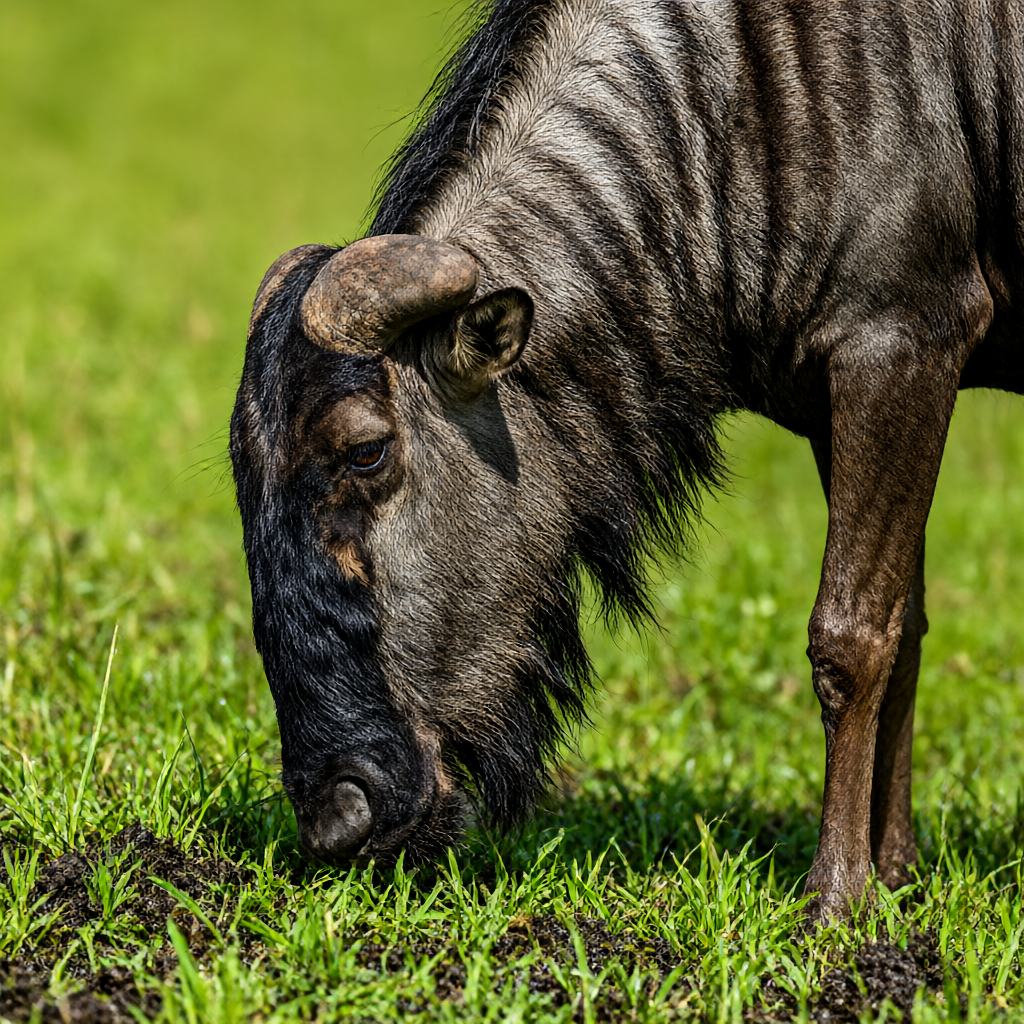
Short grass is the whole diet, and the animal crops it close to the soil. A broad muzzle lets it bite low without lifting the head. Herds graze in the morning and rest through the hot hours. Because so many mouths work one patch, the grass is gone in days.
That pressure forces the herd to move, which spreads the load across the plain. Although grazing keeps the turf short, it also stops scrub from taking the open ground. Other grazers follow behind, since fresh shoots come up in the cropped grass. The Ostrich walks the same plain and takes insects and seeds, while this animal takes grass and nothing else.
Water matters too, so the herd never strays far from a river or a pan. Teeth grind rather than cut, since nothing in the diet needs shearing.
Three weeks of calves
Why every birth lands at once
Calving is packed into 2 or 3 weeks between January and March. Up to 500,000 calves arrive. No other large mammal in Africa crowds births so tightly.
The timing works as a defence, because a hunter can only eat so much. Predators digest slowly, so the surplus of calves outruns the appetite of lions, hyenas and every other hunter. New calves stand within minutes and run soon after.
By the time the herd turns north, the young can hold the pace. Cheetahs take mostly calves, while hyenas can run down a full grown adult. Lions prefer adults, and one lion will pass other prey for this.
Least Concern, local losses
What the Red List hides
The Red List places the species in the Least Concern band. Between 1.5 and 2 million animals live in East Africa, yet the global picture still looks steady. That figure hides sharp local losses. Numbers in South Africa have fallen far below historic levels.
Fences cut old routes, and farms take the dry season range. A herd that cannot reach water in a drought dies on the spot. Rainfall is less predictable, and that threatens the timing of the migration. Drought kills many animals.
Work to protect the species centres on corridors rather than fences. Keep the road open and the herd can still find grass after a failed rainy season or a dry year.
Side by side
How It Compares
| Trait | Blue Wildebeest | African Wild Dog |
|---|---|---|
| Weight | 140-290 kg | 18-30 kg |
| Group | herds of thousands | packs of 6-20 |
| Food | short grass only | meat, hunted daily |
| Speed | 80 km/h burst | about 60 km/h |
| Young | 500,000 calves in weeks | 4-16 pups a litter |
| Standing | Least Concern | Endangered |
Common misreadings
What People Get Wrong
- Many people picture the migration as a single mass that crosses one river each year. Herds form a moving patchwork, yet the river crossing is the only part most cameras record.
- Many guides describe the herd as a resident population that stays on one plain. These animals cover 800 to 1,000 km a year, yet they return to the same calving ground.
- Film footage suggests that crocodiles kill most of the calves at the crossing. Drowning and trampling take a heavy share, while predators digest slowly and cannot eat every calf.
Going further
Sources and Further Reading
Five things to remember
Quick hits
- A sprint can reach 80 km per hour.
- Calves stand within minutes of birth.
- Up to 500,000 calves arrive in weeks.
- Crocodiles wait at the Mara crossing.
- Brindled gnu refers to the striped flanks.