 By st20113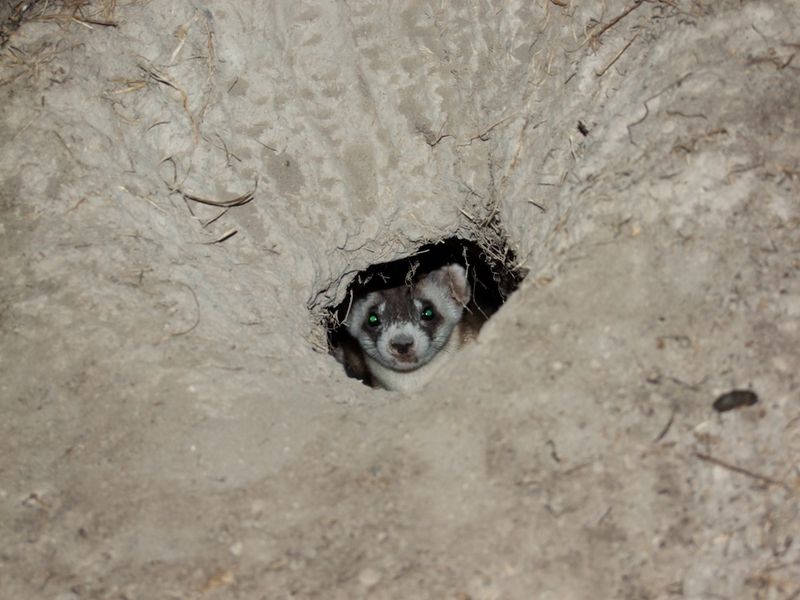
Introduction
The black-footed ferret (Mustela nigripes) is a slender, nocturnal member of the weasel family endemic to the North American Great Plains. Famous as one of the most endangered mammals in the United States, it depends almost entirely on prairie dogs for food and shelter. Once thought extinct, the species was rediscovered in 1981 and brought back from the brink through intensive captive breeding and reintroduction efforts. Its recovery remains fragile, but it stands as a powerful symbol of what focused conservation can achieve on the American prairie.
Taxonomy
Black-footed ferrets belong to the family Mustelidae, the same group as weasels, otters, and badgers. They are most closely related to the European polecat and the Siberian polecat, from which they may have descended. The species is monotypic, with no recognized subspecies. Genetic studies have guided captive breeding to maintain diversity in the small recovered population, ensuring that later generations are not too closely inbred despite the tiny number of founders. This careful management has allowed the species to persist where it would otherwise have vanished completely.
Physical Characteristics
Adult black-footed ferrets measure 45 to 60 centimeters including a bushy tail and weigh 0.9 to 2.5 kilograms, with males larger than females. They have a pale yellowish buff coat, a black mask across the eyes, black legs and feet, and a black-tipped tail. This coloration helps them blend into the dim light of prairie dog burrows. Their long, flexible bodies are perfectly shaped for chasing prey through narrow underground tunnels.
Habitat
Black-footed ferrets live exclusively in prairie dog colonies across shortgrass and mixed-grass prairies. They do not dig their own burrows but take over abandoned prairie dog tunnels, where they sleep, raise young, and escape predators. Their entire distribution mirrors that of prairie dogs, which once covered millions of hectares of the Great Plains. A single ferret family may use dozens of burrow openings across its territory. Today they share the open plains with the pronghorn and other grassland wildlife.
Diet
Prairie dogs make up more than 90 percent of the black-footed ferret’s diet. A single ferret may consume over 100 prairie dogs in a year, and it relies on them not only for food but also for shelter. Ferrets hunt at night, sneaking into burrows to catch sleeping rodents. They kill prey with a precise bite to the back of the skull, then retreat to a side tunnel to feed. When prairie dogs are scarce, they may take ground squirrels, mice, or rabbits, and they face competition and predation from the red fox and the gray wolf.
Reproduction
Breeding occurs in spring, after females emerge from winter dormancy. After a gestation of about 41 to 45 days, a litter of three to five kits is born blind and helpless in a prairie dog burrow. Kits open their eyes at about a month and begin venturing outside by midsummer. The mother moves her litter between burrows to keep them safe from floods and predators. Young ferrets disperse in autumn to find their own territories, often traveling several kilometers across the prairie.
Conservation
Once reduced to just 18 individuals, the black-footed ferret is a celebrated conservation success, though it remains one of the rarest mammals on Earth. Captive breeding at facilities like the National Black-footed Ferret Conservation Center has produced thousands of animals for release. Reintroduced populations now exist at dozens of sites, but they remain vulnerable to sylvatic plague and habitat loss. Because prairie dogs are also killed by the same plague, protecting both species together is the central challenge. Ongoing vaccination and monitoring are essential to its survival.
Fun Facts
The black-footed ferret was once declared extinct twice before survivors were found. A ferret can sleep for up to 21 hours a day to conserve energy. It performs a dizzying war dance to confuse prey before striking. Despite their fierce look, captive-born ferrets helped save the entire wild population from a single genetic bottleneck. Each ferret has a unique facial mask pattern, allowing biologists to identify individuals from photographs in the wild.