 By Iris
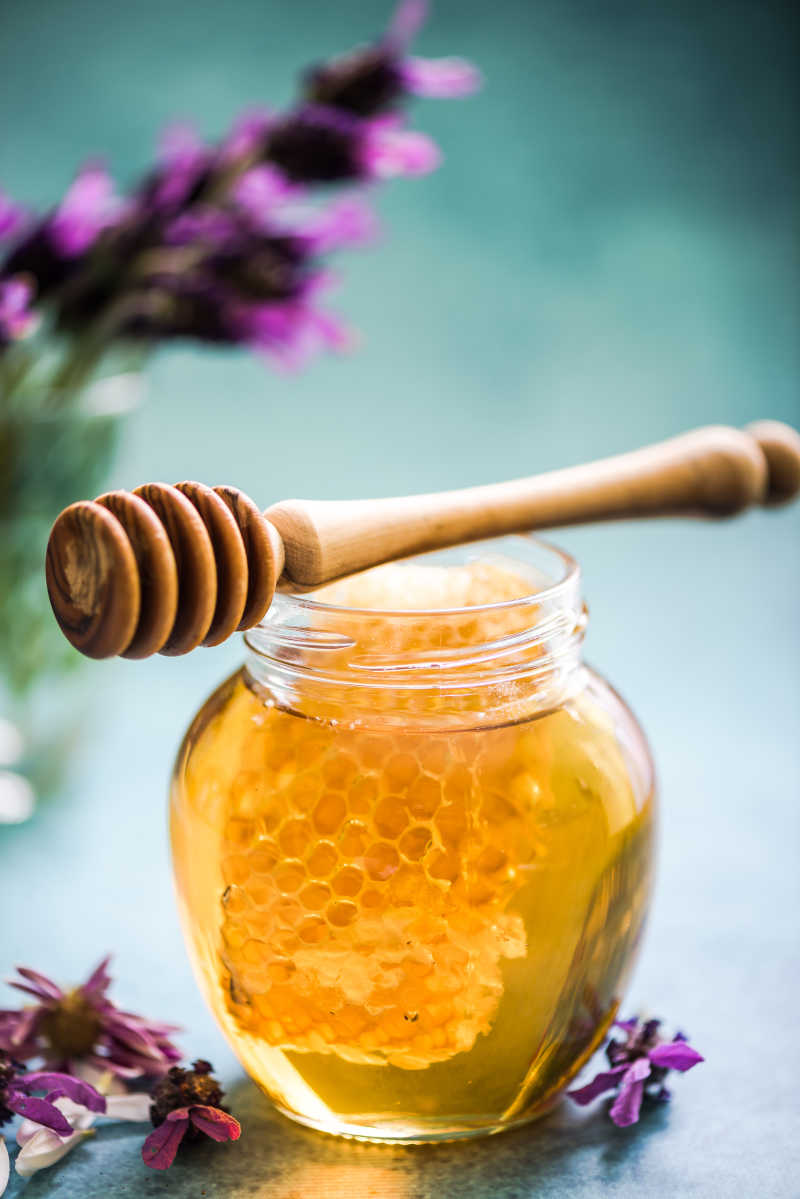
Apis mellifera | Honey Bee
Species Profile · Apidae
Honey Bee
One insect cannot live alone, because the colony reads flowers and holds its heat as a single body.
Least Concern
Workers
Queen
Eggs a day
Honey store
Forage range
Rating
A nest, not a single insect
The colony that acts as one body
A honey bee nest works like one animal with thousands of bodies. One queen lays every egg. Her daughters do the rest, building wax, guarding the door and nursing young. Few insects have travelled so far with us.
People have kept these bees for honey for thousands of years, because the habit shaped farming across three continents. The species began in Europe, Africa and western Asia. Sailors and farmers carried it to the Americas and Australia, and the insect failed only on the frozen south. This spread made it a crop partner and a rival to wild bees.
Crops gain, yet wild bees lose ground where hives crowd. Bees carry pollen for 70 to 80 percent of flowering plants, a share no other insect matches.
One genus inside Apidae
Where the honey bee sits
Honey bees form a small genus inside the family Apidae. Its scientific name is Apis mellifera, a label that means honey carrier. That name misleads, because the insect carries nectar rather than honey. Several close cousins live in Asia, and people manage one of them for honey too.
That family also holds bumblebees, orchid bees and many lone species. Social habit sets this bee apart. Wild nests once hung in hollow trees, rock cracks and wall spaces. Beekeepers offer wooden boxes now, though the insect still picks its own site.
The Wool Carder Bee nests alone and scrapes plant hairs for lining, while this species winters as a crowded nest with stored food. Both are bees, yet only this one keeps a larder, rears young in shifts and holds the nest warm through winter.
Hairs, baskets and four wings
What the body is built to do
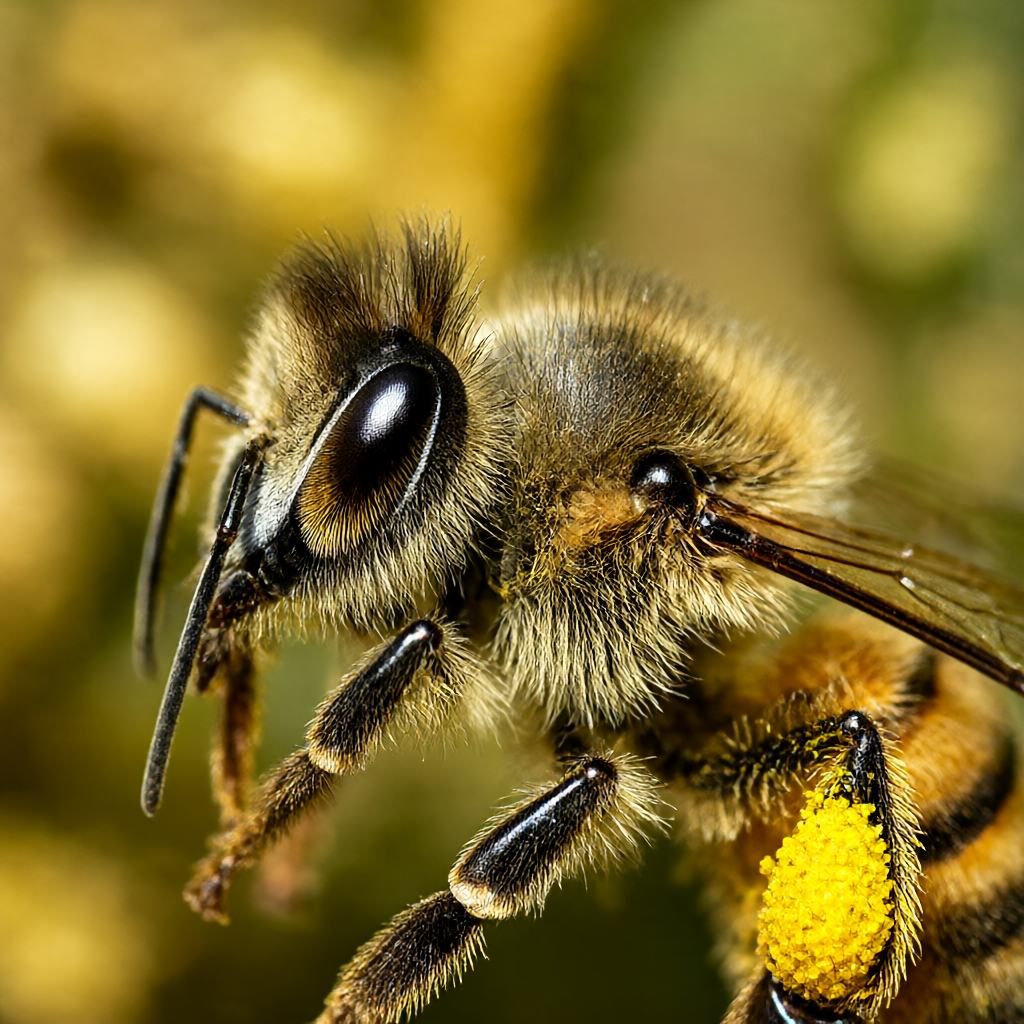
Workers measure 10 to 15 mm, and queens reach 18 to 20 mm. Fine hairs cover the body and trap pollen grains. Three body parts divide the work of living. Two compound eyes spot motion, while three small eyes read light levels.
Amber and black bands cross the abdomen. Hind legs carry pollen baskets, concave plates that hold a packed load. Wings beat 200 times a second. That coat also holds heat, because a hive stays near 35 C in summer.
Workers come home dusty, loaded and often far from the nest. Fast wingbeats carry her at 24 km/h, and the same flight muscles warm the hive on a cold night.
1
2
3
Hollow trees and wooden boxes
Where a nest can survive
Warm summers and steady flowers decide where a hive can live. Cool woodland, grassland, farmland and city garden all qualify. Cavities matter more than looks, since the brood needs warmth.
Hollow trees once gave the best site, high above most hunters. Beekeepers truck hives from field to field. Because the bees eat through their stores in a bad year, keepers leave extra honey or feed sugar syrup.
That traffic spreads the insect far past the range it reached alone. Desert and rainforest hold fewer nests, though both support some. One dry spell empties the flowers, and a hive can starve within weeks.
Nectar, pollen and ripe honey
What the colony lives on
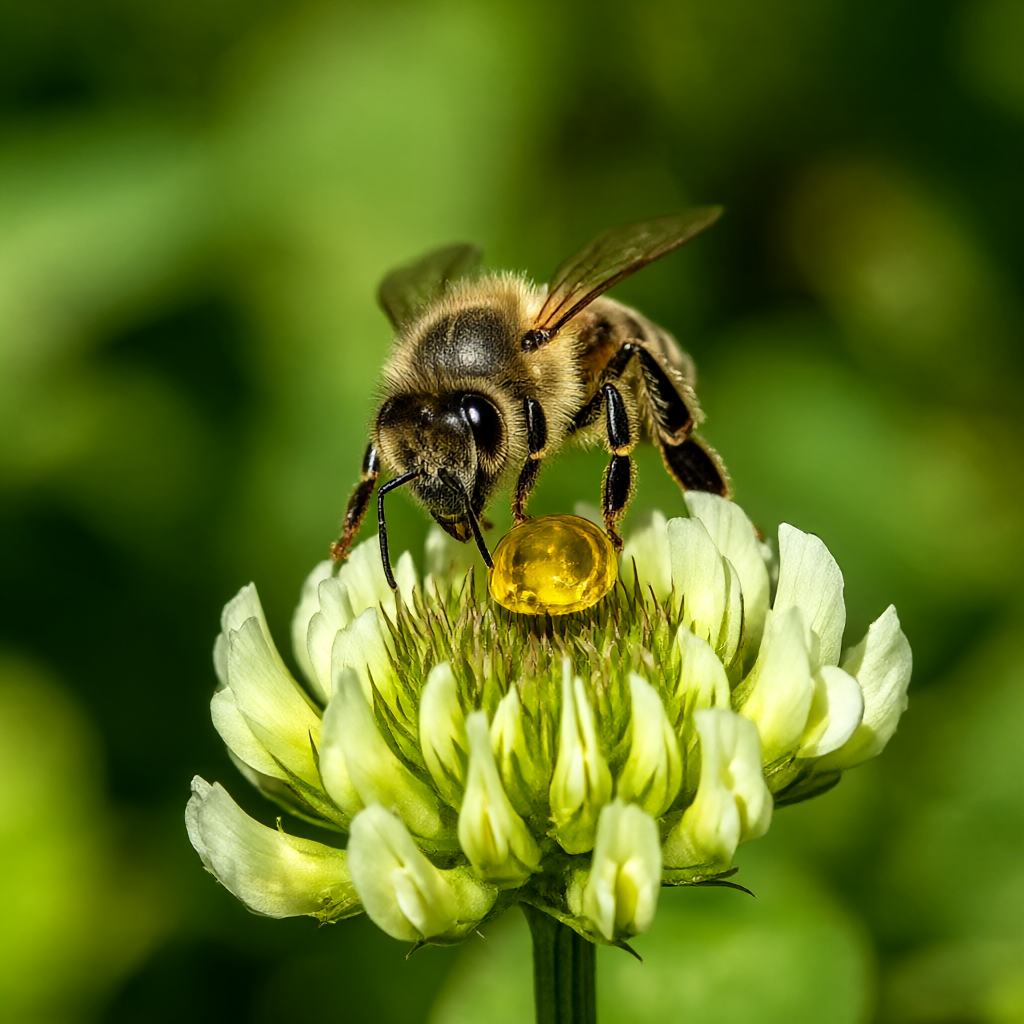
Nectar supplies sugar, and pollen supplies protein and fat. Foragers may visit 100 flowers before they turn home. Trips can reach 8 km. A scout that finds flowers dances on the comb, and the angle of her run points the way.
The length of that dance tells the hive how far the flowers lie. Nectar sits in a crop, a storage sac ahead of the gut. Enzymes there start breaking sugar down on the flight home. Workers spread the syrup in cells, then fan it until water drops below 18 percent.
A wax cap seals each ripe cell against damp and theft. Good years give 20 to 60 kg, and the bees eat only 10 to 15 percent, so keepers take the rest. Clover honey runs pale and mild, while buckwheat honey comes dark and strong. The Ruby-tailed Wasp hunts other bees for its young, while this insect gathers flowers instead.
One queen and her daughters
How new bees are made
Queens mate in the air, once, early in life. She stores sperm for years and releases it egg by egg. Fertilised eggs become daughters, while unfertilised eggs become drones with half the usual genes. That odd rule gives a male a mother but no father.
Queens lay up to 2,000 eggs a day. One year can pass 200,000 eggs through a single body, and a queen may live 3 to 5 years. Her jaw scent keeps worker ovaries shut down, so only she lays female eggs. One chosen larva fed royal jelly becomes a new queen within weeks.
When a nest grows too large, half of it leaves with the old queen. That swarm hangs on a branch while scouts hunt for a new cavity.
Mites, sprays and bare fields
What the Red List says
The species as a whole is not threatened, and the Red List rates it Least Concern. Managed hives number in the millions. The Varroa mite is the heaviest single burden.
It sucks fat from the body and carries germs that twist wings. Colony collapse disorder entered the record in 2006, when adult workers were gone and left brood and stores behind. Experts blame no single cause, and most treat that name as a sign rather than a diagnosis.
Sprays, poor diet, mites and truck travel all add pressure. Farmers who keep field edges wild give bees a mixed diet. Cities help too, because a garden full of flowers beats a bare lawn.
Side by side
How It Compares
| Trait | Honey Bee | Wool Carder Bee |
|---|---|---|
| Nest | wax combs inside a cavity | plant hairs in a hollow stem |
| Social life | colony of thousands | female works alone |
| Pollen | packed in hind leg baskets | swept under the belly |
| Food store | honey and beebread | none, each cell stocked |
| Temperament | stings to defend the nest | male rams intruders |
| Standing | Least Concern | not assessed |
Common misreadings
What People Get Wrong
- Many people call every yellow striped insect a honey bee, yet that label hides hundreds of lookalikes. Only one of those lookalikes makes the honey that most of us spread on bread.
- Field guides often say the queen rules the hive like a monarch, but she gives no orders. Her scent does the work, and workers decide where the colony goes next.
- Popular accounts call every drone a lazy male, yet the insect has no father at all. He hatches from an egg that was never fertilised and carries half the usual genes.
Going further
Sources and Further Reading
Five things to remember
Quick hits
- Workers may visit 100 flowers on one trip.
- Drones hatch from eggs no male ever touched.
- Honey keeps for years once the cell is capped.
- A swarm leaves with the old queen.
- Only Antarctica has no wild or kept hives.
interconnected food webs in which organisms may occupy multiple trophic levels simultaneously. The honey bee, for example, occupies a complex position in both agricultural and natural ecosystems: as a
that likely lived in Africa before some populations dispersed northward into Europe and Asia. The Honey Bee and the mantis, though unrelated, have both been extensively studied for their remarkable sensory
[…] black marking on the face between the compound eyes. Similar social complexity is seen in the honey bee, which shares the wasp’s highly organized colony structure and division of […]
[…] adapted for jumping and the long antennae that can exceed the length of the entire body. Like the honey bee, the cricket uses sensory perception to navigate its environment with remarkable […]
[…] Both adults and larvae are dedicated predators of soft-bodied insects, especially aphids but also scale insects, mites, and small caterpillars. A ladybird can consume dozens of aphids a day, and the spiky larva is if anything an even more efficient hunter than the adult. By suppressing pest numbers they protect crops and garden plants, reducing the need for chemical sprays. They also eat pollen and nectar when prey is scarce, linking them loosely to pollinators such as bees, and in autumn they switch to feasting on abundance, building fat reserves before the cold sets in. Honey Bee. […]
[…] scientific name Bombus terrestris was assigned by Linnaeus in 1758. It is closely related to the honey bee, though bumblebees live in much smaller annual colonies and do not store large honey reserves. […]
[…] butterflies, within the genus Vanessa. It is a distant relative of pollinating insects such as the honey bee, though butterflies and bees have followed different evolutionary paths. The genus Vanessa includes […]
[…] It is related to other colourful garden butterflies and shares flowers with pollinators such as the honey bee, though the butterfly feeds on nectar with a long proboscis rather than collecting pollen like the […]
[…] within the genus Parus. It is related to a cluster of small, acrobatic woodland birds. Like the honey bee and other flower visitors, it plays a part in the broader community of invertebrates and the […]
[…] of the drone flies. Its family holds the hoverflies, and most of them feed on nectar as adults. A Honey Bee carries a sting that this fly lacks, and the resemblance therefore pays only in one […]