 By st20113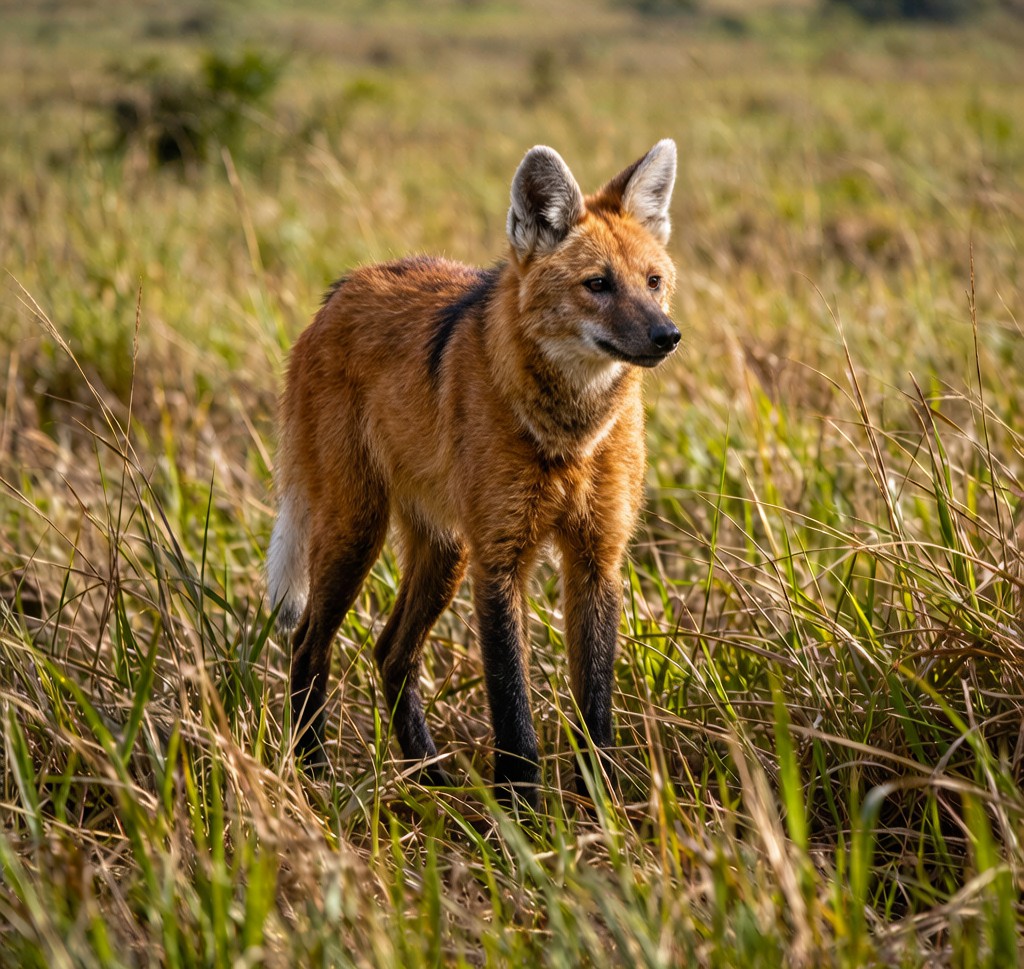
A Maned Wolf (Chrysocyon brachyurus) standing in the open cerrado grasslands of Brazil, displaying its distinctive long black legs and fox-like face
Overview
The Maned Wolf (Chrysocyon brachyurus) is one of the most distinctive and enigmatic canids on Earth. Found in the open grasslands and scrub savannas of South America, particularly the vast cerrado ecosystem of Brazil, the Maned Wolf looks like no other wolf – with its fox-like face and enormous, impossibly thin black legs, it has been described as a “fox on stilts.” Standing approximately 90 centimeters at the shoulder and weighing 20 to 30 kilograms, the Maned Wolf is the largest canid in South America and the only member of its genus. Its extraordinarily long legs – the longest of any canid relative to body size – are an adaptation to scanning for prey over the tall grasses of its open habitat.
Despite its name and wolf-like appearance, the Maned Wolf is not closely related to true wolves or foxes, and it does not howl or live in packs. It is a solitary, omnivorous hunter that occupies large individual territories. The species is best known for its dramatic black mane – which can be raised and bristled when threatened – its unique diet which includes large quantities of fruit, and its characteristic elongated calls called ” bellows ” that are emitted during the breeding season. With fewer than 20,000 individuals remaining in the wild and populations declining, the Maned Wolf is one of South America’s most endangered mammals.
Habitat and Distribution
The Maned Wolf occurs in the grasslands, savannas, wetlands, and open woodland habitats of central and eastern South America, with the vast majority of its population occurring in Brazil’s cerrado biome – a biodiverse tropical savanna that is one of the most threatened ecosystems on the continent. Smaller populations occur in Paraguay, Bolivia, and northern Argentina. The cerrado – which once covered approximately 2 million square kilometers of central Brazil – has been reduced by more than 50 percent through agricultural conversion, particularly for soy production and cattle ranching, making it one of the most threatened major biomes on Earth.
Maned wolves are strongly associated with the cerrado’s mosaic of tall grassland, shrubland, and gallery forest along rivers. They require large territories – typically 30 to 80 square kilometers per individual – making them highly vulnerable to habitat fragmentation. As forests are cleared and converted to farmland, maned wolf habitat becomes isolated in fragmented patches where populations are at high risk of inbreeding depression and local extinction. Road mortality is also a significant source of death, as maned wolves frequently cross the roads that bisect the remaining fragments of their habitat.
Diet and Unique Ecology
The Maned Wolf has one of the most unusual diets of any large carnivore in the world. Unlike true wolves that are primarily meat-eaters, the Maned Wolf is an omnivore that supplements its diet of small vertebrates – including rodents, rabbits, birds, lizards, and fish – with large quantities of fruit. During the dry season, fruit can constitute up to 50 percent of its diet by weight. The species is particularly associated with the lobeira fruit (Solanum lycocarpum), also called wolf apple, which is a key food resource that the maned wolf both eats and depends on for seed dispersal – the fruits seeds pass intact through the wolf’s digestive system and are dispersed widely across the landscape.
The Maned Wolf’s foraging strategy differs markedly from that of pack-hunting canids. Individuals hunt alone at night, stalking prey through the tall grass and using their long legs to scan over the vegetation. Their prey is taken with a characteristic pounce – the wolf leaps into the air and crashes down on small mammals in the grass, similar to the hunting technique of foxes. Unlike true wolves, maned wolves do not form packs and rarely kill large prey. They are also unusual among large canids in that they do not howl – instead, they emit a distinctive, low-frequency “bellow” or “roar-bark” during the breeding season that can carry up to a kilometer through the open cerrado.
Conservation
The Manand Wolf is listed as Vulnerable on the IUCN Red List, with populations declining throughout its range. The primary threat is the massive destruction of the Brazilian cerrado for agriculture, which has already eliminated more than half of the original biome. Beyond habitat loss, maned wolves face additional pressures including roadkill mortality (they are frequently killed by vehicles on the roads that fragment their habitat), hunting in retaliation for preying on poultry, and habitat fragmentation which increases the risk of disease transmission and inbreeding depression.
Conservation efforts for the Maned Wolf include protection of key habitat areas within the Brazilian national park network, management of road networks to reduce vehicle collisions, public education campaigns to reduce retaliatory killing, and research into disease risks from domestic dogs. The species is also the focus of a major ex-situ breeding program coordinated by the Brazilian government and international zoos, which maintains a genetically managed captive population as an insurance population. Perhaps most importantly, researchers have documented that maned wolves can survive in agricultural landscapes if sufficient natural vegetation corridors are maintained between habitat fragments, highlighting the importance of landscape-level conservation planning that protects connectivity across the fragmented cerrado.