 By Iris
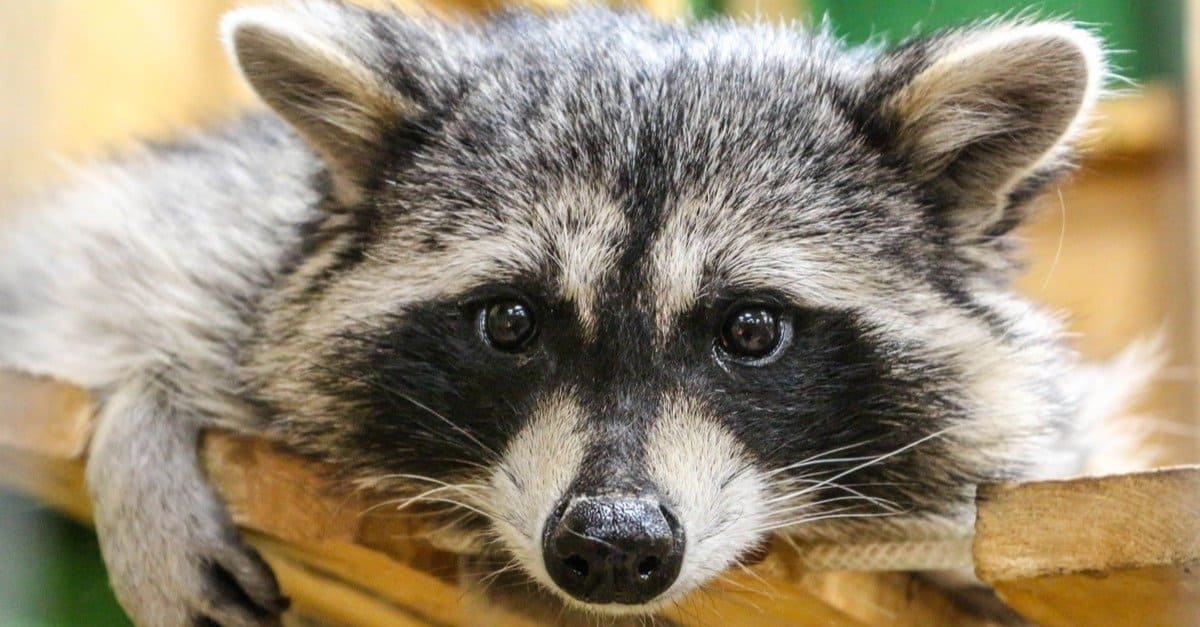
Procyon lotor | Raccoon
Species Profile · Procyonidae
Raccoon
From forest to storm drain, a masked mammal with hand-like paws has learned to live beside people.
Least Concern
Weight
Tail
Litter
Gestation
Den sites
Rating
Masked, ringed, everywhere
A mammal that moved into town
A stocky animal with a black mask climbs a fence after dark. Raccoons live almost everywhere. The species is native to North America, and it now covers the whole continent from coast to coast.
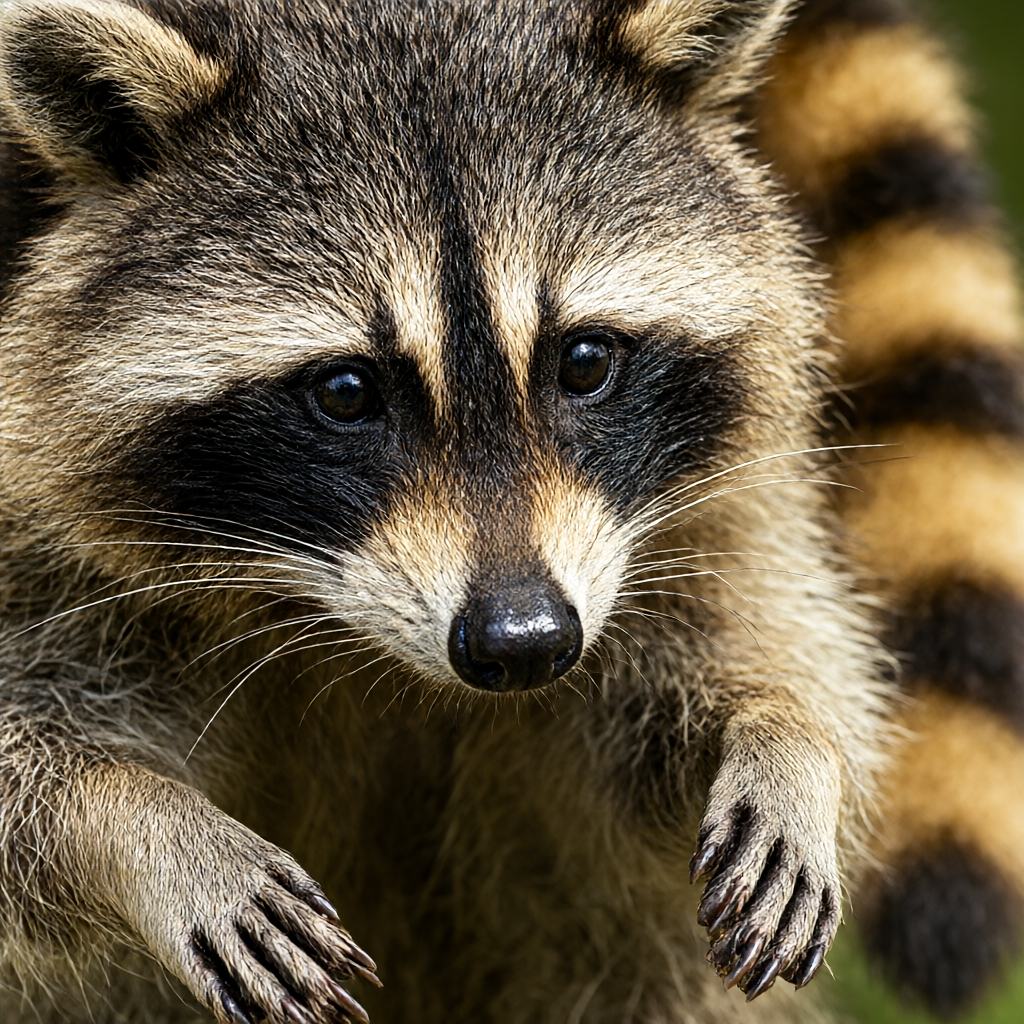
Few mammals of this size adapt so quickly. Adults weigh 5 to 15 kg and stand low on short legs. A bushy tail carries 4 to 6 dark rings.
Those rings and the eye band make the animal easy to name. Front paws work like hands, because the small fingers feel their way through everything. That pair of hands explains much of the animal’s success in towns, and the rest comes from its stomach.
One genus, one continent
Where it sits among the procyonids
The species carries the name Procyon lotor, and the family is Procyonidae. North America holds one member of the genus, spread from deep forest to inner city. A second branch of the family stays further south, where the Coati lives.
Coatis move in groups by day, while this animal hunts alone at night. Mask and rings mark the species at a glance, so few people mistake it for any other North American animal. No other mammal shares that face.
Stocky build, clever hands
What the body does
Bodies are stocky, legs short, and tails bushy. Four to six dark rings cross the tail, and each ring stands out against pale fur. Pale fur frames a dark band that runs across the eyes. That band gives the animal its bandit look.
Front paws stay highly sensitive, with fingers that work almost like hands. Captive animals open jars and unlatch cage doors with those fingers. Touch guides the paws more than sight does, because the skin reads texture and shape. Adults stand low, so a fence rail and a drain pipe both serve as road.
Colder regions slow it down, yet it never truly hibernates, and a mild spell brings it out again. Dens sit in tree hollows, burrows, attics, sheds and storm drains.
1
2
3
Forest, marsh and storm drain
Where it lives
Forest, marsh, farmland and city all hold the species. Tree hollows and burrows give it a den, and attics, sheds and drains serve just as well. Although few mammals of this size tolerate people so closely, fewer still profit from the arrangement. Food and shelter decide where it settles, because the animal follows whatever happens to be edible.
Cities offer both in abundance. The animal has learned to take them. Urban numbers hold steady or rise, since the food supply never stops. Farm edges attract animals, and the crops pay the price.
Flexible habits, not narrow ones, explain the range. A drain, a shed and a fruit tree together make a workable city territory.
Anything it can hold
What it eats
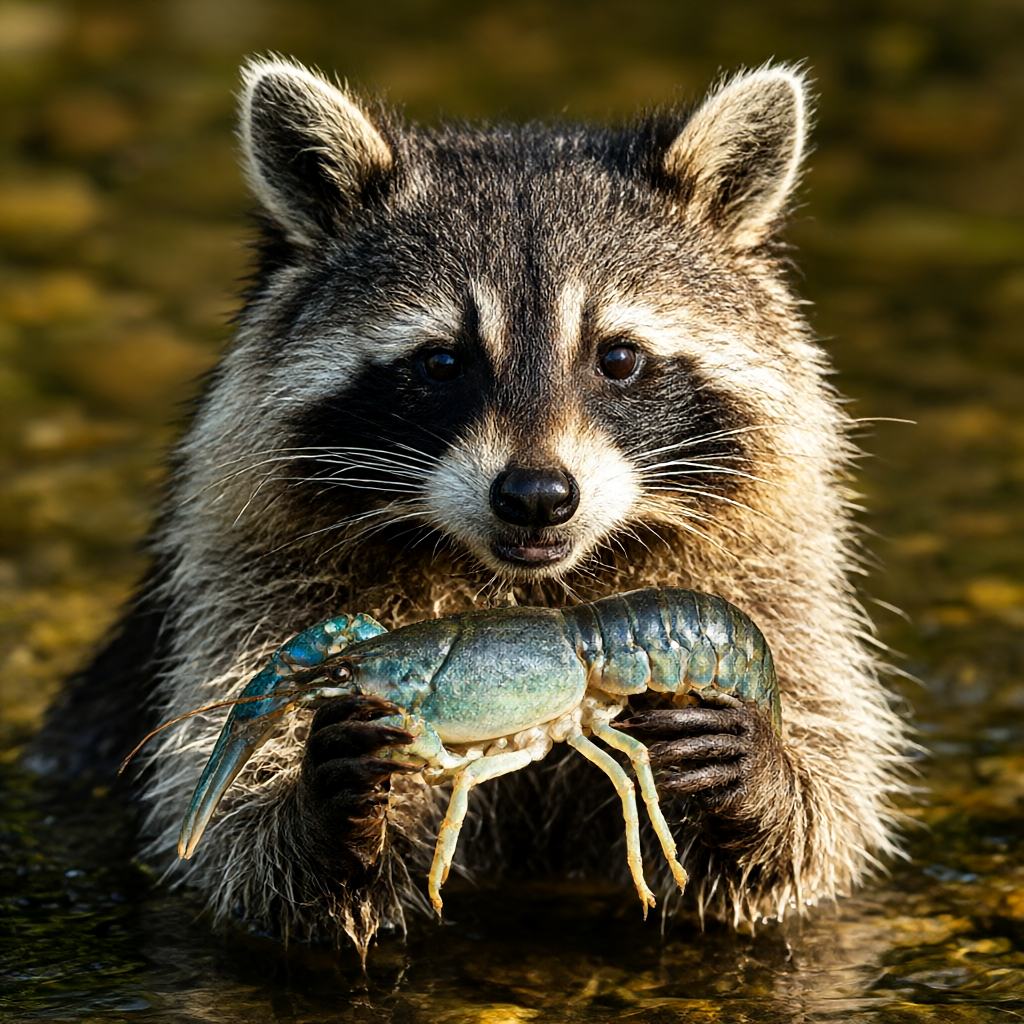
Raccoons eat almost anything they can hold. Fruit, nuts, insects, eggs, fish and frogs all count. Small mammals go down as well, and so do food scraps left by people. A varied diet lets the species use forest, wetland and town.
Raccoons douse food in water before eating it. Early writers read that habit as washing, yet the animal is not cleaning its meal. Water sharpens the sense of touch, so the paws read the food better than the eyes ever could. Dunking serves touch, not hygiene.
Foraging runs from dusk to dawn. Those fingers peel fruit and open shells with steady care. Shells, wrappers and lids all yield to the same patient fingers.
Two kits to five
The breeding cycle
Females raise one litter of 2 to 5 kits each year. Gestation runs about two months. Kits arrive blind and helpless, and they depend on the mother for everything they need. Climbing comes within weeks of birth, and the kits soon follow her.
Family groups stay together through the first winter. Family bonds stay strong while the kits depend on her, and the mother keeps them close at heel. Adults otherwise live alone, and they meet only to breed. A mother with kits is the one exception to that rule.
Young animals leave once the winter ends and find open ground of their own. No pair bond forms, because the male plays no part in raising the litter.
Pests, disease and tolerance
Conservation
It faces no global threat, since the range is wide and numbers hold. No global count suggests a decline, and the trend runs flat or slowly up. Conflict comes from the animal’s habits rather than its scarcity. Raccoons raid crops and bins, and farmers count the loss.
Rabies and distemper travel with it, which puts people and their pets at real risk. Management therefore balances tolerance with disease control. Health rules sit beside tolerance in most plans, and neither aim cancels the other one. Success here comes from flexibility, not from protection.
Few mammals of this size have spread so far alongside people, and this one simply followed the food. Knowing the ecology lowers conflict, because people then see exactly what draws the animal to a bin or a crop. That knowledge protects people and the animal at the same time.
Side by side
How It Compares
| Trait | Raccoon | Coati |
|---|---|---|
| Weight | 5-15 kg | 3-6 kg |
| Tail | bushy, 4-6 dark rings | long, held upright |
| Activity | solitary, after dark | groups, by day |
| Food | fruit, insects, scraps | fruit, insects, small animals |
| Range | North America, towns too | South American forest |
| Standing | Least Concern | Least Concern |
Common misreadings
What People Get Wrong
- Cartoons show the animal scrubbing its meal, yet the water does something else. Fingers read the shape of the food through water, and no soap enters the picture.
- Many people expect a long winter sleep, though the animal never truly hibernates. Cold weather slows the animal down, and mild nights bring it out again.
- Some guides call the raccoon a rodent, while its family sits elsewhere entirely. Teeth and skull place it near the coati, and nowhere near a rat.
Going further
Sources and Further Reading
Five things to remember
Quick hits
- Fingers on the front paws work almost like human hands.
- The tail carries four to six dark rings.
- Kits are born blind and helpless.
- It dunks food to feel it, not to wash it.
- Solved puzzles stay in memory for years.
from each eye to the corner of the mouth – a marking pattern convergent with that of the Raccoon. The species possesses semi-retractable claws and a remarkable false thumb, an enlarged radial
[…] English, French, Giant, and Satin Angoras. Each was developed for different characteristics. Raccoon represents their wild cousins adapted to different environments. Their taxonomy illustrates the […]
[…] The species plays a useful role in controlling pest populations. Related mammals such as the raccoon share its woodland and suburban range across much of the […]
[…] family has evolved adaptations for life both in trees and on the ground. Unlike its cousin the raccoon, which is nocturnal and solitary, the coati is unusually social among procyonids, living in groups […]
[…] small, fox-like canid native to East Asia, named for the dark facial mask that makes it resemble a raccoon in appearance. Unlike true raccoons, it is a genuine member of the dog family, but it is unusual […]
[…] and the same group holds raccoons, coatis and olingos. Its nearest relative on this site is the Raccoon, a ground living cousin of the same […]
[…] family also holds the Raccoon, the coati and the kinkajou. All of them share a short face, mobile fingers and a taste for varied […]