 By st20113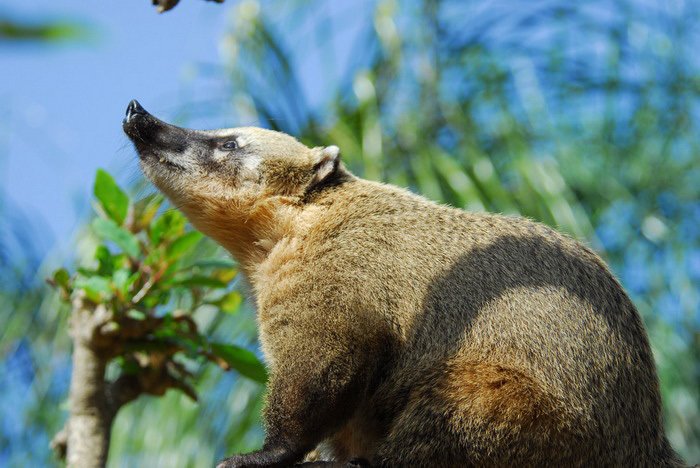
Introduction
The coati, Nasua nasua, is one of the most distinctive mammals in the forests and grasslands of Central and South America. Instantly recognizable by its elongated snout, ringed tail, and energetic foraging behavior, this member of the raccoon family has evolved adaptations for life both in trees and on the ground. Unlike its cousin the raccoon, which is nocturnal and solitary, the coati is unusually social among procyonids, living in groups of up to 30 individuals. The name “coati” comes from the Tupi-Guarani language, meaning “elongated nose.” Highly adaptable, coatis thrive in rainforests, savannas, and cloud forests, and they remain widespread and abundant despite conflicts with farmers.
Taxonomy
Nasua nasua belongs to the family Procyonidae, which includes raccoons, ringtails, kinkajous, and olingos. The genus Nasua comprises two species: the white-nosed coati (Nasua narica) of Central America and the South American coati covered here. Genetic evidence suggests these species diverged approximately 4.5 million years ago following the formation of the Isthmus of Panama. Multiple subspecies of Nasua nasua are recognized across its range from Colombia and Venezuela to Uruguay and northern Argentina. Molecular studies place the genus Nasua as sister to the mountain coati (Nasuella), together forming a clade most closely related to the common raccoon.
Physical Characteristics
The South American coati is a medium-sized mammal with an elongated body, short legs, and a ringed tail that can exceed the length of its body. Adults measure 40 to 50 centimeters in body length, with the tail adding 30 to 60 centimeters. Males typically weigh 4 to 6 kilograms, females 3 to 4 kilograms. The coat is brownish-gray to reddish-brown, with a lighter underside and distinctive pale facial patches. The most remarkable feature is the elongated, flexible snout, which rotates through a wide arc to probe crevices and locate hidden prey. Long, curved claws on the front paws tear bark and excavate soil.
Habitat
Coatis occupy a remarkable diversity of habitats across South America, from sea level to elevations exceeding 2,500 meters in the Andes. Most abundant in tropical and subtropical forests, including Amazonian rainforest and Atlantic Forest, they also thrive in savannas and semi-desert regions. Forest edges providing both open ground and tree cover are preferred, offering ground-level foraging and arboreal escape routes from predators. Unlike territorial species, coati groups utilize overlapping home ranges of 100 to 250 hectares that shift according to food availability. They sleep in trees at night, curled with the tail wrapped around the body for warmth.
Diet
The coati is an opportunistic omnivore whose diet shifts with seasonal availability. Invertebrates, particularly beetles, caterpillars, ants, and termites, form the majority of the diet year-round. The powerful sense of smell and flexible snout allow coatis to locate subterranean insects with remarkable efficiency. During fruit abundance, fruit can comprise up to 50 percent of the diet, with figs, mangoes, and palm fruits being favorites. Like the meerkat, coatis are opportunistic foragers that adjust their diet to whatever is most abundant. Small vertebrates and birds’ eggs are occasionally taken.
Reproduction
Coatis have a promiscuous mating system, with multiple males mating with multiple females during the breeding season. After a gestation of approximately 77 days, females give birth to litters of 2 to 7 pups, with 4 being typical. Newborns are blind and helpless, but develop rapidly and begin accompanying their mother by 5 to 6 weeks of age. All group females participate in cooperative breeding, carrying, grooming, and protecting pups from danger. Young males leave their birth group upon reaching sexual maturity at around 2 years of age, while females typically remain with their natal group for life.
Conservation
The South American coati is listed as Least Concern by the International Union for Conservation of Nature, reflecting its broad distribution and large, stable population. However, local declines have been documented in areas with heavy hunting pressure, habitat loss from cattle ranching and agriculture, and persecution by farmers. Road mortality is an increasingly significant threat as highways fragment forested regions. Coatis play important ecological roles as seed dispersers and insect predators. Wildlife management programs focus on reducing human-wildlife conflict through better waste management, public education, and wildlife corridors connecting protected areas.
Fun Facts
Coatis have an incredibly mobile nose capable of rotating independently to sweep through leaf litter, making them extraordinarily efficient at locating buried insects. A group of foraging coatis moves through the forest like a living vacuum cleaner. The ringed tails serve as critical social signals in dense undergrowth, and experienced wildlife guides can identify coati groups from a distance by observing the bobbing tails. Coatis are uniquely social among procyonids, living in matrilineal groups of related females and their offspring. During the dry season, adult males are expelled from these groups, becoming solitary until the breeding season returns.