 By st20113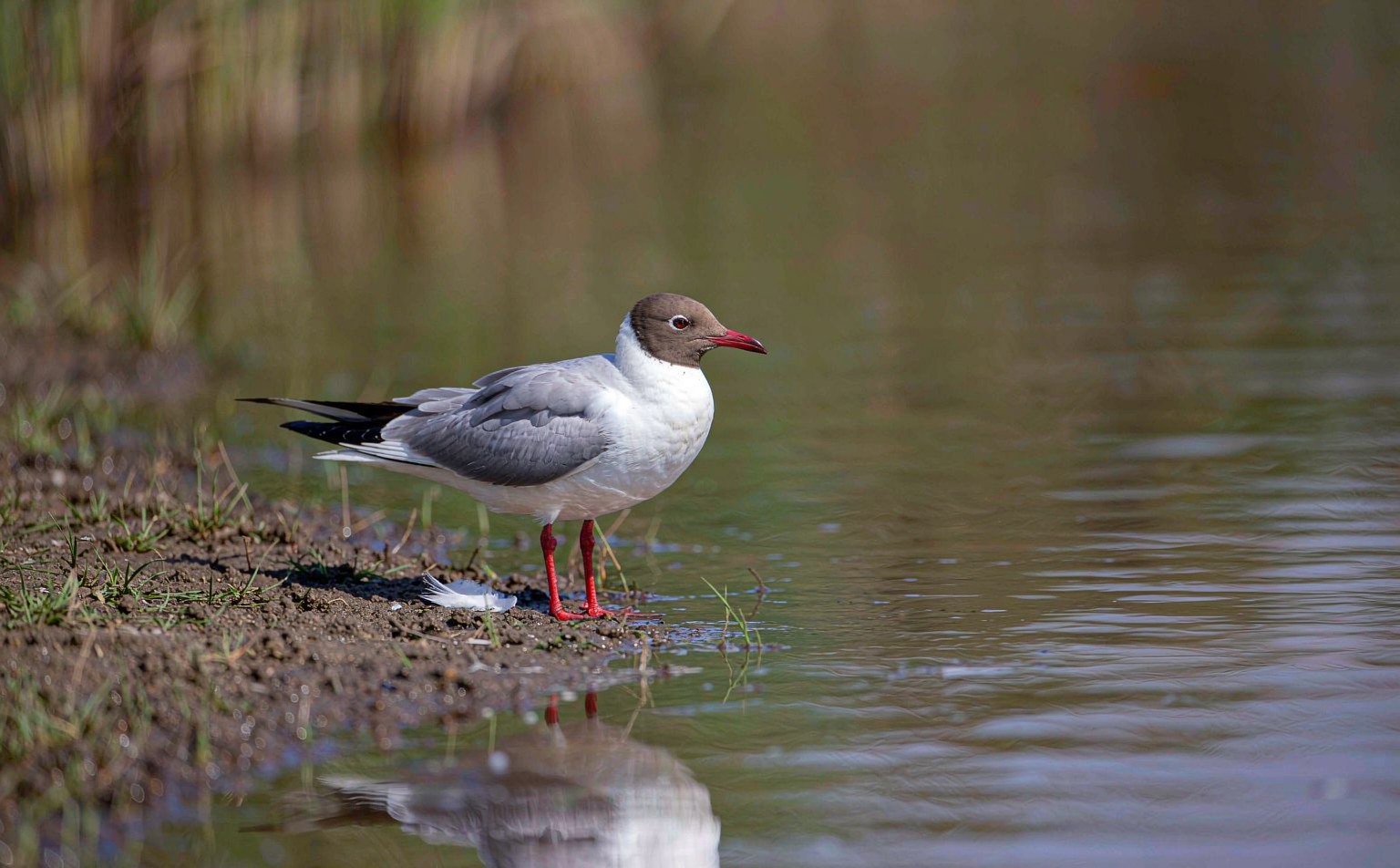
Larus ridibundus | Black-headed Gull
Introduction
The Black-headed Gull (Larus ridibundus) is one of the most familiar gulls of inland Europe, despite its name referring to a head that is actually dark brown rather than black, and only in the breeding season. Outside summer it wears a neat white head with a dark spot behind each eye, a clean grey mantle, and black wingtips, making it a slender, agile gull quite unlike the heavy herring gull of the coast.
Abundant on lakes, rivers, reservoirs, and farmland, it has also colonised towns, where it scavenges and breeds on flat roofs and industrial sites. Its ringing calls and graceful flight are a hallmark of wetland landscapes, and it often mixes with other waterbirds such as the Mute Swan on crowded lakes.
Taxonomy
The Black-headed Gull belongs to the genus Larus, the typical gulls, within the family Laridae. It was first described by the Swedish naturalist Carl Linnaeus in 1766 under the binomial Larus ridibundus. The species name ridibundus means “laughing” in Latin, a reference to its vocal, almost cackling call.
Although long placed among the smaller gulls, genetic work has shown the black-headed gulls of Eurasia and their relatives form a distinct lineage within Larus. It is closely related to the Mediterranean and slender-billed gulls, all of which share the dark summer hood and buoyant flight that distinguish them from the larger, paler-backed northern gulls.
Physical Characteristics
An adult Black-headed Gull measures 35 to 40 centimetres in length, with a wingspan of 86 to 99 centimetres and a weight of 200 to 350 grams, making it noticeably smaller and lighter than the herring gull. In breeding plumage the head is a rich chocolate brown, fading to white in autumn and winter when only a dark smudge remains behind each eye.
The body is white, the back and wings are pale grey, and the wingtips are black with white “mirrors”. The bill is slender and deep red, the legs are also red, and the eye is dark. Juveniles are mottled brown and grey, acquiring adult colours over two to three years, and first-winter birds show a black band on the tail tip that is lost with age.
In flight the species is light and buoyant, with quick, shallow wingbeats and an easy, tern-like grace. Its small size and red bill and legs are reliable field marks at all seasons.
Habitat
Black-headed Gulls breed on inland freshwater: lakes, islands in reservoirs, reed beds, and wet grassland, but they have also taken readily to artificial sites such as gravel pits, sewage works, and flat industrial rooftops. They need open water nearby for feeding and safe, predator-free ground or structures for nesting.
Outside the breeding season the species ranges widely to coasts, estuaries, rivers, ploughed fields, and urban parks, often gathering in large, noisy roosts. It is one of the most terrestrial of gulls, spending much of the winter foraging on farmland and refuse tips. The species avoids remote open ocean, preferring the interface of land and water, and it overlaps considerably with the Grey Heron and the Common Kingfisher along river corridors.
Diet
The Black-headed Gull is an opportunistic omnivore and scavenger. It feeds on insects, earthworms, small fish, crustaceans, and the eggs and chicks of other birds when available, and it readily takes human food waste, carrion, and grain spilt on fields. Its diet shifts with the season and the availability of easy food.
Foraging methods are varied: the gull picks from the surface while swimming or walking, hovers briefly to snatch prey, and follows ploughs to seize exposed invertebrates. At tips and shorelines it scavenges in flocks, and on water it sometimes patters across the surface to catch small fish. This flexibility, shared with the European Water Vole‘s wetland neighbours, has made the species one of the most successful gulls of the inland landscape.
Reproduction
Black-headed Gulls are highly colonial, nesting in dense, noisy groups on islands, reed beds, or flat roofs. Both sexes build a shallow nest of vegetation, grass, and debris, and the female lays two to three olive-brown eggs blotched with dark markings. Incubation lasts about 22 to 26 days and is shared by both parents.
The downy chicks leave the nest within a day or two and hide in nearby cover, fed by the adults on a diet rich in insects and small prey. Colonies are vulnerable to flooding, predation by foxes and large gulls, and human disturbance, but the sheer number of birds and their communal defence help many young survive. Fledging occurs at roughly five weeks.
Conservation
The Black-headed Gull is classified as a species of Least Concern by the International Union for Conservation of Nature, with a large and generally stable population across Eurasia. It has benefited from agricultural waste, inland gravel workings, and the availability of new nesting sites on buildings.
Local declines have occurred where wetland drainage, disturbance, or predator control at colonies have reduced breeding success, and the species is sometimes culled where it is considered a nuisance or a threat to other ground-nesting birds. Overall, however, its adaptability keeps it abundant, and it remains a characteristic companion of healthy inland waters throughout the continent.
Fun Facts
- The “black head” is actually a chocolate-brown hood, and it is worn only from spring through summer.
- Black-headed Gulls are one of the few gulls that commonly nest on the flat roofs of buildings in towns and cities.
- They often patter their feet on wet grass to bring earthworms to the surface before seizing them.
- In winter the dark head is replaced by a white head with a single dark spot behind each eye.
- These gulls are skilled at following ploughs, dropping in behind tractors to grab exposed worms and grubs.
[…] terns and skuas by the stout, hooked bill. It has a webbed foot. The herring gull is close to the Black-headed Gull (Larus ridibundus). That smaller, more slender gull shares the coastal habit and the scavenging way of […]
[…] bird’s habit of living off the labour of others. In the field it is often compared with the Black-headed Gull. That bird shares the same northern coasts and […]