 By st20113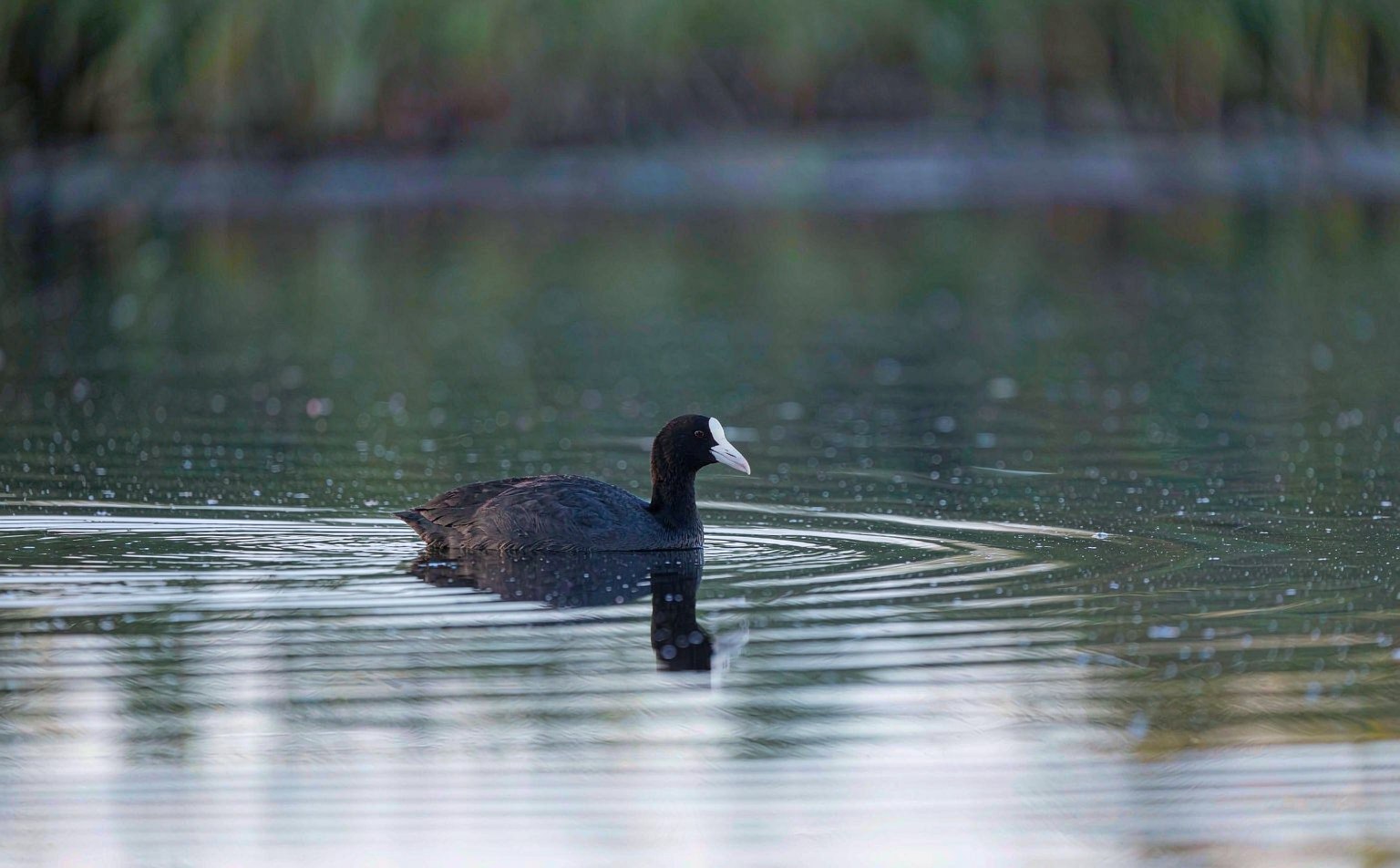
Fulica atra | Eurasian Coot
Introduction
The Eurasian Coot (Fulica atra) is a common waterbird of lakes, ponds, and marshes across Europe, Asia, and Australasia. Although often grouped with ducks by casual observers, it is not a duck at all but a member of the rail family, more closely related to moorhens and cranes. Its sober black plumage, chalk-white bill, and bald white forehead shield make it unmistakable on any stretch of open water.
Coots are gregarious and noisy, especially in winter when hundreds may gather on ice-free lakes. They are awkward on land but powerful swimmers and divers, and they have become a familiar part of both wild wetlands and urban parks. Their close relatives include the Mallard and other waterfowl that share the same habitats.
Taxonomy
The Eurasian Coot belongs to the genus Fulica within the family Rallidae, the rails. It was first described by the Swedish naturalist Carl Linnaeus in 1758 under the binomial Fulica atra. The genus name Fulica is the Latin word for a coot, while atra means “black”, a direct reference to the adult’s dark plumage.
Several subspecies are recognised across its enormous range, differing mainly in size and the colour of the frontal shield. Despite its resemblance to ducks, the coot’s lobed toes, secretive nesting habits, and terrestrial lineage place it firmly among the rails, a group that also includes the more reclusive watercocks and crakes of wetland vegetation.
Physical Characteristics
An adult Eurasian Coot measures 36 to 42 centimetres in length, with a wingspan of 70 to 80 centimetres and a weight of 600 to 1,000 grams. The body is rounded and carried low in the water, with the head and neck held slightly forward. The plumage is slate black, fading to dark grey on the underparts, and lacks the crisp contrast of many ducks.
The most characteristic features are the bright white bill and the fleshy white frontal shield that extends up onto the forehead. The eye is red, and the legs are a greyish-green, each foot bearing broad, scalloped lobes rather than fully webbed toes. These lobes act like paddles in the water but also allow the bird to walk on muddy or vegetated ground.
Juvenile coots are duller, grey-brown rather than black, and lack the white shield, gradually acquiring adult colouration over their first year. In flight the species shows a narrow white trailing edge to the wing and a flickering, weak-looking action, though it is in fact a strong and regular migrant.
Habitat
Eurasian Coots occupy still or slow-moving freshwater: lakes, reservoirs, gravel pits, canals, and reed-fringed marshes. They require open water for feeding and dense stands of reed, sedge, or rush for nesting, and they tolerate mildly brackish conditions better than many rails.
In winter the species spreads to larger lakes, estuaries, and coastal lagoons, sometimes mixing with ducks and gulls. It has also colonised ornamental ponds and city parks, where it can become remarkably tame. The coot is absent only from fast rivers, deep open sea, and treeless high mountains, and it is sensitive to the complete freezing of its wetland homes, which forces seasonal movement.
Diet
The coot is an omnivore with a strongly vegetarian lean. It feeds on the leaves, stems, and seeds of aquatic plants such as pondweeds, duckweeds, and water lilies, often diving or up-ending to reach submerged parts. It will also graze on waterside grass and pull down overhanging shoots.
Animal food is taken especially when feeding young and includes insects, snails, small crustaceans, and the eggs or chicks of other waterbirds when opportunities arise. Like the Grey Heron and the Common Kingfisher, the coot depends on clean, productive water, and declines in water quality quickly reduce the abundance of its prey and plants.
Reproduction
Coots are monogamous and form pairs that defend a territory of open water and adjoining reed bed. The nest is a bulky mound of dead reeds and other vegetation, floating or built up from the bottom among dense cover. The female lays six to ten eggs, which are buff-coloured with dark speckles, and both parents incubate for about 21 to 24 days.
The chicks are black and downy with a bald red head and an orange-tipped bill, and they can swim and dive within a day or two of hatching. Parents feed them at first, and the young often ride on the adults’ backs. Brood reduction is common in poor conditions, and the boisterous, territorial behaviour of adults means that coot colonies can be noisy and crowded places in early summer.
Conservation
The Eurasian Coot is classified as a species of Least Concern by the International Union for Conservation of Nature. It has a vast range and a population numbering in the millions, and it has expanded into new wetlands created by human activity. Its adaptability to ponds, parks, and gravel pits has buffered it against the loss of natural marshland.
Principal threats include drainage of wetlands, pollution that reduces plant and invertebrate food, and the removal of reed beds needed for nesting. Where these remain, the coot stays abundant, and it is often used by ecologists as a general indicator of wetland health. The Mute Swan frequently shares its breeding lakes, the two species tolerating one another despite occasional squabbles over territory.
Fun Facts
- The coot’s feet are not webbed but have lobed flaps on each toe that fold back as the foot lifts, making both swimming and walking easier.
- Adult coots are fiercely territorial and will chase, splash, and even strike rivals with their feet during disputes.
- Young coots have bright red or orange heads at hatching, a colour that fades as they mature.
- A coot can sink slowly beneath the surface and walk along the bottom to feed, rather than fully swimming.
- Large winter flocks often perform a synchronised “water dance” of head shaking that seems to reduce conflict within the group.