 By st20113
Stercorarius skua | Great Skua
Species Profile · Stercorariidae
Great Skua
The pirate of the North Atlantic, a gull-sized bird that makes gannets and puffins give up their catch — and whose whole world is a handful of northern islands.
IUCN: Least Concern
Range
Length
Weight
Nest
Incubation
The pirate of the north
A seabird that lives by robbery
The great skua is the heaviest and the most powerful of the skuas of the north. It is one of the most feared of all the seabirds of the Atlantic. It is a heavy-bodied and a dark brown bird. It is the size of a large gull. It has made a way of life out of the robbery of the other seabirds. The species is famous for the pursuit of the gannet and the kittiwake. It also pursues the fulmar and the puffin. It forces those birds to give up the fish that they have caught. The whole of the piracy is carried out in the open air over the sea. It is one of the most spectacular of the natural behaviours of the coast of Europe. The bird is a bird of the high and the northern islands. Its breeding range is one of the smallest of any of the birds of the continent.
The species nests only in the north-east of the Atlantic. It nests from the north of Scotland and the islands of Orkney and of Shetland. It also nests in the Hebrides and in the Faroes and in Iceland. It reaches the north of Norway and the islands of Svalbard and of Bear Island. The whole of the world population of the bird is contained within that area. The area is a single and a very restricted one. The species is therefore one of the most concentrated of all the seabirds. It is also one of the most vulnerable. A change in the conditions of that small part of the ocean would be serious for it. The bird is a very aggressive defender of its nesting territory. The pair will dive at the intruder with the wings swept back. They strike with the feet and with the bill.
The reputation of the bird among the people of the islands is old. It is one of the oldest of the records. It is a record of the behaviour of the seabirds of the region. The species has increased over the greater part of the last century. It has extended the range to the north and to the east. The growth of the population was put down in part to 1 thing. The trawlers of the north Atlantic discarded a great quantity of the waste. The modern regulation of the fishery has reduced that waste. That has removed one of the sources of the food. The avian influenza arrived among the seabirds of the north in the last years. It has caused a heavy loss of the skuas. It has made the future of the bird a matter of the serious concern.
Family tree
Stercorarius, the skuas
The great skua was described by the Danish naturalist Morten Thrane Brünnich in 1764. The modern treatment places it in the genus Stercorarius. Those are the skuas. The family is the Stercorariidae. The family contains 7 species. It is placed with the gulls and the terns and the auks and the waders. Those birds sit in the order Charadriiformes. The skuas are the most predatory of the order. They are also the pirates of the open sea. The classification of the group has been the subject of a long debate. The great skua was formerly placed in a separate genus, Catharacta. The other large skuas of the southern hemisphere went with it.
The ground for the split was their size and their distribution. The modern molecular evidence has shown something different. The large and the small skuas are not separated by a deep division. The old arrangement assumed such a division. The whole of the group is now placed in the single genus Stercorarius. The great skua is the close relative of the Black-headed Gull (Larus ridibundus). That is the small and the common gull of the lakes and the estuaries of Europe. The 2 birds share the order and the same general plan of the body. They share the same heavy body and the same long and pointed wing. They differ completely in the habits and in the plumage. The black-headed gull is a sociable bird of the shallow water. It takes the insects and the worms and the small fish without any violence.
The great skua is a solitary and a very aggressive bird of the open ocean. It takes the whole of its food by the pursuit of the other seabirds. It also takes the food by the scavenging of the surface and of the shore. The species is monotypic. No subspecies is recognised in the modern treatment. The birds of the south of the range are on average slightly smaller. The birds of the extreme north are the larger ones. The difference is not thought to justify a formal separation. The great skua of the north Atlantic is the only member of the genus. It is the only one that breeds in the northern hemisphere. The rest of the group is confined to the southern ocean and to the Antarctic.
Brown body, white flash
How to identify one
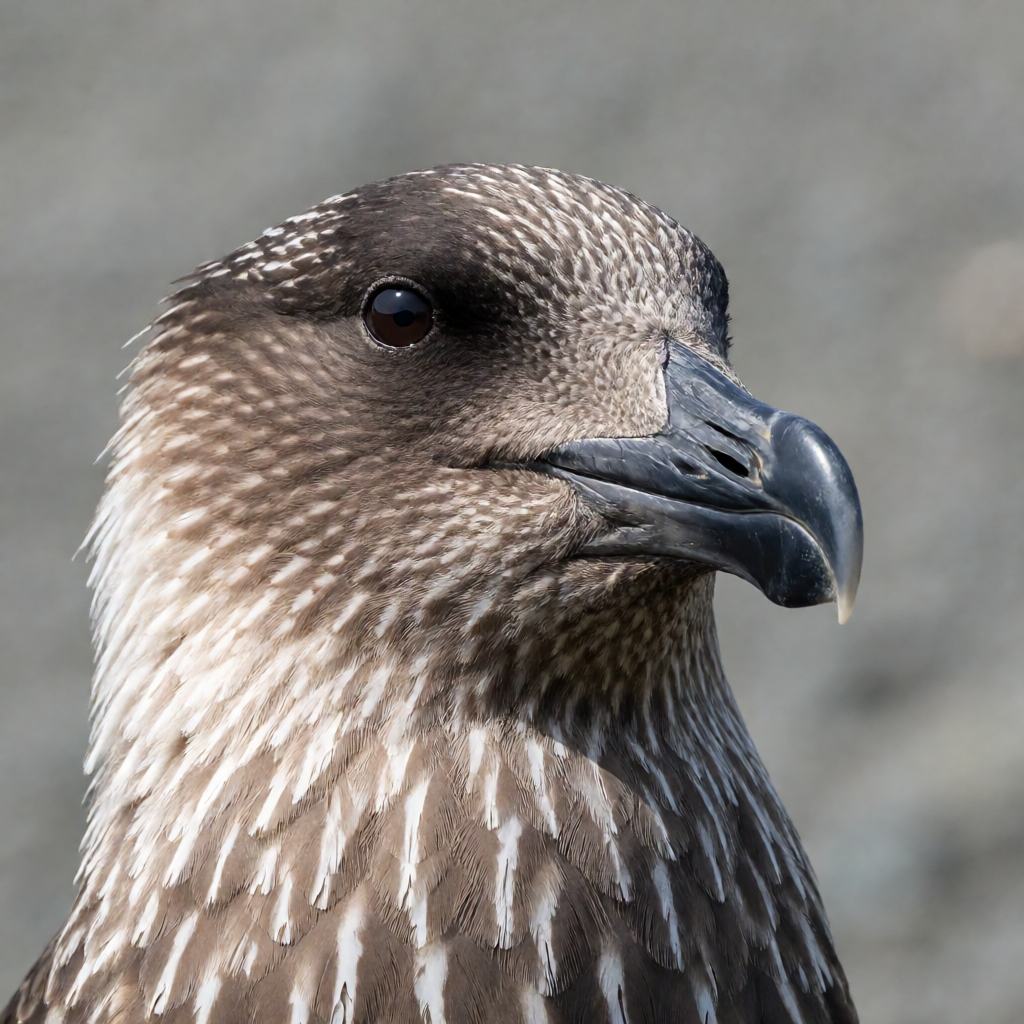
An adult great skua is between 53 and 58 centimetres in length. Its wingspan is between 125 and 140 centimetres. Its mass is between about 1.2 and 1.9 kilograms. So the bird is about the size of the great black-backed gull. It is the heaviest of the skuas of the world. The plumage of the adult is a dark and a mottled brown. It covers the whole of the upper surface. The head carries a cap of the darker brown. The neck and the sides of the head are streaked with the pale and the yellow-buff. The underparts are a little paler than the back. They are marked with the fine streaking of the dark. The whole of the plumage of the northern bird is warmer and more rufous in tone. It is warmer than the plumage of the skuas of the south.
The most conspicuous character of the bird in the air is a great patch of the white. The pale bases of the outer flight feathers form it. The patch is visible from a very long distance. It is the best of all the means of telling it apart. The other large dark seabirds of the north are hard to separate. The whole of the wing looks as if it had been struck by the light. The effect is that of 2 great flashes. The bill is heavy and is hooked at the tip. The point has a slight upward turn. The bill is dark. The structure is the bill of a bird that kills and tears. It is not the bill of a bird that pecks. The feet and the legs are black and are strong.
The claws are sharp. They are used in the attacks on the intruders of the territory. The tail of the adult is short. It is only slightly elongated in the central feathers. The bird is therefore much less graceful in the air. The smaller skuas of the same family are the graceful ones. The flight is a heavy and a deliberate and a powerful one. It is used for the direct pursuit rather than for the soaring. The 2 sexes are alike in the plumage. The female is on average slightly the larger of the 2. The young bird is a uniformly dark brown animal. It has none of the pale streaking of the adult. It does not have the full development of the white of the wing either.
1
2
3
Cliff top and open ocean
Where it lives
The great skua is a bird of the high and the exposed islands. Those islands lie in the north-east of the Atlantic. It is also a bird of the open ocean. The species breeds on the flat and the grassy tops of the sea cliffs. It breeds on the moorland of the islands. The boggy flat ground serves as well. The bird is very often found near the great colony of the other seabirds. The whole of its way of life depends on the presence of those birds. The gannets and the kittiwakes and the fulmars and the puffins are the ones. The skua takes their food. The species nests on the ground in a shallow scrape. The scrape is lined with the dry grass.
The other vegetation of the site goes in as well. The nest is placed in a solitary position. It can also be placed in a loose group of a few pairs. The pair is very territorial. It defends the area around the nest. It attacks the people and the other birds and the sheep. The territory is maintained through the whole of the breeding season. The whole of the breeding range of the species lies within 1 area. That area is a part of the Atlantic. It is influenced by the warm water of the North Atlantic drift. It is also influenced by the cold water of the northern seas. The productivity of that water is the base of the food chain.
The whole of the food chain of the bird rests on it. The population of the skua of the world is concentrated. It lives in a very small number of the island groups. The colonies of the north of Scotland hold a great part of the total. So do the colonies of Iceland and of the Faroes. Outside the breeding season the bird is a bird of the open sea. The adults of the north Atlantic winter in the south-west. They gather off the coast of Europe. They also winter off the north-west of Africa and off Newfoundland. The young and the immature birds travel much farther. They reach the coast of Brazil and the Caribbean and the west of Africa. The great skua is therefore a bird of the whole of the Atlantic for the greater part of the year.
A robber of other seabirds
What it eats
The great skua is a predator and a scavenger and a pirate. The whole of its feeding is based on the robbery of the other seabirds. The species is one of the most accomplished of the kleptoparasites of the world. The method of the hunt is the aerial pursuit of a bird that is carrying food. The skua dives at the victim from above. It forces the victim to twist and to turn. It forces the bird to drop the fish. The victim may regurgitate the meal instead. The skua then catches the food before it reaches the water. The species pursues the gannet and the great black-backed gull. It also pursues the kittiwake and the fulmar and the puffin. The Manx shearwater and the other birds of the colony are on the list too.
The size of the victim is no obstacle. The pursuit of the gannet is one of the great spectacles of the northern sea. The bird also takes the fish from the surface. It follows the trawlers of the north Atlantic for the waste that is thrown overboard. The discards of the fishery played a part in the growth of the population of the bird. That is one of the best of the documented effects. The fishing industry had that effect on a seabird. The species also kills and eats the other seabirds. The smaller birds of the colony are taken directly. The young and the eggs of the other species are important food. They matter most at the beginning of the breeding season. The species is known to take the adult puffins on the ground at night.
It takes the storm petrels and the other small seabirds as well. The great skua is therefore one of the main predators. The smaller seabirds of the islands of the north are its prey. The bird also takes the carrion of the shore. It takes the fish and the other material that is washed up. It takes the rodents and the rabbits and the other small mammals of the islands. There are the records of the attacks on the lambs. The foals of the pony of the island were attacked too. Those records have given the bird a reputation among the people of the islands. The bird does not entirely deserve that reputation.

One nest, two eggs
The breeding cycle
The great skua returns to the breeding island in the spring. The birds of the south of the range return in March. The birds of the far north arrive in May. The species forms a pair bond. The bond lasts for the whole of the life of the birds. The pair returns to the same territory year after year. The members of the pair are almost always found together. They meet at the site of the previous season. The courtship of the species is a simple one. It consists of the display of the head and of the wings. The calling on the ground is part of it as well. The pair does not carry out the elaborate aerial displays of the smaller skuas. The nest is a shallow scrape on the flat or the gently sloping ground. The scrape is lined with the dry grass and the moss of the site.
The site is chosen for the shelter and for the view. The concealment does not matter to the bird. The pair defends the area around the nest with great vigour. That vigour is unusual among the birds of the size. The clutch contains 2 eggs. The eggs are spotted and are an olive-brown or a grey-green colour. The incubation lasts for between 28 and 32 days. It is shared by both parents. The sitting bird is relieved at the intervals of 1 or 2 days. The other member of the pair can then go to the sea to feed. It can also go to rob the other birds. The chicks are covered in a grey down. They are precocial. They leave the nest within 24 or 48 hours of the hatching.
The young remain close to the site. They are fed by both parents for the whole of the rearing period. The chicks can fly at between 40 and 50 days of age. The young bird then goes to the sea. It wanders over the whole of the Atlantic for the first years of its life. The species does not breed until it is 7 or 8 years old. The bird spends the first years of its life at the sea. It comes to the land only to breed. The species is therefore one of the slowest of the seabirds. It reaches the age of the first breeding very late. The rate of the reproduction of the bird is correspondingly low. The whole of the demography of the species is built on the long life of the adult. The recorded age of the oldest of the known birds is 22 years.
Concentrated, and now falling
Conservation
The great skua is assessed as Least Concern on the global Red List. The total population of the world is put at between 30,000 and 34,999 mature individuals. The breeding population of Europe is between about 16,300 and 17,200 pairs. The whole of that figure is contained within the very small breeding range. That range lies in the north-east of the Atlantic. The species is therefore a bird of a large total number. It is also a bird of a very concentrated distribution. The population of the species increased through the greater part of the 20th century. The bird extended its range to the north and to the east. It established itself in Norway and in Svalbard and in the Barents Sea. The growth of the population had 2 explanations. The first was the protection of the bird from the persecution of the people. The second was the great quantity of the waste that the fishing industry provided. The fishing industry of the north Atlantic provided it. The second explanation is the more important in the modern period.
The species has suffered a very serious loss in the last years. The outbreak of the avian influenza began in the year 2022. It affected the seabirds of the north Atlantic. It caused a very heavy mortality in the great skua. The impact on the species was among the most severe of the region. No other seabird of the north suffered more. The loss of the breeding adults was studied in detail. The islands of the north of Scotland and of Iceland suffered most. That loss was the subject of a great deal of the concern. The reduction of the discards of the fishery is a further pressure. The modern regulation has greatly reduced the quantity of the waste. Less of the waste is thrown overboard now. The bird has lost a very considerable part of the supply of the food. That supply sustained the growth of the population. The species is also affected by the pollution of the sea by the oil.
It is affected by the ingestion of the plastic as well. The bird is one of the seabirds that are known to take the plastic. The fragments float on the surface of the water. The great skua is protected by the law in the whole of its breeding range. The great majority of the colonies lie within the designated areas. Those areas are designated for the protection of the birds and of the habitat. So the modern conservation of the bird is a matter of the sea. The management of the fishery matters more than the protection of the bird on the land. The species is one of the clearest of the examples of a seabird. The numbers of such a bird need a very large number of the young. Nothing else can maintain them. The loss of the adults to a single outbreak is therefore very serious. One outbreak of the disease can take a great many of them. The recovery of the population will be slow. The losses of the last years will take decades to make good.
Quick hits
Five things to remember
- The great skua takes the whole of its food by the robbery of the other seabirds. It forces the gannet and the kittiwake and the fulmar to give up the fish that they have caught.
- The bird dives at the intruder of its territory with the wings swept back. It strikes with the bill and the feet. Its reputation among the people of the northern islands is the oldest of the records of the behaviour of the seabirds of the region.
- The great patch of the white at the base of the flight feathers is visible from a very long distance. It is the best of all the means of telling the bird from the other large dark seabirds of the north.
- The species does not breed until it is between 7 and 8 years old. The oldest of the known birds lived for 22 years.
- The whole of the world population is contained within the islands of the north-east of the Atlantic. The bird is therefore one of the most concentrated of the seabirds of the world.