 By st20113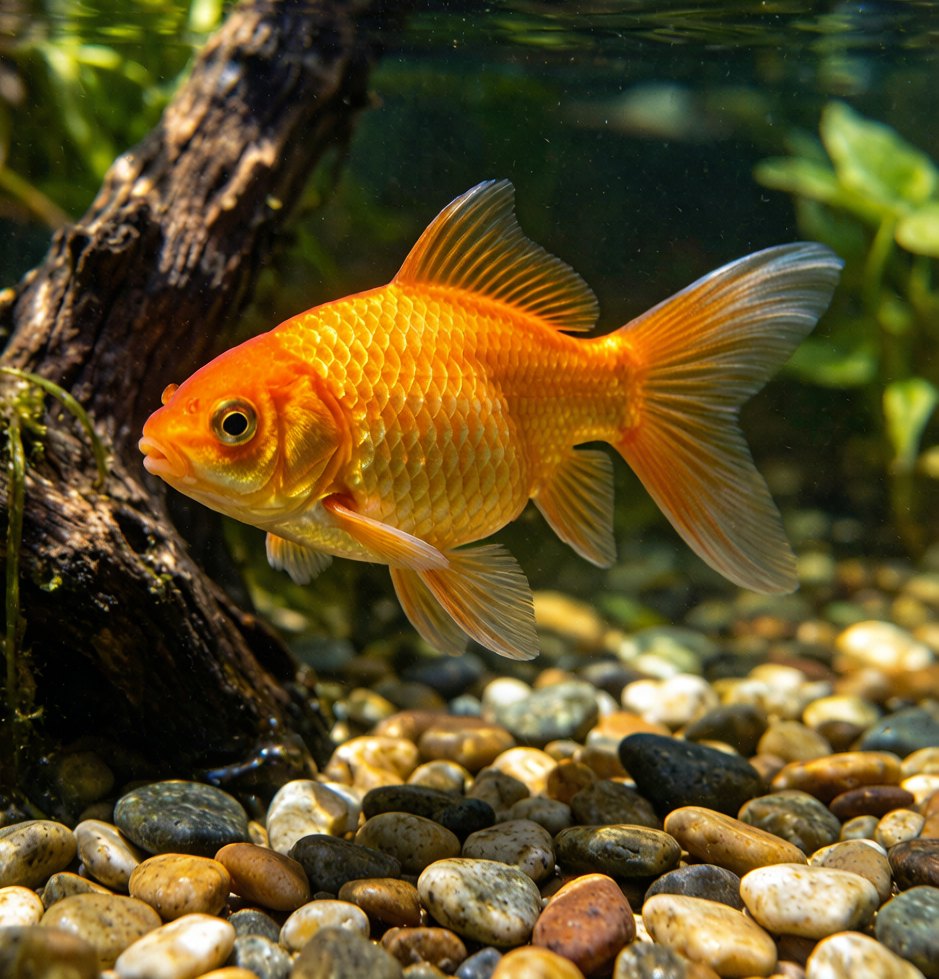
Introduction
The Goldfish is a small, hardy freshwater fish originally domesticated in China from a wild carp-like ancestor more than a thousand years ago. Today it exists in countless ornamental forms kept in ponds and aquaria worldwide, yet feral populations thrive in rivers and lakes on every continent except Antarctica. Beloved for its varied colours and tolerant nature, it is one of the most widely kept pet animals on Earth and a familiar sight in garden ponds everywhere.
Taxonomy
Carassius auratus belongs to the carp family Cyprinidae, the same family as the common carp, and is closely related to the crucian carp of Eurasia. Selective breeding over centuries has produced extremes of body shape, fin length and colour while the species remains a single biological unit beneath the variety. Its genus Carassius includes several Eurasian minnow-relatives, but the goldfish is by far the best known through domestication and the devotion of generations of fish keepers across many cultures and continents through history.
Physical Characteristics
Wild-type goldfish are olive-green and rather plain, but domesticated forms show red, orange, white, black, calico and metallic hues, with body lengths from a few centimetres to over forty centimetres in ponds. They have a single dorsal fin, no barbels in most forms, and keen colour vision suited to shallow water. Their lateral line senses water movement around them, and they possess pharyngeal teeth for grinding plant and animal food thoroughly. Selective breeds may have telescoping eyes, bubble heads or flowing double tails that impair their swimming ability in the wild.
Habitat
Goldfish prefer slow or still freshwater—ponds, lakes, canals, backwaters and flooded fields—with abundant vegetation and soft bottoms for feeding. In the wild they tolerate a wide range of temperatures and low oxygen better than many fish, even surviving beneath ice through winter. Released pets establish feral schools that can grow large and disturb ecosystems by stirring sediments and uprooting plants, reducing water clarity and harming native species that share the same habitat with them in lakes and slow rivers.
Diet
They are omnivorous and unfussy, eating algae, plant matter, aquatic insects, crustaceans, detritus and prepared foods with equal enthusiasm. In ponds they graze constantly, using acute senses to find food by sight and smell in the murk. Their adaptable feeding lets them thrive in captivity and in the wild alike, though overfeeding in aquaria is a common welfare problem that pollutes the water. They forage mostly in the water column and along the bottom, sifting through sediment for edible morsels throughout the day.
Reproduction
Spawning occurs in spring and summer when the water warms sufficiently. Females scatter sticky eggs among vegetation, where males fertilize them externally; a single female may release hundreds to thousands of eggs in a season. The parents provide no care, and the eggs hatch in a few days into tiny free-swimming fry. Fry grow quickly on minute live foods before graduating to larger items. Selective breeding by humans, rather than natural selection, now drives most of the species’ astonishing variety seen in shows and ponds today.
Conservation
As a domesticated species the goldfish is not threatened, but its release into the wild makes it an invasive pest in many regions, outcompeting native fish and degrading habitats through disturbance. Responsible ownership—never releasing pets into the wild—is the key conservation message for keepers everywhere. In its native Asian range the wild ancestor remains part of healthy freshwater ecosystems, while ornamental forms depend entirely on human care and controlled breeding for their continued existence and welfare.
Fun Facts
Goldfish can remember things for months, not just seconds as the persistent myth claims about them. They have no eyelids and can sleep with their eyes open at the bottom. Some individuals live more than twenty years, and pond fish can grow surprisingly large over decades. Their colours can change with diet, light exposure and age as they mature. A goldfish’s hearing is excellent, picking up sounds and vibrations through its swim bladder and lateral line system.
[…] it a favorite of European herpetologists for centuries, though introduced competitors such as the goldfish now threaten […]
[…] ditches, and flooded meadows where it breeds in noisy spring choruses. Introduced fish such as the goldfish can devastate its […]
[…] The Alpine Newt (Ichthyosaura alpestris) is a colorful montane newt found across the hills and mountains of central and southern Europe, from the Pyrenees to the Balkans. Famous for the brilliant blue flanks and crested back of breeding males, it is one of the most attractive European amphibians and a favorite subject of pond naturalists. Like other newts it leads a double life, splitting the year between aquatic breeding habitat and terrestrial woodland shelter, and its larvae are vulnerable to stocked fish such as the goldfish. […]
[…] nickname. It is the sole living member of its genus Tinca and is traditionally farmed alongside the goldfish and the […]
[…] entirely aquatic, rarely straying far from water except during dispersal after heavy rain. The goldfish is frequently introduced to the same ponds where edible frogs breed, and both species compete for […]
[…] on vegetation and bridges over streams. The order has a global distribution except Antarctica. The goldfish and the atlantic salmon share the same freshwater habitats and both prey on caddisfly larvae, […]
[…] abundant submerged vegetation for egg-laying. Their breeding ponds are typically fish-free, and the goldfish is a significant threat where introduced into acidic moorland pools. The species range extends […]
[…] of the genus Barbus, the barbels. The genus belongs to the carp family Cyprinidae, alongside the Goldfish and common carp, and is distinct from the salmonids such as Brown Trout. Several other European […]