 By st20113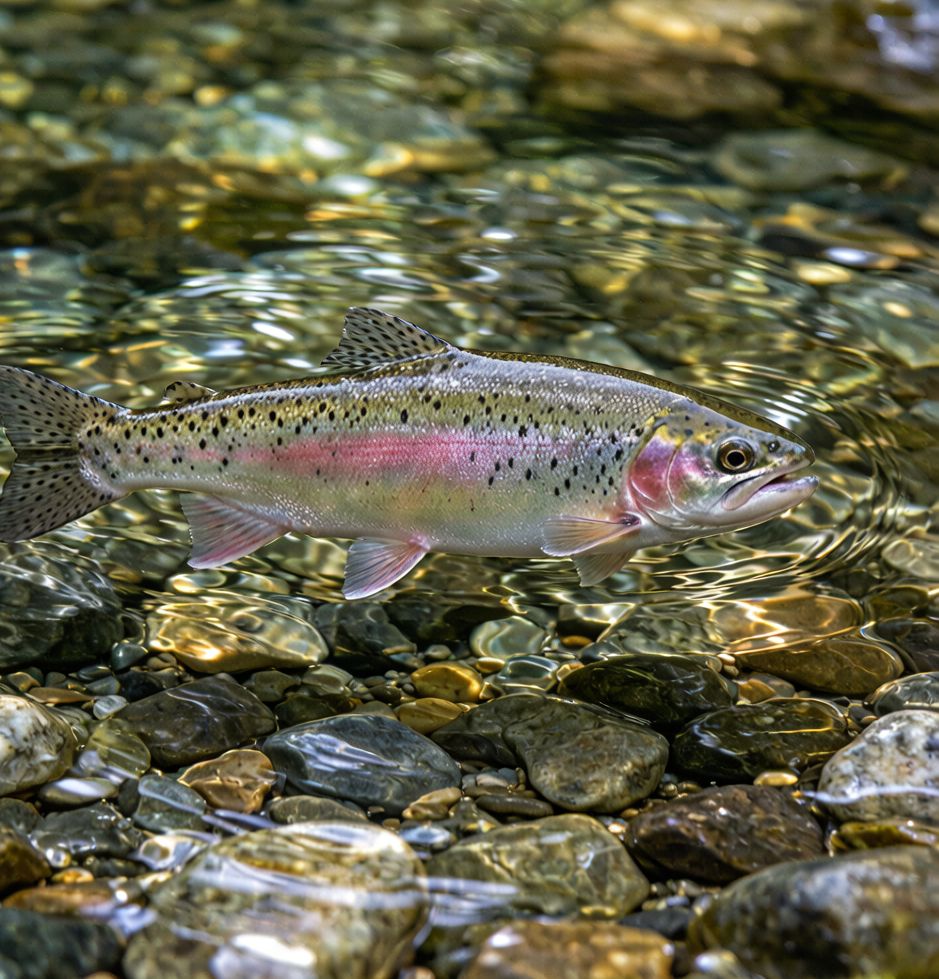
Introduction
The Rainbow Trout is a colorful, economically important freshwater and anadromous fish native to the rivers of North America and now established on every continent except Antarctica through stocking. Named for the iridescent pink stripe along its side, it is prized by anglers and fish farmers alike for its sporting quality and fine flavour. Adaptable and fast-growing, it thrives in cool, well-oxygenated streams, lakes and rivers across a remarkable range of conditions and altitudes worldwide.
Taxonomy
Oncorhynchus mykiss belongs to the salmon family Salmonidae, the same family as the swordfish is a different family, Xiphiidae, but both are bony fish sought by anglers; the trout’s true relatives include salmon, char and whitefish of the Northern Hemisphere. The steelhead is the sea-running form of the same species, while the entirely freshwater form is the familiar rainbow trout of streams and lakes. Its genus Oncorhynchus contains the Pacific salmon, to which it is closely related despite its very different life history and appearance in the water.
Physical Characteristics
Rainbow trout typically measure twenty-five to sixty centimetres, though lake-dwelling and anadromous forms can exceed one meter in length. The body is streamlined and silvery with a broad pink-to-red lateral band and numerous small black spots on the body and fins. They have an adipose fin, a forked tail and sharp, small teeth suited to seizing prey. Coloration intensifies in breeding males, which may develop a hooked jaw called a kype. Excellent vision and a keen sense of smell guide their feeding and their homing to natal streams each spawning season.
Habitat
They require cool, clear, oxygen-rich water and are most abundant in upland streams, spring-fed rivers, glacial lakes and reservoirs across their range. Spawning occurs in gravelly shallows where groundwater upwells through the bed. Stocked populations inhabit everything from tiny creeks to large lakes and impoundments. Because they are sensitive to warm, deoxygenated water, they are regarded as useful indicators of healthy, unpolluted waterways and of the overall integrity of freshwater ecosystems in which they live.
Diet
Rainbow trout are active predators and opportunistic feeders, taking aquatic and terrestrial insects, crustaceans, small fish and fish eggs with equal readiness. In hatcheries they are raised on pellets, but wild fish hunt live prey near the surface and along the bottom of the stream. Larger trout become increasingly piscivorous, taking smaller fish when available. Their willingness to strike artificial flies and lures makes them a cornerstone of recreational fisheries worldwide and a valuable species for aquaculture and food production alike.
Reproduction
Spawning runs begin in spring or autumn depending on latitude and local conditions. Females dig shallow nests, called redds, in gravel, where they deposit eggs that males fertilize externally. The eggs incubate through winter and fry emerge in spring to begin life. Unlike Pacific salmon, rainbow trout and steelhead may survive to spawn several times across their lives. Stocked fish support put-and-take fisheries, while wild populations undertake localized migrations to the natal gravels where they themselves hatched years before.
Conservation
The species is not globally threatened and is among the most widely propagated fish on the planet, yet wild, self-sustaining populations face pressures from habitat degradation, dams, pollution and hybridization with introduced strains. Carefully managed stocking and protected riparian zones help maintain wild genetics and healthy rivers. As both a food source and a sport fish, the rainbow trout links conservation with substantial economic value for communities that depend on angling tourism and sustainable aquaculture operations.
Fun Facts
The steelhead is the ocean-going version of the same species and can return to spawn multiple times in its life. A rainbow trout’s pink stripe shimmers with a shift of light as it turns. They can leap waterfalls by swimming straight up the flow with determination. Wild fish remember feeding spots and underwater structures with surprising precision over time. Some lake trout grow so large they are mistaken for other, unrelated species entirely by casual observers.