 By st20113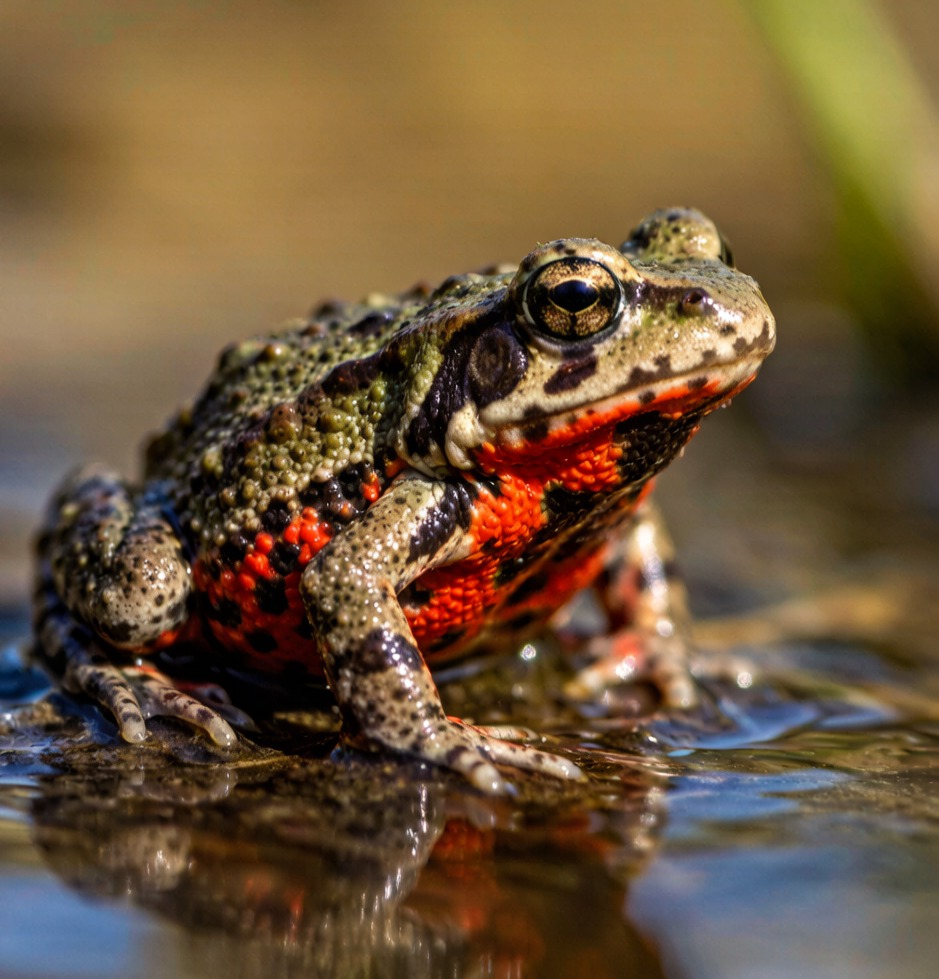
Introduction
The Fire-bellied Toad (Bombina bombina) is a striking European amphibian named for the brilliant red and black patterning on its underside, a vivid warning to predators that its skin secretes distasteful toxins. Found across the lowlands of central and eastern Europe, it is one of two fire-bellied toad species in the region and a familiar inhabitant of stagnant ponds, ditches, and flooded meadows where it breeds in noisy spring choruses. Introduced fish such as the goldfish can devastate its tadpoles.
Taxonomy and Evolution
The Fire-bellied Toad belongs to the family Bombinatoridae, the bell toads, and the genus Bombina, which contains about eight species across Europe and Asia. It was first described by Carl Linnaeus in 1761. The genus is ancient, with fossil relatives from the Paleocene. Its closest European relative is the Yellow-bellied Toad, and the two form a hybrid zone in central Europe where their ranges meet. The genus name Bombina is derived from the Latin bombus, referring to the male’s deep booming call that carries across still water at dusk.
Physical Characteristics
Fire-bellied toads are small, measuring 4 to 7 cm in body length, with females slightly larger. The dorsal surface is warty and gray-green to olive, providing excellent camouflage among pond vegetation. The ventral surface is the dramatic contrast: bright red to orange with black blotches, visible only when the animal is active or threatened. The eyes have horizontally elliptical pupils, unusual among toads. The hind limbs are partially webbed, and the skin is rough with numerous parotoid glands that produce the defensive toxin when the animal is grasped by a predator.
Habitat and Distribution
These toads inhabit shallow stagnant or slow-flowing water bodies in lowland landscapes: ponds, ditches, oxbow lakes, gravel pits, and temporary flood pools. They prefer warm, sun-exposed water with abundant vegetation and soft bottoms. Unlike many amphibians they tolerate somewhat polluted and fish-free water, breeding in habitats that larger predators avoid. Their range centers on the lowlands of Poland, Germany, and the Balkans, extending into Russia and Ukraine, with isolated populations in the Netherlands and Belgium where pond creation has aided them.
Diet and Feeding Behavior
Fire-bellied toads are active foragers that feed on a variety of small invertebrates: insects, spiders, worms, crustaceans, and mollusks encountered at the water’s edge and in adjacent grassland. Tadpoles are herbivorous and detritivorous, grazing algae and organic matter from submerged surfaces. Adults hunt by sight, flicking a sticky tongue to capture prey, and can tackle surprisingly large items relative to their size. During the breeding season males call from the water and may feed little while holding territories against rivals in the chorus.
Reproduction and Life Cycle
Breeding spans spring through summer, triggered by warming water. Males produce a low booming call and grasp females in axillary amplexus. Females lay strings of 100 to 300 eggs attached to submerged vegetation, typically in several clutches. Tadpoles hatch in 3 to 10 days and metamorphose into toadlets after 6 to 8 weeks, emerging from the pond in mid to late summer. They reach sexual maturity at 2 to 3 years. In favorable years a single pond may produce thousands of juveniles, though many fall prey to the red fox and wading birds.
Conservation Status
Listed as Least Concern but declining locally across its range. Principal threats include drainage of breeding ponds, agricultural intensification, pollution from fertilizers and pesticides, and the introduction of fish and invasive amphibians that eat eggs and tadpoles. Climate-driven drought in summer can dry ponds before tadpoles complete metamorphosis. Conservation focuses on pond creation, buffer zones, and reducing pesticide use in farmland. In several countries it is a protected species under amphibian action plans and benefits from agri-environment schemes.
Fun Facts
When threatened, the fire-bellied toad performs an unkenreflex, arching its body and limbs to display the vivid red belly, a classic example of warning coloration in amphibians. Its skin secretions contain bombesin, a peptide toxin that is distasteful to predators and has been studied for medical applications. Despite the toxin, the species is harmless to humans who simply handle it. The male’s call is unusually low-pitched for such a small frog, sounding like a soft drumbeat across the water at dusk that carries surprising distances.
[…] to challenging environments, from high-altitude foraging to seasonal hibernation or migration. the fire-bellied toad, the yellow-bellied toad, and the smooth newt frequently coexist with the bombina danubiana across […]