 By st20113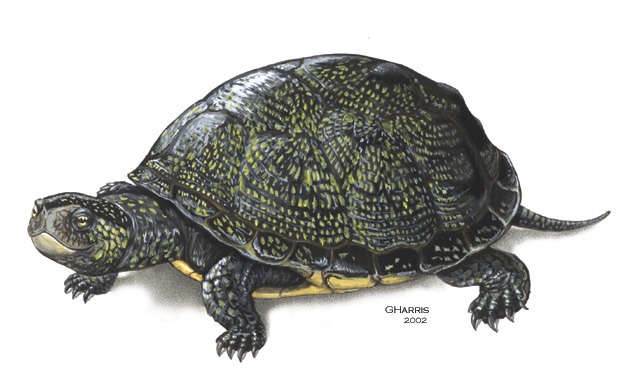
Introduction
The European Pond Turtle (Emys orbicularis) is the only native pond turtle of Europe and one of the continent’s most widespread freshwater reptiles, ranging from the Iberian Peninsula to Central Asia. A semi-aquatic basking species, it has declined sharply across much of its northern range as marshes and slow rivers have been drained. Its handsome spotted shell and docile nature have made it a favorite of European herpetologists for centuries, though introduced competitors such as the goldfish now threaten it.
Taxonomy and Evolution
The European Pond Turtle belongs to the family Emydidae, the pond and marsh turtles, and is the sole European representative of the genus Emys. Between 10 and 14 subspecies are recognized across its broad range, differing in size, coloration, and scale counts. The genus Emys is ancient, with fossil relatives dating to the Eocene epoch some 50 million years ago. Its closest relatives are the North American box turtles of the genus Terrapene, from which it diverged when the Atlantic opened. The species name orbicularis refers to its rounded shell shape, a key identification feature.
Physical Characteristics
European pond turtles measure 12 to 38 cm in shell length, with females typically larger than males. The carapace is olive to dark brown, marked with numerous small yellow or cream spots that fade with age. The plastron is dark with yellow markings and only partially hinged at the front, unlike the fully hinged box turtles. The head is greenish with yellow stripes, and the limbs are webbed with claws adapted for both swimming and walking on land. Males have a longer thicker tail and a concave plastron that helps them mount females during mating.
Habitat and Distribution
These turtles inhabit slow-moving rivers, canals, lakes, ponds, and marshes with abundant aquatic vegetation and muddy bottoms. They require sunny basking sites such as logs, rocks, or banks, and they hibernate buried in mud or under submerged roots through winter. Their range once extended across most of Europe but is now fragmented, surviving mainly in southern and eastern Europe, with isolated relict populations in Germany, France, and the Baltic region. They need both aquatic feeding habitat and terrestrial nesting sites nearby, making landscape connectivity essential.
Diet and Feeding Behavior
European pond turtles are omnivorous and opportunistic. Adults feed on aquatic insects, crustaceans, mollusks, small fish, frogs, and tadpoles, supplemented by fallen fruit and aquatic plants. Hatchlings and juveniles are more carnivorous, taking insect larvae and small invertebrates. They are active foragers that hunt by sight and scent in shallow water, and they will scavenge carrion. In captivity they readily take provided food, but in the wild their diet shifts seasonally with prey availability and water temperature through the year.
Reproduction and Life Cycle
Breeding occurs from May to July. Females lay 2 to 3 clutches per season, each with 3 to 18 elongated eggs deposited in sunny sandy or loose soil nests away from water. Incubation lasts 60 to 90 days and, like many turtles, sex is determined by temperature, with warmer nests producing more females. Hatchlings emerge in late summer or may overwinter in the nest, emerging the following spring. They reach sexual maturity at 6 to 8 years for males and 8 to 10 years for females. Lifespan in the wild can exceed 40 years, with some individuals living over 60.
Conservation Status
Listed as Least Concern globally but declining and locally threatened across much of its range. In many European countries it is strictly protected under national and EU law. Major threats include drainage of breeding habitat, pollution, introduction of invasive turtles and the goldfish that outcompete it, and collection for the pet trade. Road mortality of nesting females is significant, and eggs are taken by the red fox and corvid birds. Reintroduction and head-starting programs operate in several countries to bolster remnant populations and restore former range.
Fun Facts
European pond turtles are devoted sunbathers, sometimes piling several deep on a single log at favored basking spots, sliding into the water at the first sign of danger. They can absorb dissolved oxygen through the lining of their cloaca while hibernating underwater, allowing them to survive months without surfacing. Some individuals live more than 60 years, making them among the longest-lived European reptiles. In ancient Rome the turtle was associated with the god Hermes and appeared on mosaics as a symbol of slow wisdom and patience.
[…] is now placed in the genus Mauremys alongside several Asian pond turtles. It was long sunk within Emys orbicularis, the European Pond Turtle, and the two are still frequently mistaken for one another where their […]