 By st20113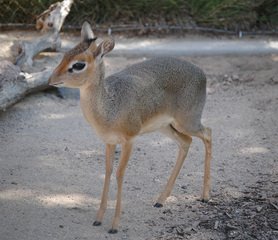
Introduction
The dik-dik is among the smallest antelopes in Africa, standing only 30–40 cm tall at the shoulder and weighing 3–6 kg. Named for the whistling alarm call of females, which sounds like “dik-dik,” these tiny creatures inhabit dense shrublands and bushy savannas across eastern and southwestern Africa. They form monogamous pairs and maintain small, lifelong territories that both male and female defend. Found from Kenya and Tanzania south to Namibia and Angola, dik-diks are a distinctive presence in the thornbush ecosystems of the African hinterland.
Taxonomy
The dik-dik belongs to the order Artiodactyla, family Bovidae, and genus Madoqua. The species Madoqua kirkii was first described by Albert Günther in 1880 and is named after Sir John Kirk, the British explorer and naturalist who accompanied David Livingstone in Africa. Four species are currently recognized within the genus Madoqua, each occupying distinct geographic ranges. The genus diverged from other bovid lineages in the Miocene epoch, and the dik-dik’s small size represents an extreme case of island-rule-like dwarfism adapted to dense, predator-rich habitats.
Physical Characteristics
Dik-diks have a compact body and an unusually elongated snout that gives them a almost comical appearance. This mobile proboscis helps dissipate heat in arid environments. The preorbital gland at the corner of each eye produces a dark, tar-like secretion that the dik-dik wipes onto twigs and grass stems, leaving scent marks that communicate territorial boundaries. Coat color varies across the range: East African populations are more reddish-brown, while southwestern populations tend toward greyish. Males sport short, spiky horns that curve backward, while females are typically larger and hornless.
Habitat
Dik-diks thrive in thick vegetation within arid and semi-arid savannas from Kenya and Tanzania south to Namibia and Angola. They require dense bushes to hide from predators, preferring areas close to seasonal rivers and waterholes. Like the related gerenuk, they inhabit regions where tall grasses and shrubs provide both food and cover. During heavy rains they briefly venture into more open ground, but they retreat to the bush at the first sign of danger. Dry season concentrations near water sources make them especially vulnerable to human hunters at these times.
Diet
Dik-diks are selective browsers, feeding on fruits, berries, and leaves from acacia and mimosa trees. Their elongated snout allows them to browse vegetation that other antelopes cannot reach. Like the African elephant, they play a role in seed dispersal through their feces, contributing to forest regeneration in arid regions. They obtain most of their water from food but require access to surface water daily. They feed primarily in the early morning and late afternoon, resting in shade during the hottest hours.
Reproduction
Dik-diks are monogamous and form lifelong pair bonds, one of the few antelope species to do so. Both the male and female actively defend their shared territory against intruders, using dung piles at the boundaries and gland secretions on vegetation. Females give birth to a single fawn after a gestation of approximately 170 days. The fawn lies hidden in dense bush for the first few weeks of life, suckled by the mother at regular intervals. Pairs reunite after each bout of foraging and spend most of their time within a few meters of each other.
Conservation
The dik-dik is classified as a species of Least Concern by the IUCN, with populations considered stable across most of its range. Major threats include habitat loss from agricultural expansion and uncontrolled burning of savanna vegetation. They are hunted for their skin, which produces a fine suede called “dik-dik suede,” and for bushmeat in some regions. Natural predators include the African lion, cheetah, and African wild dog. Protected areas such as Tanzania’s Ruaha National Park and Namibia’s Etosha National Park provide important refuges for the species.
Fun Facts
The dik-dik’s name comes from its distinctive alarm call: females emit a stuttering whistling sound that sounds like “dik-dik.” These tiny antelopes can leap up to 2 meters in the air when startled, a behavior known as a “stott.” Despite their small size they are extremely territorial and will face down much larger animals to protect their mates and offspring. They engage in a behavior called “lying out,” where fawns remain motionless in dense vegetation for hours while their parents forage nearby, relying on camouflage and stillness for protection.