 By st20113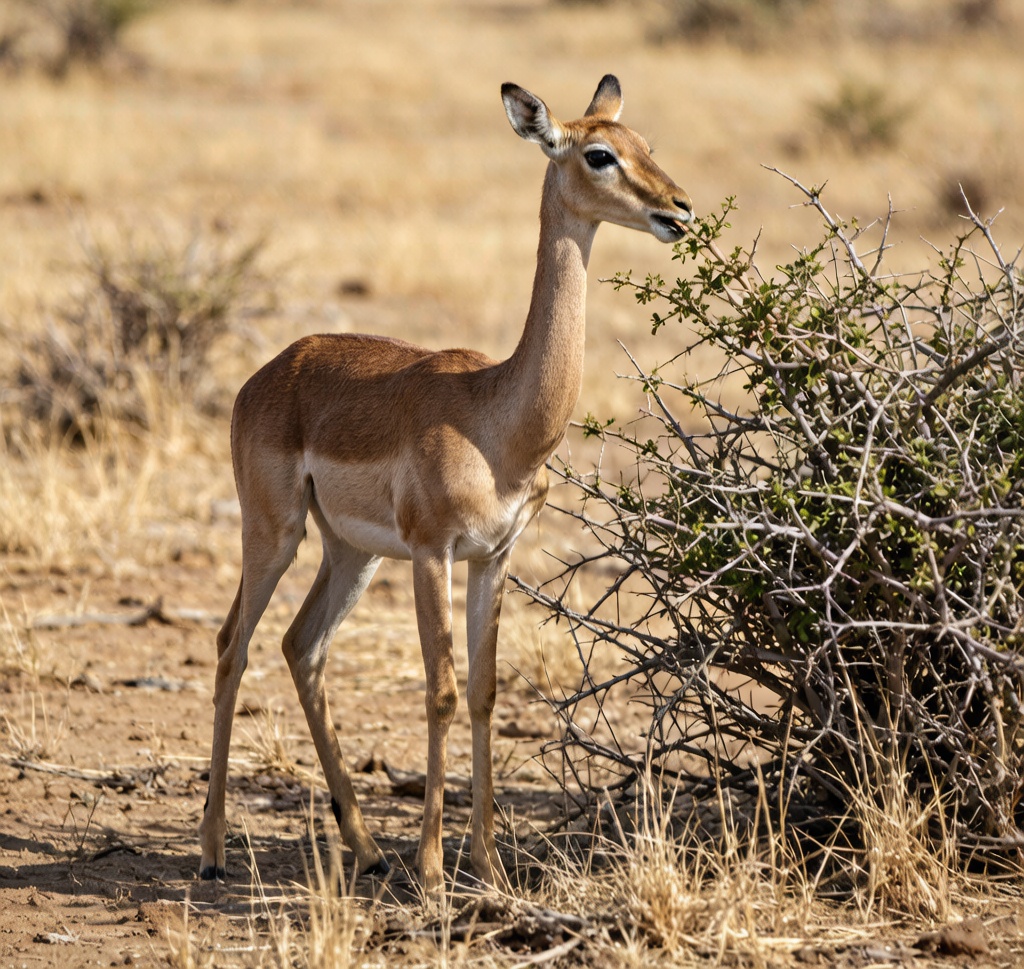
Introduction
The gerenuk (Litocranius walleri), whose name means ‘giraffe-necked’ in Somali, is one of the most unusual antelopes in Africa. With an elongated neck and slender limbs, it stands on its hind legs to browse leaves that other herbivores cannot reach. This remarkable posture has earned it the nickname ‘the standing antelope.’ Found in the dry bushlands of the Horn of Africa and East Africa, the gerenuk has evolved a lifestyle almost entirely independent of standing water, feeding on foliage that supplies both food and moisture.
Taxonomy
The gerenuk belongs to the family Bovidae and the tribe Antilopini, which includes many small to medium antelopes. Its genus, Litocranius, is monotypic, containing only this species, with two recognized subspecies: Litocranius walleri walleri and the larger Litocranius walleri sclateri. It is most closely related to the Saiga Antelope and other slender antelopes within its tribe, though its distinctive form sets it apart from every other member of the group.
Physical Characteristics
Gerenuks are slender animals, standing about 80 to 105 centimeters at the shoulder and weighing 28 to 52 kilograms. Males are larger than females and are the only sex that bears horns, which are relatively short, heavily ringed, and curved backward like lyres. The long, flexible neck and raised posture give the gerenuk a Giraffe-like silhouette. Their large, dark eyes and mobile lips help them select tender leaves, while a narrowed muzzle lets them pick out the choicest shoots with precision.
Habitat
Gerenuks inhabit dry, thorny bushland, semi-arid savanna, and open scrub, mostly in Somalia, Ethiopia, Kenya, and Tanzania. They prefer regions with scattered acacia and commiphora trees that provide browse at height. They are well suited to the Desert Ecosystem fringes, where they avoid competition by feeding above the level used by ground-grazing antelopes. Their ability to extract moisture from leaves means they can survive far from rivers and waterholes.
Diet
Unlike most antelopes, the gerenuk is almost exclusively a browser rather than a grazer. It feeds on leaves, shoots, flowers, and fruits of woody plants, especially acacia. By rearing up on its hind legs and using its front hooves to pull down branches, it reaches forage up to 2 meters above the ground. This unique strategy reduces competition with grazers such as the Blue Wildebeest. Gerenuks rarely drink, obtaining nearly all needed water from their food, a key adaptation to arid life.
Reproduction
Gerenuks do not have a strict breeding season and may mate at any time of year, though births often peak with the rains. After a gestation of about six to seven months, a single calf is born, usually hidden in vegetation for the first weeks of life. The mother visits periodically to nurse, and the calf begins to sample leaves within a few weeks. Young gerenuks stay with their mother until they are independent, with males eventually establishing small territories marked with scent and dung middens to attract females.
Conservation
The gerenuk is classified as Near Threatened by the IUCN. Its population has declined due to habitat loss from agricultural expansion, overgrazing by livestock, and hunting for meat and trophies. Because it depends on specific dry bushland, it is vulnerable to conversion of its habitat to farmland. Related mountain browsers such as the Markhor face similar pressures, underscoring the fragility of specialized browsing antelopes across their ranges.
Fun Facts
The gerenuk can stand balanced on its hind legs for extended periods, using just its hind feet and a stiff tail for support while both front legs pull down foliage. It is one of the few antelopes that almost never drinks water, living entirely off the moisture in leaves. Despite its delicate look, the gerenuk is a remarkably efficient forager that can survive in some of the driest habitats in Africa. Its Somali name, ‘geri,’ reflects how long it has been known to local peoples, and its lyre-shaped horns make males easy to identify from a distance.
[…] to hide from predators, preferring areas close to seasonal rivers and waterholes. Like the related gerenuk, they inhabit regions where tall grasses and shrubs provide both food and cover. During heavy rains […]