 By st20113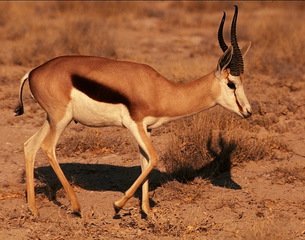
Introduction
The springbok is a medium-sized antelope native to the open plains and arid savannas of southwestern Africa. Known for its spectacular high jumps and graceful builds, the springbok is the national animal of South Africa and one of the most recognizable large mammals on the continent. Herds of hundreds or even thousands once moved across the Namib and Kalahari in sweeping seasonal migrations, though these massive aggregations are now largely confined to protected areas. The springbok’s combination of speed, agility, and striking coat pattern has made it a symbol of vitality across southern Africa.
Taxonomy
The springbok belongs to the order Artiodactyla, family Bovidae, and genus Antidorcas. The species Antidorcas marsupialis was scientifically described by Anselme Gaëtan Desmarest in 1810. The genus name Antidorcas translates from Greek as “opposite to gazelle,” a reference to the springbok’s distinctive habit of jumping rather than running when startled. Phylogenetic studies place the springbok as closely related to true gazelles within the subfamily Antilopinae, sharing a common ancestor that diverged roughly 5 million years ago during the Miocene epoch.
Physical Characteristics
Springboks weigh 26–48 kg, with males larger than females. Their coat is light reddish-brown with a dark stripe running along each side from the elbow to the hind leg, and a white belly and inner legs. They are slender and long-limbed, built for sustained running at high speed. Their most famous feature is their ability to pronk: a high vertical leap in which the animal arches its back, extends all four legs stiffly downward, and lands again without breaking stride. Males possess curved, lyre-shaped horns, while females have smaller, straighter horns or none at all.
Habitat
Springboks inhabit the open plains and arid savannas of southwestern Africa, particularly the Namib Desert, Kalahari Basin, and South African Karoo. They favor short-grassed plains where their vision is unobstructed and can detect approaching predators from a distance. Herds migrate following rainfall patterns and the growth of fresh vegetation, sometimes forming large congregations of thousands in the most favorable seasons. Like the blue wildebeest, they are adapted to moving across vast distances in response to seasonal conditions.
Diet
Springboks are mixed feeders, primarily grazing on grasses and browsing on shrubs and forbs when grasses are scarce. During the dry season they shift toward tougher plants, including bitterbush leaves and wild melons. They can survive long periods without drinking, obtaining most of their water requirements from their food. They feed in the early morning and late afternoon, resting during the heat of the day to conserve water. Their diet shifts seasonally with plant availability, providing nutritional flexibility across the arid and unpredictable environments they inhabit.
Reproduction
During the breeding season, dominant males establish territories and attempt to gather harems of females through elaborate displays and chasing. Males perform exaggerated pronking displays to attract mates and repel rivals, with the African lion and cheetah as their primary natural predators. Females reach sexual maturity at about one year and typically give birth to a single lamb after a gestation of roughly 5.5 months, most commonly during the rainy season when fresh forage is plentiful. Lambs are active within hours of birth and can keep pace with the herd shortly after birth.
Conservation
The springbok remains the most abundant large antelope in southwestern Africa, classified as a species of Least Concern. Its populations are stable within protected areas including Namibia’s Etosha National Park and the Kalahari Desert reserves of Botswana and South Africa. Outside protected zones, populations have declined in areas of intensive human settlement and agricultural development. The meerkat shares parts of the springbok’s range, though they occupy different ecological niches and compete minimally. Commercial farming of springbok for meat and leather has created sustainable economic incentives for habitat preservation in parts of its range.
Fun Facts
The name “springbok” comes from Afrikaans and Dutch roots meaning “jumping antelope,” a reference to the animal’s extraordinary pronking ability. During the 19th century, springbok herds of up to several million individuals migrated across the Karoo, one of the largest animal aggregations on Earth, though these great treks were largely ended by extensive hunting. The springbok was one of the first African animals depicted in European art, appearing in Dutch landscape paintings from the Cape Colony in the 17th century. Its national symbol status in South Africa reflects its deep cultural significance, appearing on coins, corporate logos, and sporting team emblems throughout the country.