 By st20113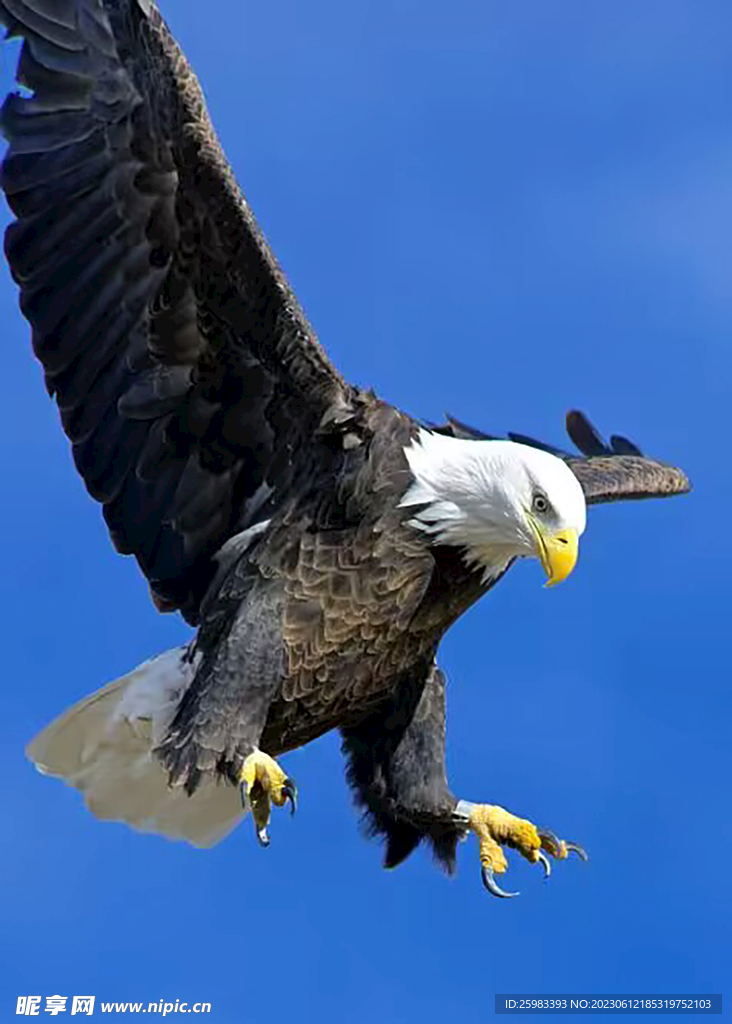
The Bald Eagle (Haliaeetus leucocephalus) is one of North America’s most iconic birds of prey, serving as the national emblem of the United States since 1782. The bald eagle’s striking appearance — gleaming white head contrasting with a dark brown body and wings, sharp yellow beak, and powerful wingspan reaching 2.3 meters (7.5 feet) — has made it a symbol of strength, freedom, and wilderness across the continent. Once endangered due to DDT pesticide poisoning, the bald eagle has made a spectacular recovery and now numbers over 300,000 individuals, making it one of the most celebrated conservation success stories in modern wildlife protection.
Physical Characteristics
The bald eagle is one of the largest raptors in North America, with adults typically weighing 3–6.3 kg (7–14 lbs) and measuring 70–102 cm (28–40 inches) in body length, females being approximately 25% larger than males. The wingspan is impressive at 1.8–2.3 meters (6–7.5 feet), enabling the bird to soar on thermal currents for hours with minimal wing-flapping. Despite its common name, the “bald” descriptor comes from an older English word “piebald” meaning white-headed, not lacking hair — the distinctive white plumage of the head and tail develops fully at 5 years of age, with juvenile bald eagles appearing mottled brown and white until they mature.
The bald eagle’s vision is legendary — estimates suggest its visual acuity is 4–8 times superior to that of humans, enabling it to detect fish and prey from great distances. Like all raptors, the bald eagle has a strongly hooked beak and powerful talons adapted for catching and carrying prey. The legs are unfeathered (unlike some eagle species) and covered in rough scales. Bald eagles are capable of diving at speeds exceeding 120 km/h (75 mph) and can lift prey weighing up to approximately 4 kg (9 lbs), though they more commonly scavenge carcasses or steal fish from osprey.
Diet and Foraging Ecology
The bald eagle is an opportunistic apex predator and scavenger whose diet is heavily dominated by fish — approximately 50–75% of its diet in most populations. Bald eagles are expert fishers, employing two primary hunting strategies: plunge-diving from height to snatch fish near the water surface with their talons, and wading in shallow water to catch fish and other aquatic prey. In areas where fish are abundant, bald eagles may focus almost exclusively on this resource, but they are highly opportunistic and will readily take waterfowl, small mammals, turtles, snakes, and carrion. The image of bald eagles gathering at salmon runs in Alaska, feasting on spawning fish, is one of the most iconic wildlife spectacles in North America.
The bald eagle’s role as a scavenger and facultative predator places it at the top of the North American terrestrial and aquatic food web, making it an indicator species for ecosystem health. Bald eagles concentrate in areas where food is abundant — along major rivers, coastlines, and fish-rich lakes — and their nesting distribution closely tracks the availability of reliable food sources. In this respect, the bald eagle’s ecological role parallels that of the Snow Leopard in Asian mountain ecosystems or the Lion in the African savanna: as apex predators, both species regulate prey populations and help maintain the ecological balance of their respective environments.
Nesting and Reproduction
Bald eagles are monogamous and mate for life, typically maintaining the same nest site year after year. They construct the largest nests of any North American bird — called eyries — woven from sticks and lined with softer materials such as moss, grass, and seaweed. The largest recorded bald eagle nest, in Florida, was 2.9 meters (9.5 feet) deep, 2.6 meters (8.5 feet) wide, and weighed an estimated 2 tonnes. Bald eagles typically lay 1–3 eggs per clutch, with both parents sharing incubation duties for approximately 35 days. Eaglets fledge at 10–12 weeks but remain dependent on their parents for several additional months, learning to hunt and survive before dispersing to establish their own territories.
Conservation and Recovery
The bald eagle’s near-extinction in the contiguous United States during the mid-20th century stands as one of environmental science’s most important lessons. The pesticide DDT, widely used in agriculture after World War II, accumulated in the bodies of fish-eating birds and caused eggshell thinning — females laid eggs so thin-shelled that they broke during incubation. By 1963, the bald eagle population had plummeted to just 417 nesting pairs in the lower 48 states. The 1972 ban on DDT in the United States, combined with the Endangered Species Act of 1973 and aggressive conservation breeding and reintroduction programs, triggered one of the most remarkable wildlife recoveries ever documented. The bald eagle was removed from the U.S. Endangered Species List in 2007 and now numbers over 300,000 individuals across North America — a testament to what focused conservation action can achieve.
result of natural range expansion. Widespread North American birds such as the common raven and the bald eagle share the monarch’s geographic range and cultural significance as iconic species of the
[…] can “bottle”—sleeping underwater with only their nostrils above the surface. Like the bald eagle, which has a unique fingerprint-like pattern of feathers on its head, each harp seal’s spot […]
[…] feeds on carrion and plays a vital role in keeping mountain ecosystems clean. Far larger than the bald eagle, the Andean condor is a true symbol of the high Andes and one of the most powerful fliers on […]
[…] The peregrine falcon (Falco peregrinus) is a widespread raptor found on every continent except Antarctica, renowned as the fastest animal on the planet. In dramatic hunting stoops, it can exceed speeds of 320 kilometres per hour as it dives on avian prey. Historically devastated by pesticide poisoning, the peregrine has recovered spectacularly following the ban on DDT and captive-breeding programmes. Today it nests on remote cliffs and increasingly on city skyscrapers, where ledges mimic its natural cliff habitat. Its global comeback is considered one of the great successes of modern conservation, alongside other recovered raptors such as the bald eagle. […]
[…] Common Kestrel is a small, colorful falcon found across Europe, Asia and Africa. Roughly the size of a pigeon, it […]
[…] Bald Eagle (bald-eagle-haliaeetus-leucocephalus) shares with the Blackbird a place as a flagship species in […]