 By st20113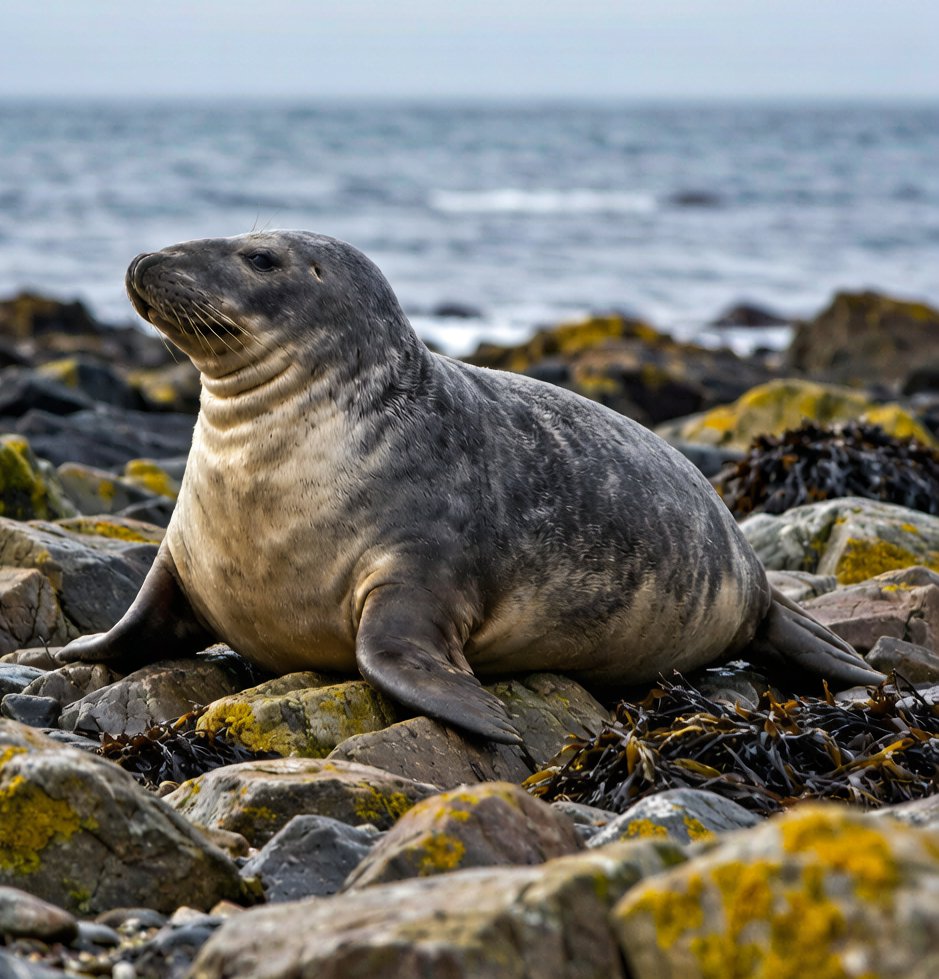
Introduction
The Gray Seal (Halichoerus grypus) is one of just two true seal species breeding in British and Irish waters, with a global population of around 400,000. Males are impressively large reaching 2.3 to 3.5 meters and 300 kg while the smaller females measure 1.6 to 2.0 meters and up to 150 kg. Known for their dog-like faces and a distinctive Roman-nose profile on adult males, gray seals are highly vocal during the breeding season and haul out on remote coasts and islands to pup and rest.
Taxonomy and Evolution
The Gray Seal is the sole member of the genus Halichoerus within the family Phocidae, the true seals. Three subspecies are recognized: H. g. grypus in the Baltic and North Atlantic, H. g. atlantica in the western Atlantic from Canada to Iceland, and H. g. macrorhyncha in the eastern Atlantic from Iceland to Norway. The species was first described scientifically in 1791 and molecular data suggest the three subspecies diverged during the last glacial period when populations were isolated on separate ice margins.
Physical Characteristics
Gray seals have a robust streamlined body with a broad rounded head and a relatively long straight muzzle giving adult males a distinctive arched nose profile. Adult males are dark gray-brown with lighter blotches and scars while females are lighter silvery-gray with darker blotches. Pups are born with a creamy-white lanugo coat shed within 2 to 4 weeks. The fore-flippers are powerful with strong claws for hauling out on rocks, and the rear flippers cannot be rotated forward so movement on land is a cumbersome humping motion.
Habitat and Distribution
Gray seals are found on both sides of the North Atlantic on coasts of Britain, Ireland, France, the Faroe Islands, Scandinavia, the Baltic Sea, Iceland, Greenland, and eastern North America. They prefer remote rocky coasts, sand dunes, and offshore islands for hauling out and breeding, spending most of the year at sea foraging on the continental shelf. Key UK breeding colonies include the Farne Islands, the Isle of May in Scotland, the Blasket Islands in Ireland, and the Donna Nook in Lincolnshire.
Diet and Feeding Behavior
Gray seals are opportunistic hunters that consume a wide range of fish and some cephalopods. Primary prey includes sand eels, cod, haddock, flatfish such as plaice and sole, and octopus. They may travel 50 to 100 kilometers from haul-out sites to feeding grounds, diving repeatedly through the day and resting on land at night. Studies using dive loggers show feeding dives are most frequent during daylight hours. The relationship with atlantic salmon is complex: while seals do prey on salmon the overall impact on populations is considered moderate relative to other pressures.
Reproduction and Life Cycle
Breeding occurs in autumn on land with males establishing territories among groups of females. Males vocalize extensively to attract females and deter rivals, producing distinctive guttural calls audible at some distance. After an 11-month gestation including delayed implantation, females give birth to a single white-coated pup from September to December. Pups nurse for about 3 weeks on extremely rich milk and gain weight rapidly. They are weaned abruptly and the mother returns to sea while pups undergo a fasting period of 2 to 3 weeks while molting their white coat before entering the water.
Conservation Status
Listed as Least Concern globally with a population currently estimated at around 400,000 individuals, roughly half of which are in the UK. Numbers are stable or increasing in most parts of the range and the species has recolonized parts of its former range in the Baltic Sea. Primary historical threats included hunting for meat, blubber, and oil, but these have largely ceased. Contemporary concerns include bycatch in fishing nets, collisions with vessels, and entanglement in marine debris.
Fun Facts
Gray seal milk is so rich in fat that pups can gain up to 2 kg per day during the nursing period, among the fastest growth rates of any mammal. Adult males can be identified by their unique pattern of scars from fighting much like fingerprints. They have a highly developed vocal repertoire and have been recorded producing over 30 distinct call types from loud male threats to quiet pup contact calls. Despite their clumsy appearance on land they are graceful and powerful swimmers capable of holding their breath for over an hour.