 By st20113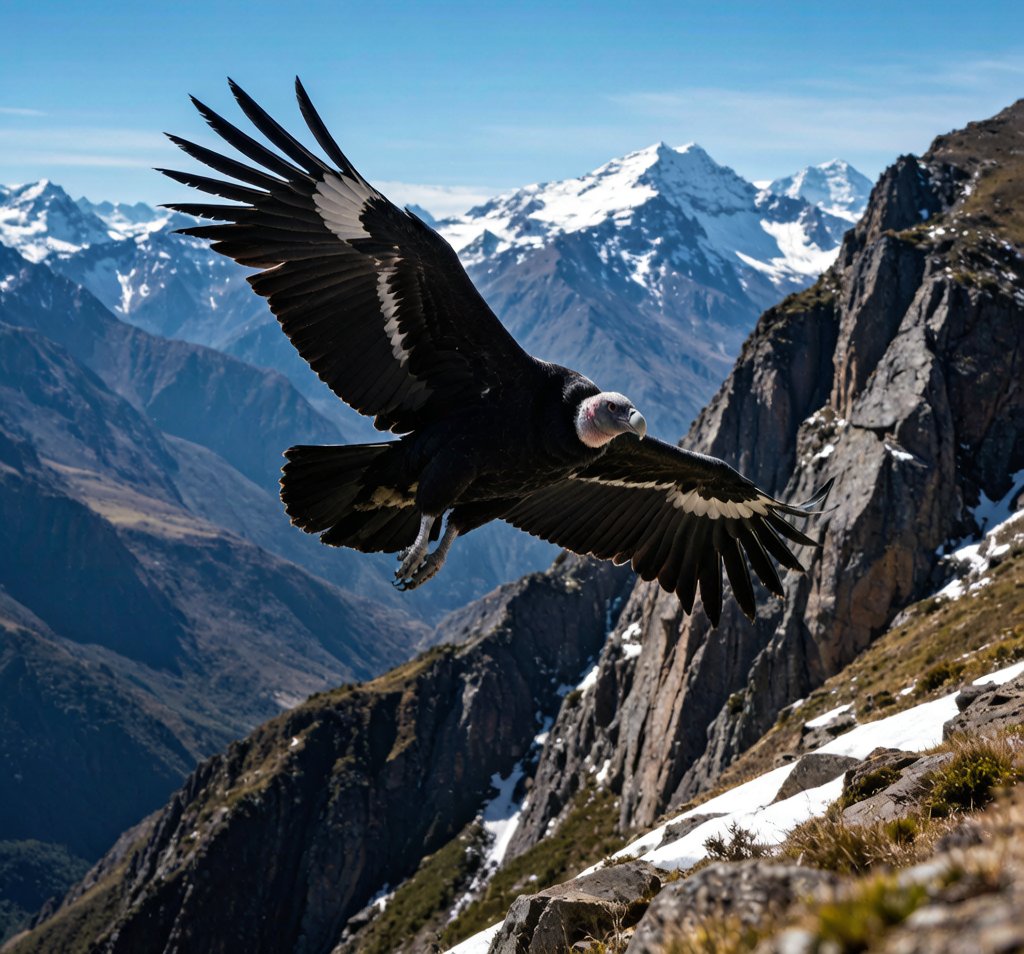
Introduction
The Andean condor (Vultur gryphus) is a giant New World vulture that soars over the Andes mountains of South America, from Venezuela and Colombia in the north to Patagonia in the south. It is one of the largest flying birds in the world, with a wingspan of up to 3.3 meters, and it holds deep cultural significance, appearing on the national emblems of several South American countries. Like other vultures, it feeds on carrion and plays a vital role in keeping mountain ecosystems clean. Far larger than the bald eagle, the Andean condor is a true symbol of the high Andes and one of the most powerful fliers on Earth.
Taxonomy
The Andean condor belongs to the family Cathartidae, the New World vultures, which are only distantly related to the vultures of Africa and Eurasia. It is the only member of its genus, Vultur, and its scientific name combines the Latin word for vulture with a reference to the griffin, a mythical creature. Its closest living relative is the California condor, another species that teetered on the brink of extinction. New World vultures are unusual among birds of prey in having a well-developed sense of smell, although the Andean condor relies more on sight than smaller turkey vultures do.
Physical Characteristics
The Andean condor is among the heaviest flying birds, with males weighing up to 15 kilograms and females slightly less. Adults are mostly black with white wing patches and a distinctive white collar of down around the neck. The bare head and neck are reddish, and males bear a fleshy comb on the crown. Its wings are long and broad, perfectly adapted for soaring on thermal updrafts for hours without flapping. Although it is dwarfed by the blue whale, the condor is the undisputed giant of the skies in its mountain realm.
Habitat
Andean condors inhabit open grasslands, alpine zones, and rugged mountain terrain at elevations between 3,000 and 5,000 meters, though they descend to coasts and lowland valleys to forage. They depend on strong updrafts and open country where they can spot carcasses from the air. In Patagonia, condors also patrol coastlines, where dead marine animals wash ashore. A beached humpback whale, for example, can attract condors from far away, providing a feast that lasts for weeks. The species ranges widely but is nowhere abundant, since each bird needs a huge territory.
Diet
The Andean condor is a scavenger that feeds on the carcasses of large mammals such as guanacos, deer, cattle, horses, and sheep. It locates food by sight, scanning slopes from great heights, and often follows other scavengers to a meal. Condors may travel more than 200 kilometers a day in search of food and can go days without eating. At a large carcass, several condors feed together, tearing at the meat with their hooked beaks. Like the brown bear, the condor is a powerful, opportunistic consumer of carrion, and it fills the same ecological role in the Andes that large scavengers fill elsewhere. In Africa, for example, the carcasses of animals such as the African elephant support entire communities of vultures.
Reproduction
Andean condors reproduce slowly. They form lifelong pair bonds, and courtship involves elaborate aerial displays in which males chase females in acrobatic dives. A single egg is laid every other year in a cave or crevice on a cliff face. Both parents incubate it for about two months, and the chick remains in the nest for six to seven months. Even after fledging, the young condor stays with its parents for nearly two years, learning to find food. Because pairs produce so few young and only every other year, the population grows very slowly, and the loss of even a few adults can set back recovery for years.
Conservation
The Andean condor is listed as Vulnerable by the IUCN. Its numbers have declined because of habitat loss, poisoning, and persecution, since some ranchers still shoot or poison condors they blame for killing livestock, although condors rarely attack live animals. Secondary poisoning from carcasses laced with poison intended for predators is a major threat, along with collisions with power lines. Captive breeding and release programs and education campaigns have been launched in several countries, where the condor is increasingly seen as a national symbol. Protecting the vast, open landscapes it needs remains the key to its survival.
Fun Facts
The Andean condor can soar for hours without flapping its wings and has been recorded flying at altitudes above 6,500 meters. It can fast for days, then eat up to five kilograms of meat in one sitting. Condors are extremely long-lived, with lifespans of up to 70 years in captivity. In Inca culture, the condor was considered the messenger of the heavens, and the Condor’s Dance is still performed in the Andes today. Unlike most birds, condors lack a voice box and communicate through hisses and grunts.
[…] example of convergent evolution. The California condor is therefore the close relative of the Andean Condor (Vultur gryphus). That bird is the giant scavenger of the Andes of South America. The 2 birds share the family and […]