 By st20113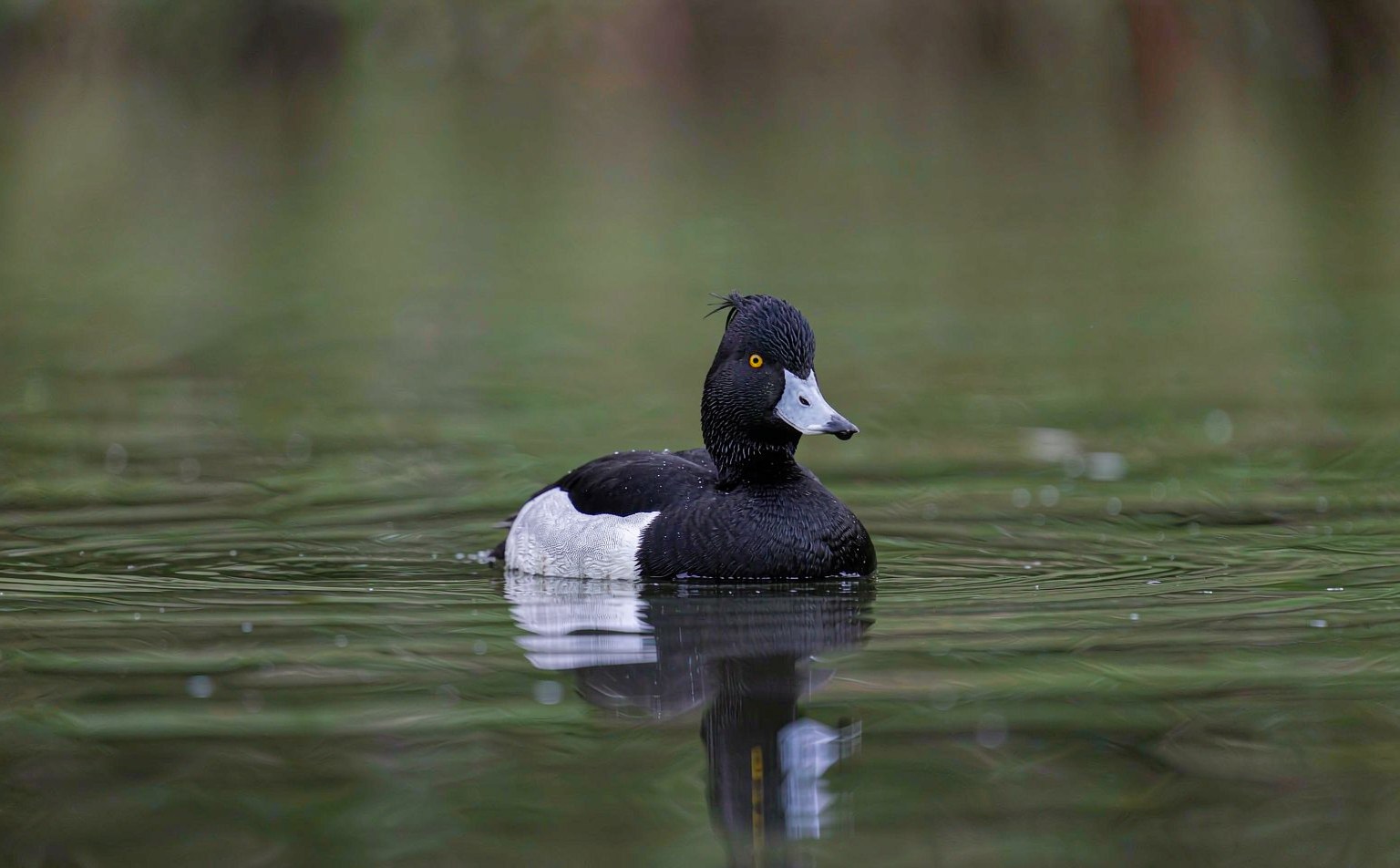
Aythya fuligula | Tufted Duck
Introduction
The Tufted Duck (Aythya fuligula) is a compact diving duck found across temperate and northern Eurasia. The male is one of the most recognisable ducks on European lakes, with glossy black plumage, a clean white flank, and a drooping crest at the back of the head that gives the species its common name. Females are plainer, dressed in warm brown with a smaller crest and a pale patch at the base of the bill.
A bird of freshwater lakes, gravel pits, and slow rivers, the tufted duck has benefited from the creation of artificial wetlands and flooded quarries, and in winter it gathers in large flocks on ice-free water. It belongs to the same diving duck group as the Mallard‘s more specialised relatives and is a familiar sight to birdwatchers across the continent.
Taxonomy
The Tufted Duck is placed in the genus Aythya, a group of diving ducks that also includes pochards and the canvasback, and within the family Anatidae. It was first described by the Swedish naturalist Carl Linnaeus in 1758, who gave it the binomial Anas fuligula; it was later moved to the genus Aythya as the relationships among diving ducks became better understood.
The genus name Aythya is derived from the Ancient Greek for a seabird or diver, while the species name fuligula combines the Latin for “soot” and “throat”, a reference to the bird’s dark colouring. Although superficially similar to the larger and rarer greater scaup, the tufted duck is distinguished by its crest and, in flight, by the broad white band along the trailing edge of the wing.
Physical Characteristics
An adult tufted duck measures about 40 to 47 centimetres in length, with a wingspan of 62 to 73 centimetres and a weight typically between 600 and 1,000 grams. Males in breeding plumage are striking: the head, neck, breast, and back are deep black with a green sheen, contrasting sharply with pure white flanks and belly. The long, slender crest hangs from the rear of the head and is most pronounced in display.
The bill is broad and slate blue-grey with a black tip, and the eye is vivid yellow. Females are uniformly dark brown above and paler below, with a smaller crest and a broad whitish patch at the base of the bill that helps separate them from similar species. In eclipse plumage, the male resembles the female but retains darker, blacker upperparts and a suggestion of the white flank.
In flight the species shows a narrow white wingbar and rapid, whirring wingbeats. Its body is round and buoyant, and when taking off from water it patters across the surface before becoming airborne, a typical behaviour of diving ducks.
Habitat
Tufted ducks breed beside shallow freshwater lakes, ponds, and slow-moving rivers, preferably with plenty of submerged vegetation and reed beds that offer cover. They also use gravel pits, reservoirs, and flooded clay or sand workings, which has allowed the population to expand in heavily modified landscapes.
Outside the breeding season the species widens its range to larger lakes, estuaries, and sheltered coastal bays where it can find open water and food. It avoids fast-flowing rivers and entirely marine environments except in calm, sheltered inlets. In northern parts of its range it is migratory, moving south and west to avoid frozen water, while birds in milder western Europe may remain through the winter in favoured flocks.
Diet
Unlike dabbling ducks that tip up at the surface, the tufted duck feeds by diving, often submerging for 15 to 30 seconds to reach food on the bottom. Its diet is dominated by animal prey such as freshwater mussels, snails, small clams, aquatic insects, and their larvae, which it crushes with its strong bill and grit-filled gizzard.
Plant material becomes more important outside the breeding season, when the duck eats seeds, roots, and leaves of pondweeds, wigeon grass, and other submerged vegetation. The species’ preference for molluscs links it ecologically to other water-edge hunters such as the Grey Heron and the Mute Swan, though the duck takes smaller, bottom-dwelling prey.
Reproduction
Pair formation begins in late winter on the wintering grounds, and pairs arrive at the breeding lakes together. The female builds a shallow nest of reed stems and down among waterside vegetation, often on a small island or floating raft of vegetation. She lays seven to ten olive-buff eggs and incubates them alone for about 25 to 28 days.
Soon after hatching, the dark, mobile ducklings leave the nest and follow the female to water, where they feed themselves on tiny invertebrates. The male takes no part in caring for the young. Broods may be adopted or mixed, and predation by large fish, gulls, and mammals can be heavy, but the large clutch size helps compensate for losses.
Conservation
The Tufted Duck is listed as a species of Least Concern by the International Union for Conservation of Nature, with a large global population that has grown considerably over the past century. The spread of man-made wetlands, including flooded quarries and ornamental lakes, has provided abundant new breeding and feeding habitat.
The main threats are the loss of clean water through pollution, the decline of freshwater mussels, and disturbance at sensitive breeding sites. Climate-driven changes to ice cover may shift the species’ winter range, but its adaptability means it is not currently at risk. It remains a common and welcome indicator of healthy lowland wetlands, sharing these habitats with mammals such as the European Water Vole.
Fun Facts
- The tufted duck’s crest is longest and most obvious on breeding males, and is used in courtship displays alongside head pumping and whistle-like calls.
- It feeds by fully submerging and can dive to several metres, staying underwater for up to half a minute.
- The species is sometimes called the “black duck with the pigtail” because of the male’s drooping head tuft.
- Females can lay very large clutches, occasionally more than a dozen eggs, sometimes including eggs from other females.
- Tufted ducks are strong migrants, with northern birds travelling thousands of kilometres to reach ice-free winter waters.
[…] of the adaptations of the family. The red-breasted merganser is the close relative of the Tufted Duck (Aythya fuligula). That is the common diving duck of the lakes and the reservoirs of […]
[…] to the sea duck group. Members of that group feed under water rather than at the surface. The Tufted Duck is one of its relatives in that […]