 By st20113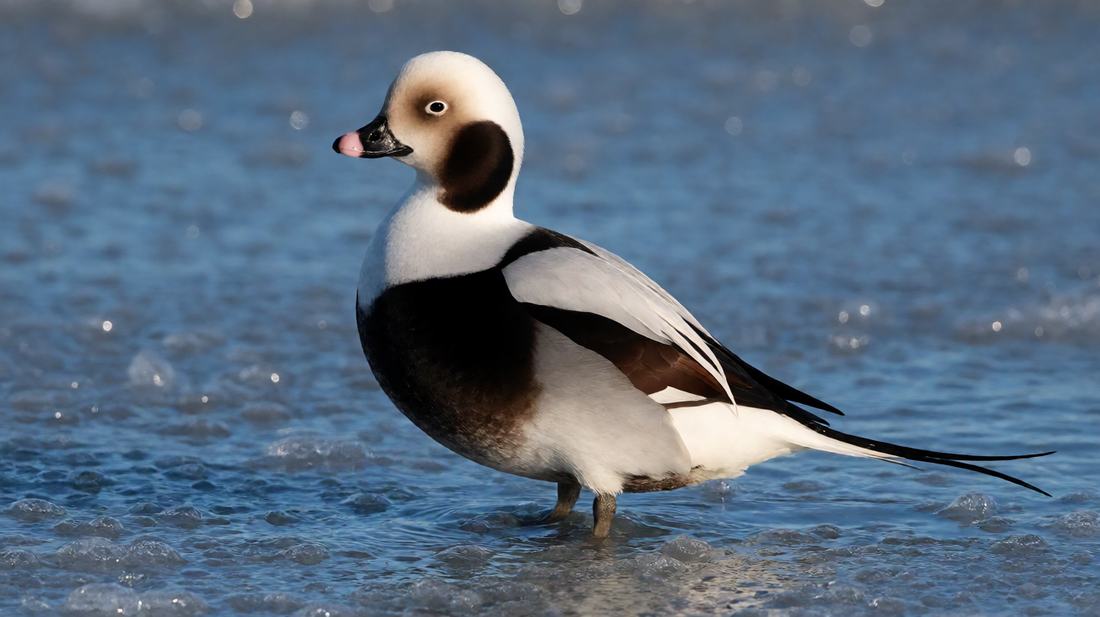
Clangula hyemalis | Long-tailed Duck
Species Profile · Anatidae
Long-tailed Duck
The deepest-diving duck of the north, and the only one that changes its plumage three times a year — now falling fast in the Baltic where it winters.
IUCN: Vulnerable
Range
Length
Weight
Nest
Incubation
Three plumages a year
A duck of the far north
The Long-tailed Duck is a small, stocky sea duck of the far north. It is one of the most distinctive waterfowl in the world. The male changes shape and colour through the year. In winter he carries a long, needle-like tail. He has a pale head with a dark cheek patch. His plumage is almost entirely white. In summer the same bird turns dark brown and black. He then wears a white face mask. So a male in February and the same male in July look like 2 different species. The bird is 36 to 41 cm long without the tail. The male’s tail streamers add a further 10 to 15 cm. It weighs 500 to 1100 g.
The male is noticeably heavier than the female. The body is compact and rounded. The neck is short, the head small and the bill short. That bill suits taking prey from the surface and from shallow water. The species is a champion diver. It regularly feeds at depths of 10 to 20 m and has been recorded far deeper. On land it walks awkwardly. In water it swims and dives with great ease. It uses its wings as well as its feet below the surface. The style looks more like a penguin than a paddling mallard. It can stay submerged for well over a minute. It breeds in the high Arctic and sub-Arctic.
Its range covers northern Europe, Russia, Alaska and Canada. It nests on islands and tundra ponds beside freshwater lakes. It winters at sea in the cold temperate waters of the North Atlantic and North Pacific. There the flocks gather in enormous rafts. It is the only living member of the genus Clangula. Its scientific name refers to its voice. Clangula comes from the Latin for a babbling or clanging sound. Hyemalis means of winter. So the whole name means the winter clanger. That refers to the far-carrying, yodelling, two-note call of the male. The call carries across the tundra for a surprising distance.
Family tree
Clangula, a genus of one
The Long-tailed Duck sits in the family Anatidae, with the ducks and geese. Within that family it sits in the subfamily Merginae, the sea ducks. That group includes the eiders, the scoters, the mergansers and the goldeneyes. It also includes the Tufted Duck. Sea ducks prefer coastal and northern waters. They dive hard and live in very cold water. The Long-tailed Duck is the only member of the genus Clangula. It has no close living relatives. So it stands alone among the ducks. It has no named forms anywhere in its range.
That is odd for a bird with such a vast range. The species was described by Linnaeus in 1758. It has had a confusing string of common names. In North America it was long called the Oldsquaw. That name is now abandoned on grounds of respect as well as accuracy. In Europe it has been called the Long-tailed Duck or the Old Wife. In many tongues the name notes the bird’s habit of showing up in winter. That is when the male’s white plumage and long tail are at their most striking. DNA work has recast the sea duck tree a good deal. They clarified the position of the Long-tailed Duck rather than simplifying it.
The genes show it is not close to the scoters or the goldeneyes. It represents an early split within the sea duck group. That is one reason it keeps odd features found in no close kin. Its voice is quite un-duck-like. Its moult is unique among ducks. Its breeding system is unusual too. The common English name simply describes the male’s tail. In winter that tail can be longer than the rest of the bird’s body.
White body, long tail
How to identify one
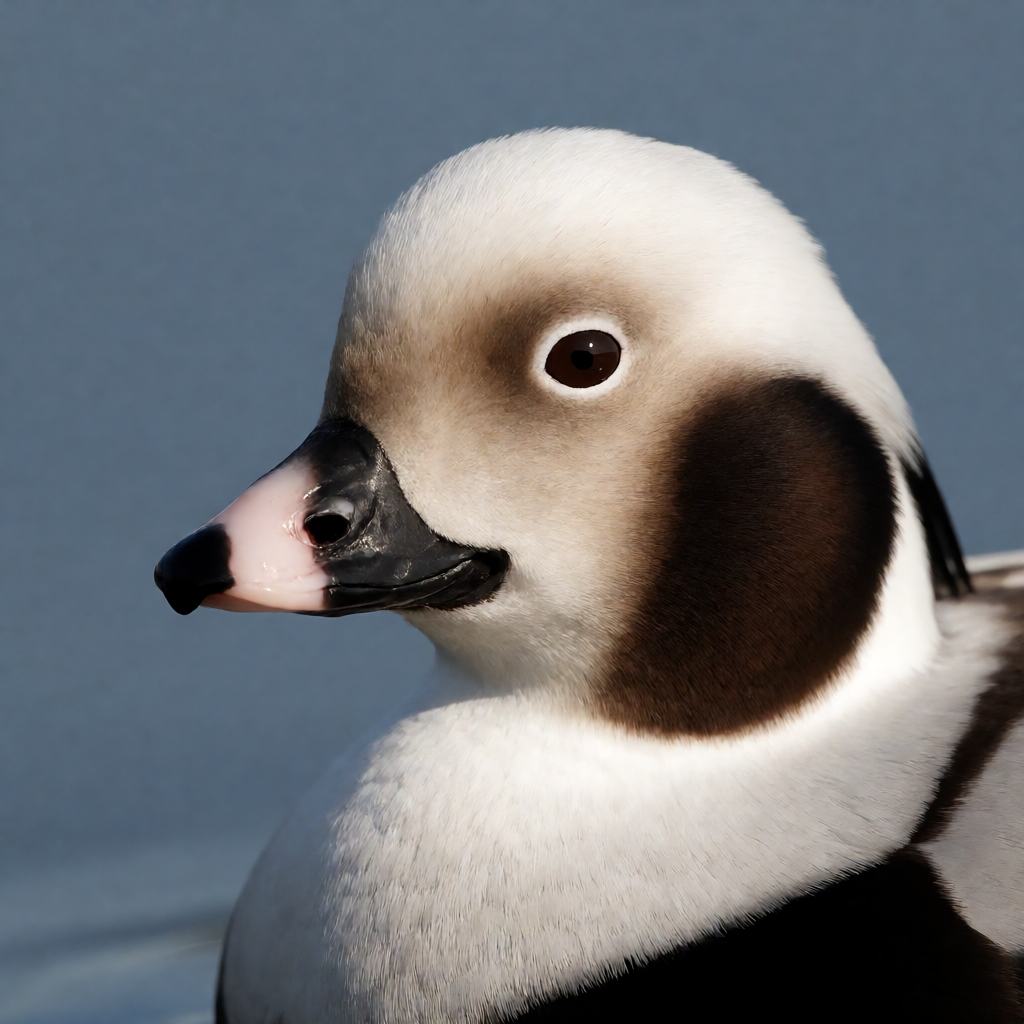
The most remarkable thing about the bird is how its look changes through the year. This is not a simple swap between bright breeding dress and dull winter dress. The male passes through a complex sequence of 3 distinct plumages. The female has 2. The male in particular is more or less continuously moulting. So individuals can be found in almost every intermediate state. The male in winter is largely white with a dark brown or blackish back. A dark patch on the side of the head spreads down the neck. The grey bill is crossed by a pink or orange band. A pair of extremely long, narrow, pointed central tail feathers gives the bird its name. The bird holds them cocked and slightly raised. In summer the same bird turns dark brown over the head, neck and mantle.
A white patch appears around the eye and the belly turns white. The long tail feathers are much shorter and less conspicuous. The female is much more restrained and much more constant. She is brown above and whitish below in all seasons. She has a dark crown, a white collar and a dark cheek patch. She never develops the long tail of the male. So she is easy to overlook among other female diving ducks. The shape of the head and the pattern of the face give her away. The bill is short and thick compared with those of most diving ducks. The legs are placed far back on the body. That gives the bird powerful swimming and diving ability. It costs the bird a shuffling, awkward walk on land.
The wings are small for the size of the body. The bird needs a long run across the water to become airborne. Once in flight it moves fast and low with rapid, whirring wing beats. It often flies in tight, fast flocks that wheel and turn as one. Males in winter flash white and dark as they bank. That makes the flocks highly conspicuous at sea. The sexes are similar in size but the male is heavier. Weight varies a good deal through the year. It is lowest in midsummer and highest in late winter. The birds then need fat reserves to survive the coldest water.
1
2
3
Tundra pool and coastal sea
Where it lives
The Long-tailed Duck is a bird of the far north in summer. It is a bird of cold coastal water in winter. Its year has 2 halves that could belong to 2 species. In the breeding season it lives on the Arctic tundra and the forest tundra. It nests beside shallow freshwater ponds, pools, lakes and slow rivers. It often picks small islands safe from mammal hunters. It prefers spots with low, open plants and clear water. It will also nest in coastal lagoons and river deltas close to the sea. It arrives on the breeding grounds in late spring as the ice breaks up. Males and females gather in small groups on the open water before pairing.
The species is unusual in one respect. Many males desert the breeding areas in early summer. They migrate to moulting grounds, sometimes hundreds of km away. There they gather in large flocks at traditional coastal sites. They cannot fly for many weeks as they grow new feathers. Outside the nesting season the bird lives almost wholly at sea. It likes shallow coastal water with sand or gravel below. It works at depths of 5 to 20 m. It uses estuaries, bays, fjords and the channels between islands. It shuns the deep open sea and the muddy inshore flats used by many ducks.
In winter the species gathers in flocks that can number many thousands. In the Baltic those winter rafts are among the largest of any duck in Europe. The birds feed almost all day through the short winter light. They rest at night, often in tight rafts that cut heat loss. The species is highly migratory. Birds that breed in the Canadian Arctic move south and east. They winter off the coasts of Greenland, Iceland and northern Europe. So the winter birds of the North Atlantic come from nesting areas thousands of km apart.
A diver of the sea bed
What it eats
The Long-tailed Duck eats flesh, mostly small sea animals. Its diet is dominated by molluscs, crustaceans, small fish and insect larvae. The mix shifts a lot with the season, the depth and the sea bed. In the breeding season the bird feeds in fresh water. It takes insect larvae, especially those of midges and caddisflies. It takes small crustaceans. It takes the seeds and shoots of aquatic plants and a few small fish. The chicks feed on insects and small sea life beside the nest. In winter the species feeds in the sea and takes a much wider range of prey. The most important items are bivalve molluscs and small gastropods.
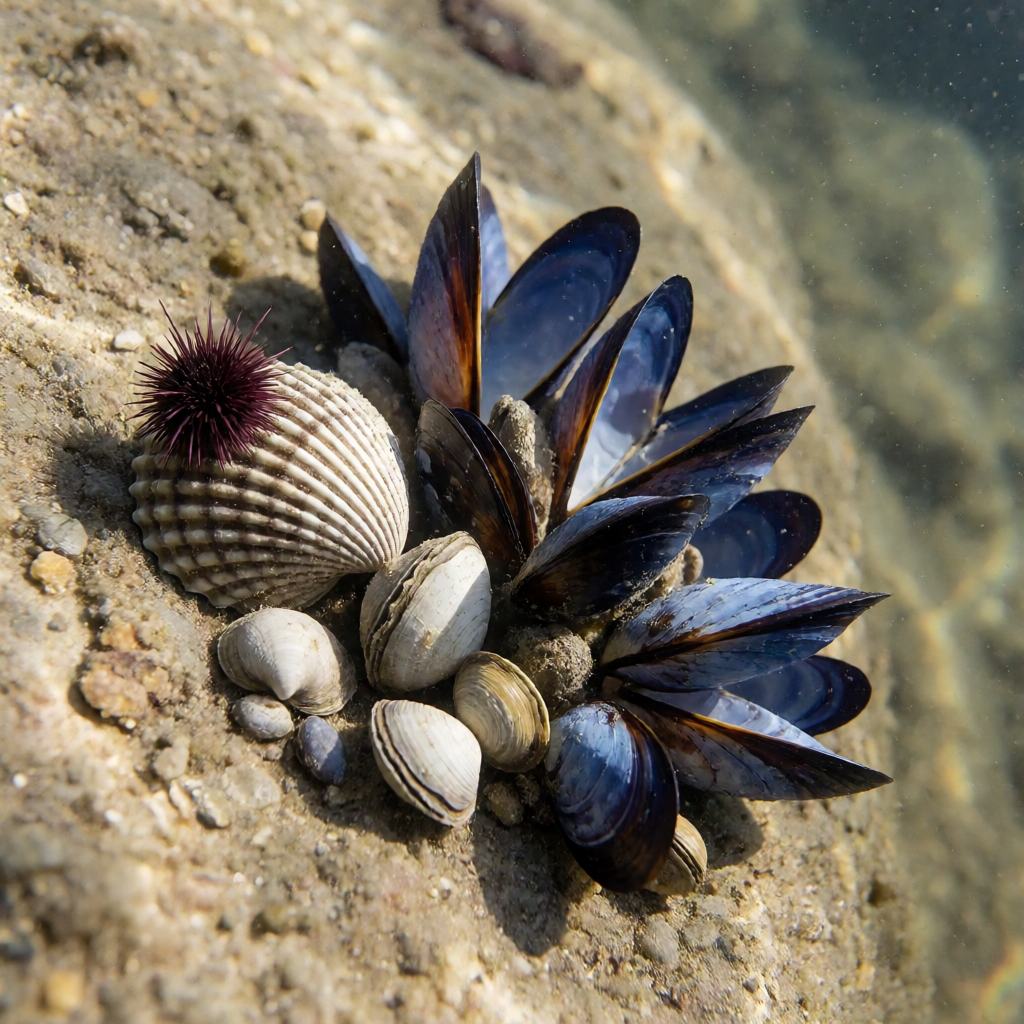
The bird gulps them whole and crushes them in its strong gizzard. It also takes amphipods, mysid shrimps, isopods and small crabs. It takes brittle stars, marine worms and small fish such as sand eels and gobies. It will also take fish eggs at spawning time when these are available in quantity. The species is a fast and agile diver. It hunts by diving repeatedly from the surface. It works along the bottom and seizes prey with its bill. It does not filter food from the water. So it can exploit prey far below the reach of dabbling ducks. That includes mussels attached to rocks.
It includes the small animals that live among the stems of seaweed. The bird winters in very cold water because its body burns fuel fast. The birds must feed for much of the day and night to fuel their bodies. They feed hard at night in midwinter, when the cold drives their needs up. The bird has an odd habit of feeding in tight, matched flocks. Many birds dive and surface more or less together. That seems to help them find patches of prey. It also reduces the risk of losing contact with the feeding group.
A scrape lined with down
The breeding cycle
The breeding season is short and hard, as it must be so far north. The birds arrive on the tundra in late May or early June. They pair quickly. The whole breeding cycle is finished before the ice returns in September. The bird is odd among ducks in keeping one mate for longer than most. Pair bonds form on the wintering grounds or during migration. They persist through the nesting season. The male’s display is spectacular and noisy. He swims around the female with the long tail raised. The neck is stretched and the head is thrown back and forwards. All the while he gives the yodelling call that named the genus.
The nest is a shallow scrape on the ground. It sits near water, often on a small island, a spit or a hummock. The plants round it are low so that a hunter can be seen coming. The nest is lined with a thick layer of down and plant material. The female plucks the down from her own breast. It keeps the eggs warm and hidden at once. Between 6 and 8 eggs are laid, occasionally as many as 11. They are olive-buff and smooth. The female incubates them alone for between 24 and 29 days. She leaves the nest rarely and only to feed. The male stays nearby but does not incubate.
The ducklings leave the nest within a day of hatching. They can feed themselves and dive almost immediately. The female tends them alone. In some groups females with broods gather in crèches. The young of many families are then tended by fewer adults. That frees some females to leave the breeding grounds earlier. The young fledge at between 35 and 40 days. The family breaks up soon afterwards. The adults then move to moulting areas. The juveniles begin the long migration south. The species does not breed until it is 2 or 3 years old.
Vulnerable, and still falling
Conservation
The Long-tailed Duck is assessed as Vulnerable on the global Red List. This change is fairly new and unwelcome. The bird was long thought safe and common. The new label reflects a clear and heavy fall across much of its range. The worst problem is the loss and harm to the winter grounds. The bird is odd among threatened ducks in one way. It is held back not by its far breeding grounds but by what happens at sea. Those seas take in the Baltic, the North Sea, the Atlantic and the North Pacific. Baltic numbers above all have fallen by a huge share since the 1990s. The causes take in big oil spills and long-term oil waste from ships.
Nets are another cause. So is the loss of the mussel beds the birds feed on, through dredging and warmer water. Rich water and warming have also cut the small sea life that makes up the winter diet. Warming is a second and growing threat. The Arctic nesting grounds are warming faster than almost anywhere on Earth. The shallow tundra pools the bird needs are drying up in places. The birds arrive at times that match the insect hatch less well. Less ice has opened the Arctic to ships and to industry. That takes in oil and gas work in places once out of reach. The bird is also shot for sport in many lands.
The numbers taken are small next to the size of the stock. Even so, hunting may matter when other pressures add up. That is true above all where the birds gather. Saving the Long-tailed Duck depends on nations working together. The key steps are less oil waste. Laws against dumping oil at sea must be enforced. Nets must take fewer of the birds. Key moulting and winter areas should be set aside as sea parks. The health of the Baltic must improve. The bird is listed under world deals that cover migrating waterbirds.
Quick hits
Five things to remember
- The male has 3 distinct plumages in a year, more than any other duck.
- Its winter tail streamers can be longer than the rest of the bird’s body.
- It dives with its wings as well as its feet, in a style much like a penguin.
- Male and female both have pink or orange colouring on the bill.
- It was long known in North America as the Oldsquaw, a name that has since been dropped.