 By st20113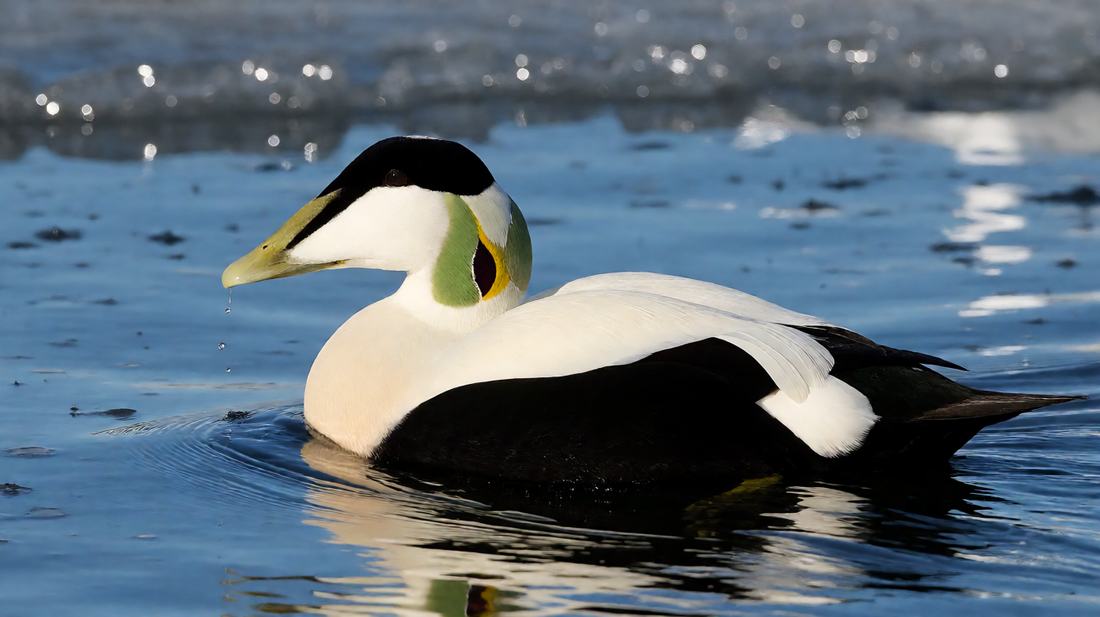
Somateria mollissima | Common Eider
Species Profile · Anatidae
Common Eider
The largest duck of the north, named not for its looks but for the down its female plucks from her own breast to line a nest on a bare island.
IUCN: Near Threatened
Range
Length
Weight
Nest
Diving
The duck named for its down
A heavy sea duck of cold coasts
The Common Eider is a heavy sea duck of cold northern coasts. It is the largest duck in the Northern Hemisphere. Its bulk and thick feathers suit water that stays near freezing all year. The drake is easy to know in spring. He has a black crown and belly and a white back and breast. The breast carries a faint pink flush and the nape a patch of lime green. His bill is long, wedged and olive-yellow. The hen looks nothing like him.
She is mottled and barred in soft brown all year, so she disappears against the stones of a nesting islet. She alone makes the thing that people have valued for more than 1000 years. Both the English name and the scientific name point to the same material. The bird is named for its down, not for its looks. The hen plucks that down from her own breast. She uses it to line the nest and to cover the eggs. The harvest in Iceland is taken from nests the chicks have already left. No bird is harmed.
The world total is about 2,300,000 birds. That figure hides a lot of trouble. The species is Near Threatened worldwide and Vulnerable in Europe. In the Baltic Sea its breeding numbers are now classed as Critically Endangered. Sweden held more than 300,000 pairs around 2000. By 2018 it held only about 60,000.
Family tree
Somateria, a genus of three
The Common Eider was first described by Linnaeus in 1758. Its name is still Somateria mollissima. It sits in the family Anatidae, with the ducks, geese and swans. It belongs to the sea duck group. Members of that group feed under water rather than at the surface. The Tufted Duck is one of its relatives in that group.
The genus Somateria holds only 3 living species. They are the Common Eider, the King Eider and the Spectacled Eider. Steller’s Eider sits in its own genus, Polysticta, because its body and habits are so different. The word Somateria comes from the Greek for body and wool. Mollissima is Latin for very soft. So the full name means the very soft woollen-bodied duck.
The name describes the nest lining, not the bird. Six subspecies are accepted. They differ in the length and colour of the bill and in the throat pattern of the male. The Pacific race has a black V mark under the chin. The generation length is about 7 years. That number matters when a population starts to fall.
Black and white, green and brown
How to identify one
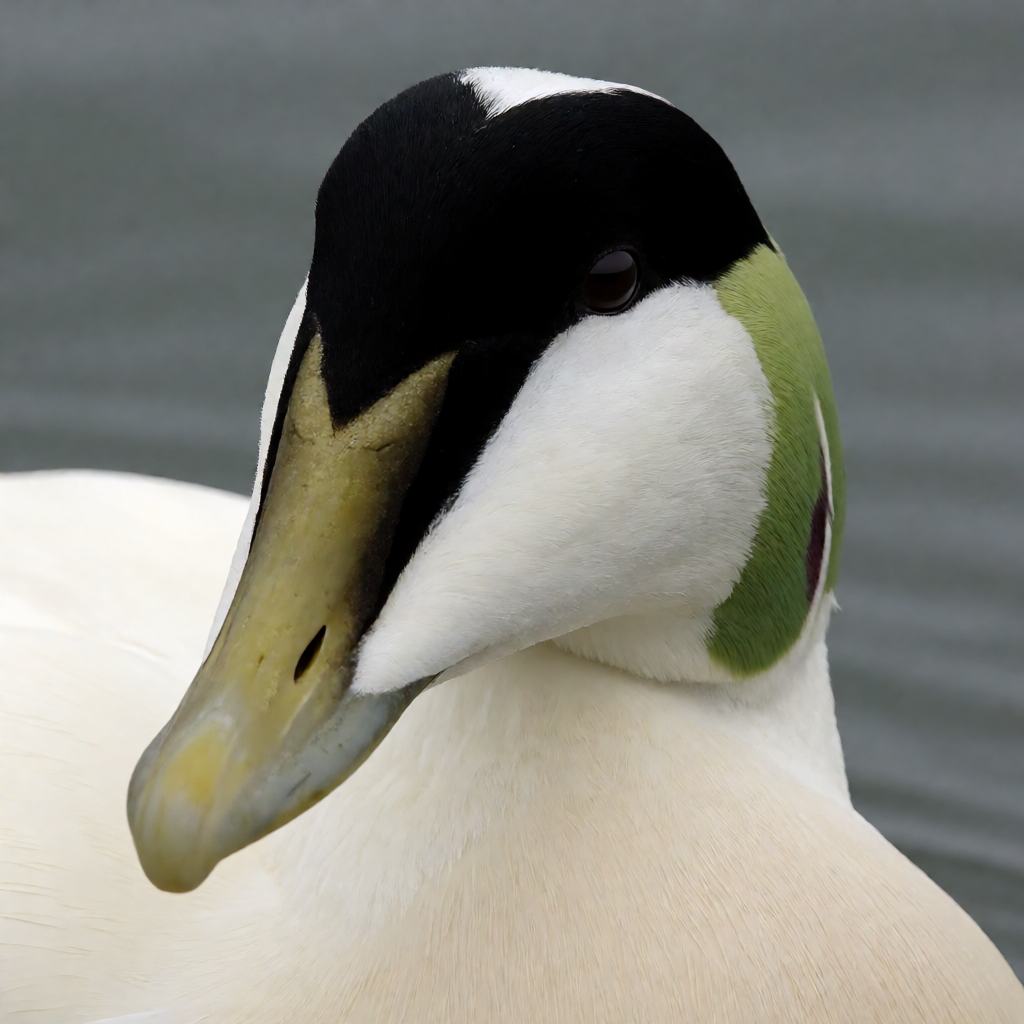
An adult is 50 to 71 cm long. Its wings span 80 to 108 cm. Those sizes look modest. The frame that carries them does not. An eider weighs 1.2 to 2.8 kg. Drakes weigh 1.2 to 2.2 kg and hens 1.0 to 1.8 kg. The bill is the key to the bird. It is long and wedge-shaped. It has a large lobe at the front and its sides are feathered almost to the nostrils. The bird uses it to lever shellfish off rock.
The legs and webbed feet are orange-yellow. They sit far back on the body. That makes the bird clumsy on land and strong in water. The drake in spring wears black and white. His crown, rump and belly are black. His back and breast are white with a pink flush. His nape is light green and the tip of his bill is pale. He wears this suit for part of the year only. After breeding he moults into a mixed dress of black, brown and white. The hen is barred and mottled in brown all year.
Her shade runs from grey-brown to red-brown or sandy. She has a dark wing patch edged in white. On an open island nest she is almost invisible. Both sexes share a triangular head shape. Both carry dense feathers over a thick mat of down. That keeps them warm and afloat. The drake gives a soft rising note. The hen chatters. An eider can live about 20 years.
1
2
3
Rocky shore and mussel bed
Where it lives
The species rings the top of the world. It breeds on Arctic and northern temperate coasts of Europe, North America and eastern Siberia. In winter it moves a little south. Then it gathers in big flocks on coastal water that stays open. It is a bird of the sea and of brackish water. It likes rocky shores, shallow bays, sheltered fjords and river mouths. It depends on beds of mussels and clams.
So it feeds in water less than 10 m deep, where it can reach the bottom in one breath. Some groups stay put. In Greenland and Iceland the birds simply shift to the nearest open water. Others are part migrants and move with the season. Breeding happens on offshore islets and small islands free of foxes. The birds nest in dense groups. A group may hold a few pairs or several thousand.
Birds tend to return to the place where they were reared. The winter gatherings are huge. About 500,000 birds were counted in West Greenland in 1999 and again in 2017. About 150,000 more winter off Newfoundland and Quebec. The Baltic and Wadden Sea flyway held around 976,000 by 2012. That followed a fall of 36 per cent. The count dropped from about 1,200,000 in 1990 to about 760,000 in 2000.
Shellfish specialist
What it eats
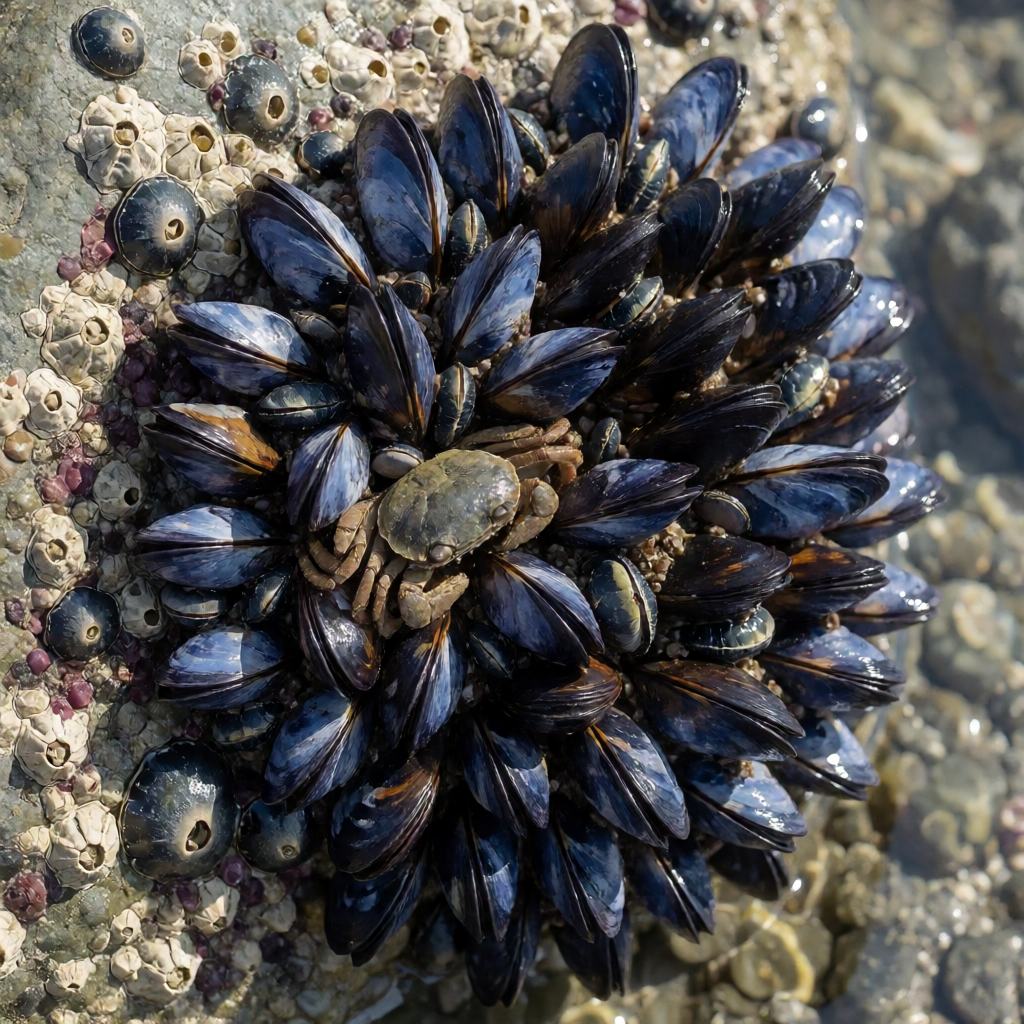
The eider is a shellfish specialist. Blue mussels form the base of its food across most of its range. It also takes clams, cockles, whelks and other snails, sea urchins, crabs and worms. It eats a few small fish now and then. It does not crack shells open. It swallows them whole, shell and all. A strong gizzard grinds them to bits.
The bits then pass out of the body. That trick lets it use food most ducks cannot touch. Most dives go down 2 to 10 m. The bird can reach 20 m if it must. A dive lasts about 30 seconds. The biggest birds can stay under for 1 minute. The feet drive the bird, not the wings.
The wings stay tucked against the body. Prey is levered off rock with the wedge bill and swallowed under water. Eiders often feed in loose flocks. The birds dive and surface together. Young birds can swim and dive within hours of reaching the sea.
Down-lined scrape on an islet
The breeding cycle
Pairs form in autumn or winter in some places and in spring in others. The bond lasts one season, not a lifetime. The drake stays until the hen is deep into sitting. Then he leaves to moult and joins other males. Most hens breed first at 3 years old. They tend to return to their own birth area. Birds reach the breeding grounds in May. The season runs from May to August, depending on latitude. The nest is a scrape in the ground on a sheltered islet.
The hen lines it and later covers the eggs with down from her breast. Plucking the down leaves a bare patch of skin. Heat passes straight from her body to the eggs. She lays 3 to 6 eggs, about 1 a day. She starts to sit properly after the second or third egg. Then she stays for 24 to 28 days and does not leave to feed. She can lose 45 per cent of her weight. The eggs hatch within about 24 hours of each other. The chicks reach water within a day of drying out.
Broods from many nests then merge. A crèche can hold 150 ducklings and about 10 hens. Some of those hens have never bred. They act as aunts and help guard young that are not their own. The young leave the hen at 55 to 60 days. They can fly at 65 to 75 days. In some colonies more than half die before they reach water. Skuas, gulls, foxes, rats and mink take them.
Falling fast in the Baltic
Conservation
The eider is Near Threatened worldwide and Vulnerable in the European assessment. In the Baltic its breeding numbers were classed as Critically Endangered in 2024. Its winter numbers there were classed as Endangered. The bird is in real trouble in a region where it was once common. The trend is clear in national counts. Sweden counted more than 300,000 pairs at the turn of the century. By 2018 it held about 60,000. Flyway counts tell the same story. Eiders wintering in the Baltic and Wadden Sea fell 36 per cent between 1990 and 2000. The count went from about 1,200,000 birds to about 760,000.
It then rose to around 976,000 by 2012. Oil is the worst danger. Thick feathers and down lose their warmth once oil soaks them. A coated bird in cold water dies of cold within a short time. Other threats pile up. Fishing gear drowns birds at sea. Hunting removes adults in some countries. Disease has swept through dense colonies and killed many. Mink and raccoon dogs raid nests on islands that used to be safe. Heavy mussel fishing cuts the food supply.
Warming seas change the Arctic breeding grounds and the prey. Disturbance, mining, building and boat traffic add more pressure. One human use does no harm. Down is gathered from nests after the chicks have gone. The birds are not killed or even handled. Iceland has run this harvest for centuries. On the Farne Islands the birds are still called St Cuthbert’s duck. That saint banned their killing in the 7th century.
Quick hits
Five things to remember
- The genus and species names say the same thing twice, a very soft woollen body.
- Every barb of eiderdown ends in a tiny hook, and the hooks lock into a mat, a warmth per gram that no factory fibre has matched.
- A sitting hen never leaves to eat, so she can finish her stint having shed nearly half her starting weight.
- A crèche is a nursery with no single owner, and one group may hold around 150 chicks behind roughly 10 hens, some of which never laid an egg.
- St Cuthbert’s ban on killing eiders in the 7th century is one of the oldest bird protection rules known.