 By st20113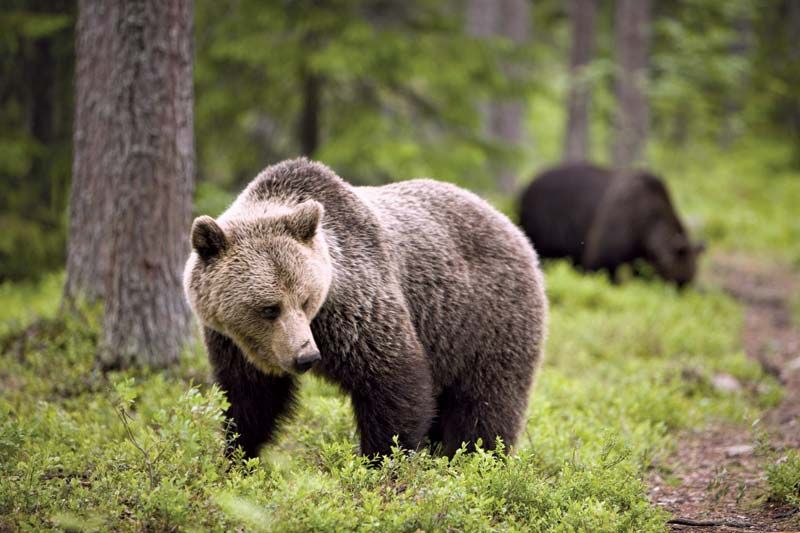
The brown bear is one of the largest land-dwelling carnivores on Earth, a powerful mammal whose range once stretched across most of the Northern Hemisphere. Today it survives from the forests of North America and Europe to the mountains of Asia, including the famous grizzly bears of western North America and the huge Kodiak bears of Alaska. An adult male may stand more than two and a half meters tall on its hind legs and weigh well over 300 kilograms, though bears in poorer habitats are considerably smaller. Despite its bulk and meat-eating ancestry, the brown bear is fundamentally an omnivore.
A distinctive feature of the brown bear is the muscular shoulder hump above its front legs, formed by the great mass of muscle used to dig and to power its forelimbs. Its long claws, up to 15 centimeters, are suited to excavating roots, bulbs, and burrows rather than to climbing. The coat ranges from blonde through brown to nearly black, and the face bears a dished profile. Perhaps its most acute sense is smell: a brown bear’s nose is many times more sensitive than a human’s and can detect food, mates, or danger from several kilometers away, guiding much of its behavior.
The diet of the brown bear shifts with the seasons and the place. In spring it grazes on fresh grasses and shoots and digs for roots and insects; through summer it feasts on berries, nuts, and fungi; and in autumn it may consume large quantities of fish. In regions where salmon crowd the rivers to spawn, brown bears gather at the water’s edge to catch them, a spectacle that links the bear directly to the river’s annual bounty. At such moments the bears become key distributors of marine nutrients, carrying fish into the forest where scraps feed scavengers and fertilize the soil. At other times they may take mammals, from mice to elk calves, though plant food usually makes up the greater part of what they eat.
As winter approaches in colder parts of its range, the brown bear enters a deep rest called hibernation. It seeks a den among rocks, roots, or an excavated burrow and, from late autumn to early spring, lowers its heart rate and body temperature and lives off the fat stored during the autumn feast. Cubs are often born in the den in mid-winter, tiny and helpless, and nurse while the mother sleeps. This seasonal cycle lets the bear survive months when food is buried under snow, and it is one reason the species can occupy such varied and harsh landscapes.
Brown bears shape their surroundings in ways that ripple through the wider ecosystem. By dispersing seeds in their droppings, turning soil as they dig, and concentrating nutrients from rivers into forests, they act as ecosystem engineers. They share the northern wilderness with other large predators such as the gray wolf, with whom they may compete for prey and carrion, though the two often avoid open conflict. Once hunted to the edge of extinction across much of its range, the brown bear has recovered in areas where habitat and tolerance allow, yet remains threatened by logging, roads, and shrinking wild country. As a symbol of the untamed North, it reminds us of the value of leaving room for great wild animals in a crowded world.
Hemisphere. These evergreen conifers are foundational species in numerous ecosystems, from boreal forests to mountain slopes, and have been economically significant to human societies for
[…] with open areas for grazing. In mountainous regions, they move between elevations seasonally. Brown Bear populations share some of these same mountain […]
[…] nuts, palm nuts, and seeds from numerous tree species form the core of its nutrition. Like the brown bear, which uses its powerful bite to access hard-shelled foods, the macaw’s hooked beak and […]
[…] acid poisoning from harmful algal blooms, which has caused mass strandings and pup deaths. Like the brown bear, which shares coastal habitats with sea lions in some regions, both species benefit from habitat […]
[…] in Yellowstone National Park, Wind Cave National Park, and various state and tribal lands. Like the Brown Bear, bison require large areas of protected habitat to maintain healthy […]
during the day. Across their range they share the landscape with other large mammals such as the brown bear, which occasionally predates vulnerable
[…] terrestrial life than many frogs. It shares European landscapes with large wild mammals such as the brown bear and the red fox, though the tiny toad is rarely noticed by such bigger neighbours and keeps to […]
[…] related to other European brown frogs and shares the landscape with large wild mammals such as the brown bear and the red fox, though the frog keeps to damp margins where these bigger animals rarely forage for […]
[…] on land rather than in water. It shares Mediterranean habitats with larger mammals such as the brown bear and the red fox, which may prey on eggs and young, while the adult tortoise relies on its bony […]
[…] Both sexes have robust bodies and relatively large heads, characteristic of the genus. The brown bear represents a much larger species that shares some of the same remote mountainous […]
[…] the brown bear, which shares many of the same ancient European forests, the stag beetle has persisted in these […]
[…] pandas belong to the family Ursidae, making them close relatives of the Brown Bear. Genetic studies have confirmed that pandas diverged from other bears approximately 19 million […]