 By st20113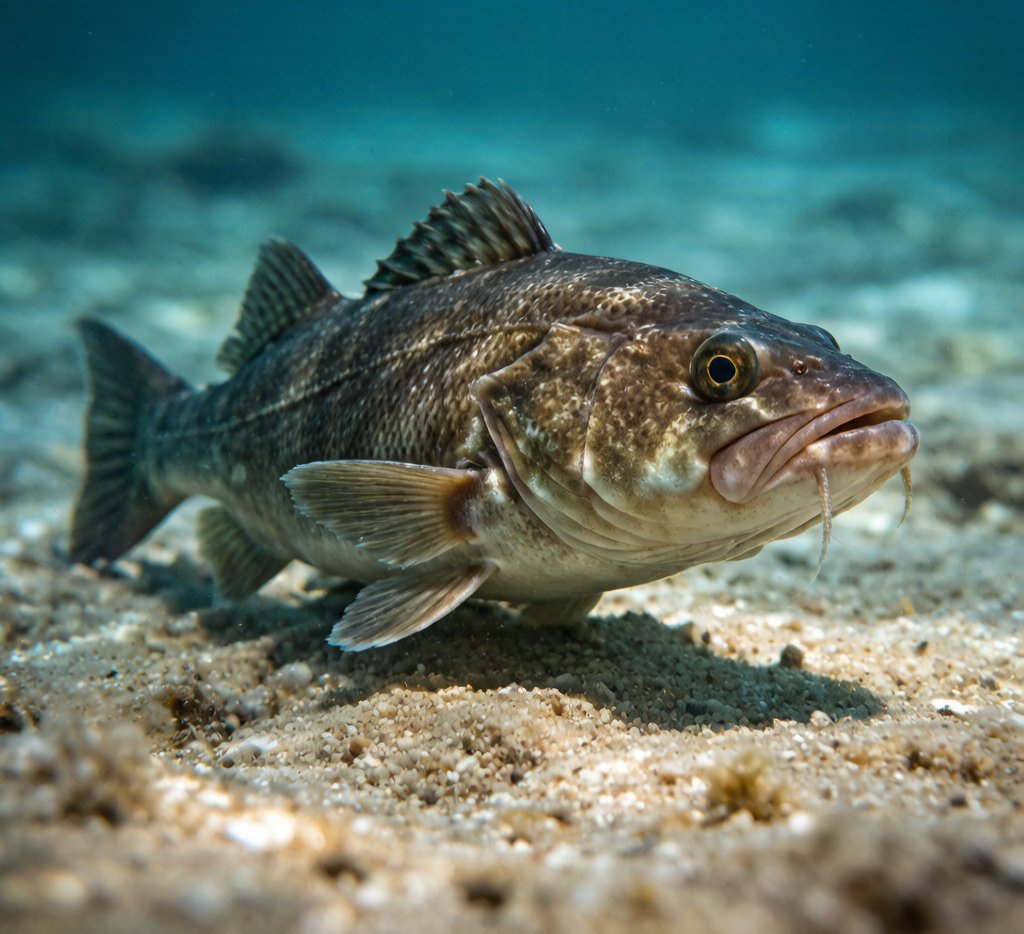
Introduction
The Atlantic cod (Gadus morhua) is a large, commercially important groundfish of the North Atlantic. For centuries it has been a staple of North Atlantic fisheries and a cornerstone species of cold-water marine food webs. Its mild flavour and flaky white flesh have made it one of the most traded fish in the world for over a thousand years. Adults commonly reach 60 to 100 centimetres and may exceed 1.5 metres in exceptional cases, with a weight of several kilograms. Its body is elongate and speckled brown or greenish, marked with a pale lateral line and a distinctive chin barbel. Like other northern fish such as the Atlantic salmon, the cod is a cold-water species central to both ecology and fisheries.
Taxonomy
Gadus morhua is classified in the family Gadidae, order Gadiformes. It was described by Carl Linnaeus in 1758. The genus Gadus includes several cod-like fishes of the North Atlantic and Arctic. Three rounded dorsal fins and two anal fins characterise the group. Genetic work has identified distinct populations, such as those of the North Sea, the Baltic, and the Grand Banks, though all are treated as one species. The name morhua has long been used in European languages for this fish.
Physical Characteristics
Atlantic cod have a broad head, a large mouth with many small teeth, and a single barbel on the chin used to detect food on the seabed. Their colour provides camouflage against rocky and sandy bottoms. Cod possess a swim bladder that helps control buoyancy in midwater. Like the related Atlantic sturgeon, they are built for life near the bottom but can also rise through the water column to feed and spawn.
Habitat
This species inhabits continental shelf waters from close inshore to depths of several hundred metres, favouring temperatures between about 2 and 10 degrees Celsius. It associates with rocky reefs, gravel, and sand where prey is abundant. Cod migrate seasonally between feeding and spawning grounds, sometimes covering long distances. Juveniles use shallow bays and estuaries as nursery areas before moving to deeper water as they grow. They are schooling fish, particularly when young.
Diet
Atlantic cod are aggressive, opportunistic predators. Their diet includes smaller fish such as herring, capelin, and sand lance, as well as crustaceans, molluscs, and worms. They are known to swallow almost anything edible that fits their mouth, including the occasional seabird. Large marine predators including the great white shark and seals prey on adult cod, while juveniles are taken by a wide range of fish and birds. Cod sit near the top of the demersal food web.
Reproduction
Spawning occurs in winter and spring on the continental shelf, where females release millions of buoyant eggs that drift in the plankton. A single large female can produce several million eggs in a season. Larvae develop in open water before settling to the bottom as juveniles. Cod mature at three to six years depending on population and environment. Because they produce vast numbers of eggs, year-class strength varies enormously with temperature and food supply.
Conservation
Atlantic cod has suffered severe declines from centuries of intensive fishing, most famously the collapse of the Newfoundland Grand Banks stock in the early 1990s. Some populations are slowly recovering under strict quotas and closures, while others remain depleted. The IUCN lists the species as vulnerable. Sustainable management, bycatch reduction, and protection of spawning aggregations are essential to prevent further loss and to rebuild stocks for both ecosystems and fisheries.
Fun Facts
A single female cod can release up to nine million eggs in one spawning season. The fish has an excellent sense of hearing and uses it to locate shoaling prey in dark water. Cod livers are famously rich in oil and vitamins, historically a major source of cod-liver oil. Some individuals can change colour slightly to match the seabed, and old, large cod were once called “skrei” during their spawning migrations in northern waters.
[…] That family also holds the tunas and bonitos. Its closest well-known kin in European waters is the Atlantic Cod. Cod is a bottom fish with a swim bladder and a barbel on its chin. It hunts in a wholly different […]
[…] fish of the same cold northern seas shares its fishing grounds. That is the Atlantic Cod. It is a large predator with a very different body. It hunts in midwater and near the seabed. Young […]
[…] Morocco. It also covers the whole Mediterranean and the Sea of Marmara. The comparison with a cod, Gadus morhua, is the most useful one for a European reader. The 2 species are taken by the same boats in the […]
[…] largest member of that family in European waters. Its best-known kin in the Atlantic fishery is the Atlantic Cod. That is a plain fish with a smooth body and a front mouth. It has a normal tail. The two share the […]
[…] Atlantic cod was split open and dried in the cold air of the north. It went as hard as wood. The method needs no […]