 By st20113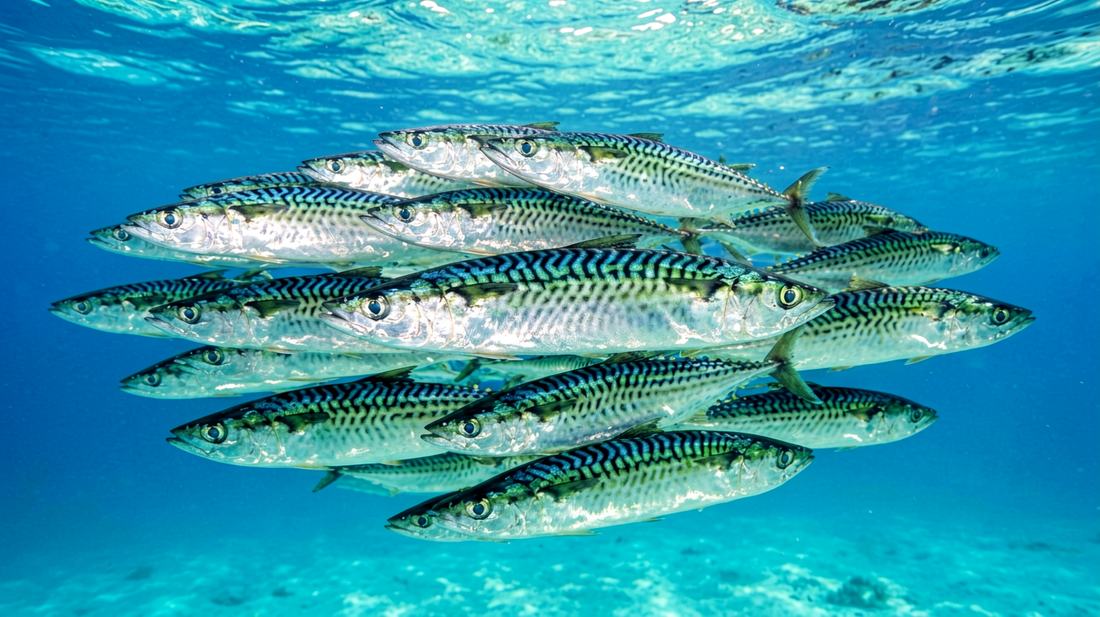
Scomber scombrus | Atlantic Mackerel
Species Profile · Scombridae
Atlantic Mackerel
A fast, striped shoaling fish that puts on fat in a single summer, releases hundreds of thousands of eggs a season and drives one of the biggest fisheries in Europe.
IUCN: Least Concern
Range
Length
Weight
Eggs
Maturity
The striped sprinter
The Atlantic mackerel
The Atlantic mackerel is a fast, slim, silver-blue fish. It swims in shoals so big they show from the air. They look like dark patches moving over the sea. It is one of the key food fish in the north-east Atlantic. Its back bears twenty or more wavy dark bars over a blue-green ground.
Its belly is bright silver. This makes it hard for a foe to pick one fish from a shoal. The species has no swim bladder. It is built for steady motion. It matures young and grows fast.
It is eaten by almost everything bigger than itself. Its foes range from cod to dolphins to gannets. It supports fisheries that land hundreds of thousands of tonnes a year.
Family tree
A tuna relative in a smaller body
The Atlantic mackerel is in the class Actinopterygii. It is in the order Scombriformes and the family Scombridae. That family also holds the tunas and bonitos. Its closest well-known kin in European waters is the Atlantic Cod. Cod is a bottom fish with a swim bladder and a barbel on its chin. It hunts in a wholly different way.
The two share a range and meet directly. Cod are among the main foes of mackerel. Mackerel eat the eggs and young of cod. Within the Scombridae the mackerels form the genus Scomber, which has four species worldwide. The Atlantic mackerel is the one on both sides of the North Atlantic. It is sometimes split into a western and an eastern stock that mix only partly.
The best-known members are the true tunas. They share its stiff body, fast swimming and special finlets. They grow far bigger. Mackerel have been eaten in Europe for thousands of years. The species was named by Carl Linnaeus in 1758.
Bands, finlets and speed
Built for a life in shoals
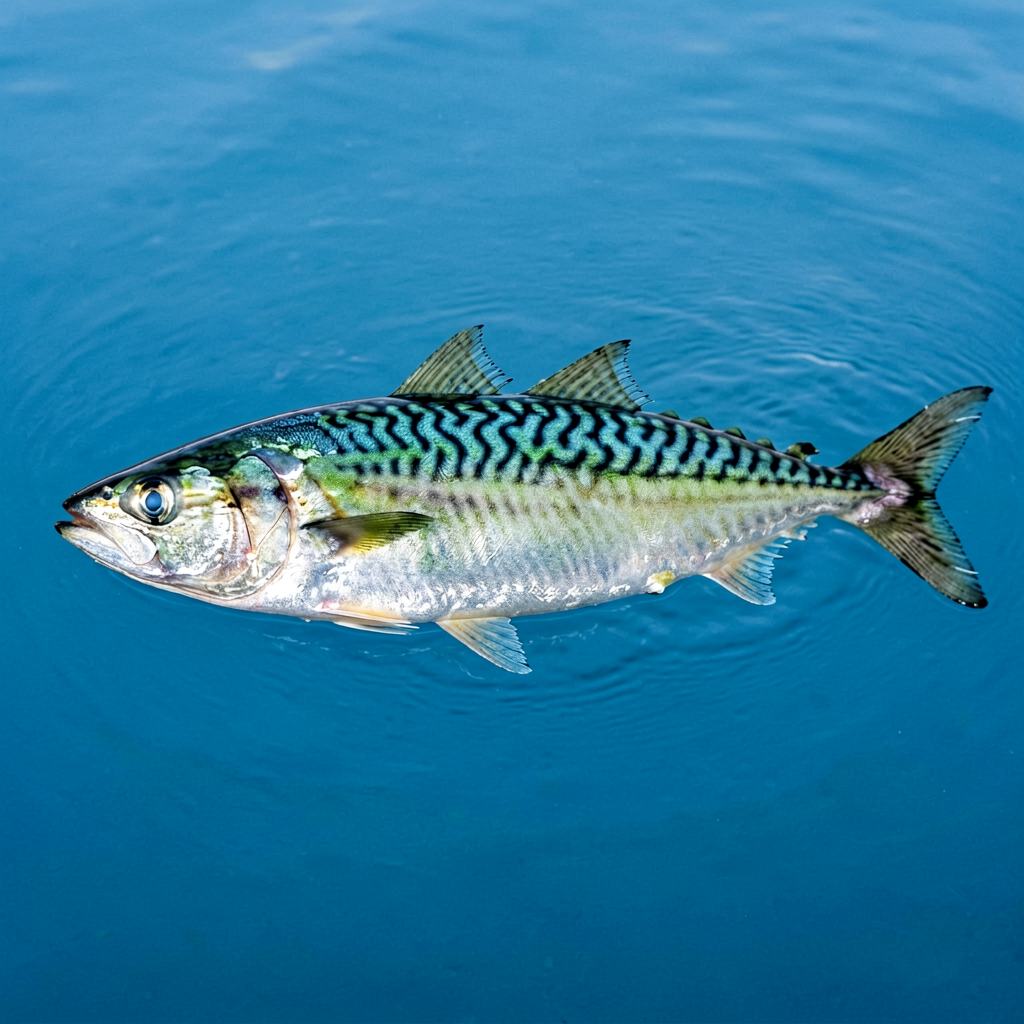
An adult Atlantic mackerel is usually 25 to 45 centimetres long. It weighs 0.5 to 1.5 kilograms. Big ones reach about 60 centimetres. The body is long and spindle-shaped and tapers to a narrow tail stock. It is covered in tiny, smooth scales that lie almost flat with the skin. The back is dark blue-green with wavy vertical bars from behind the head to the tail base.
The underside is silver-white with a metallic shine. Two dorsal fins sit well apart. The second is followed by five small finlets. The anal fin has a matching set of five finlets. These traits are shared with the tunas. The eyes are big, with a fatty lid.
The mouth filters and seizes prey, and fine gill rakers can strain plankton. Mackerel have no swim bladder. This is rare among bony fish. Growth is fast. The skin is smooth and oily, and the flesh is rich in fat. This is why the species was once called the “fish that makes the sea shine”.
1
2
3
Open water and deep shoals
Where it swims
The Atlantic mackerel lives on both sides of the North Atlantic. In the east it ranges from North Africa north to Iceland, Norway and the Barents Sea. In the west it ranges from North Carolina to Newfoundland and the Gulf of Saint Lawrence. It is also found in the Mediterranean, the Black Sea and the Baltic. It lives in the open water from the surface down to several hundred metres. In Europe it is most common in the Celtic Sea.
It is also found in the North Sea, the Bay of Biscay, around Iceland and off west Ireland and Scotland. The species makes set seasonal trips. In spring it leaves deep winter grounds for shallow coastal water to spawn and feed. It reaches southern Britain and Ireland in April and May. It moves north through the summer. In autumn and winter it returns to deeper water off the edge of the continental shelf.
There it forms dense shoals at 150 metres and more. Water warmth shapes these moves strongly. The warming of the north-east Atlantic has pushed the stock north and west. This is one reason for the fight between European states and Iceland and the Faroe Islands. Young live in shallow coastal water and estuaries. They feed on plankton and can be caught from piers and beaches.
What it eats
Filtering and chasing
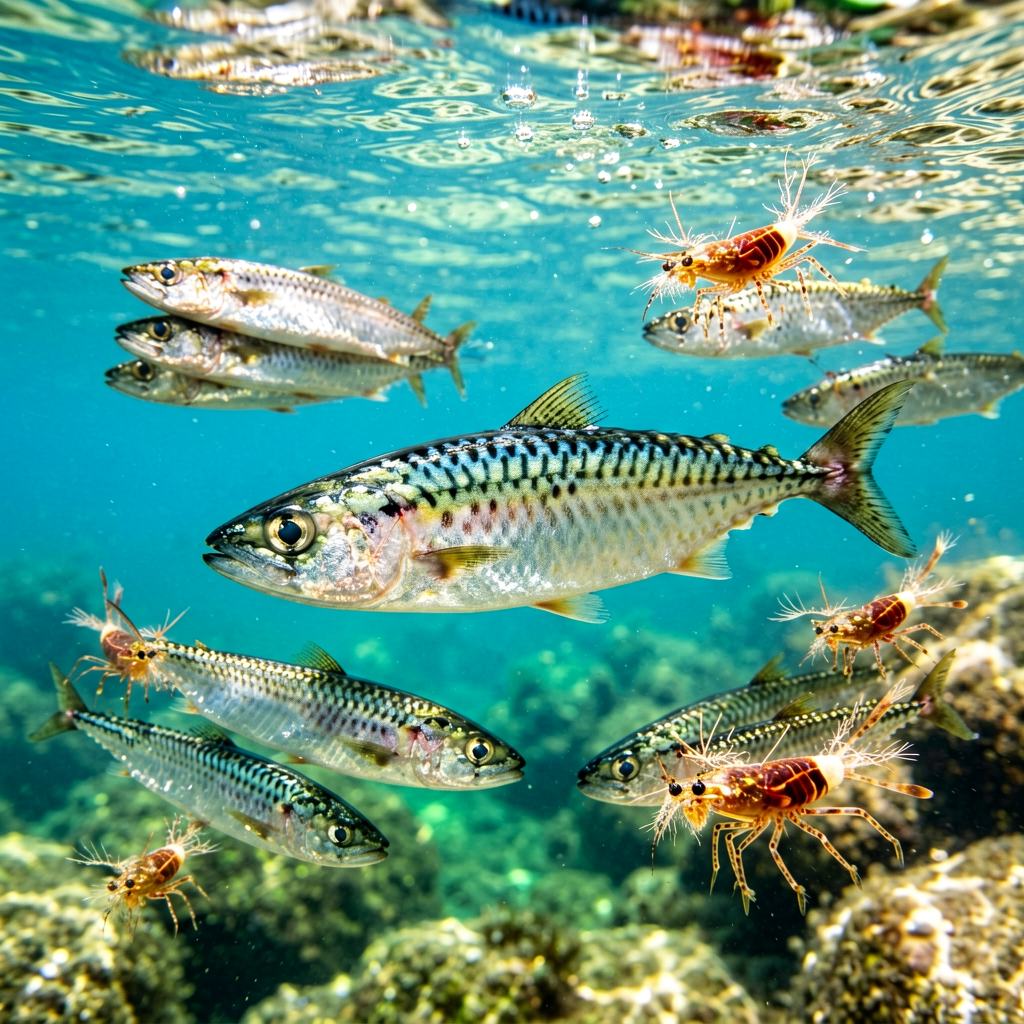
Mackerel filter-feed as young fish and hunt as adults. The change happens in their first year. Young mackerel strain plankton from the water with their gill rakers. They take copepods, shrimp larvae and the eggs and young of other fish. Adults chase small fish such as sandeels, sprats, herring, small cod and whiting. They also eat squid and bigger crustaceans.
Feeding happens by day, mainly in the upper fifty metres. The fish shoal tight while hunting, which lets them herd and confuse prey. Because they must swim without stop, mackerel need much energy. They feed heavily in summer and store fat under the skin and in the flesh. By autumn an adult may be 20 per cent fat by weight. That fat is why mackerel are good food for other animals.
It is also why they were once a key source of oil. In turn they are eaten by almost every big foe in the north-east Atlantic. These include cod, pollack, tuna, sharks, dolphins, porpoises, seals, gannets and other seabirds. They are a key link between plankton and top foes. People take huge numbers too. The stock supports one of the most valued fisheries in Europe.
Half a million eggs
Spawning in batches
Atlantic mackerel spawn in spring and summer. The timing varies across the range. In the Channel and the Celtic Sea spawning peaks in May and June. Off Iceland it happens in June and July. In the Mediterranean it runs into late spring. Spawning happens in the upper water column. It is often in coastal waters where currents and nutrients pile up plankton for the young.
One female may release 200,000 to 500,000 eggs in a season, in several batches over a few weeks. The eggs float and drift in the plankton. They hatch in about a week depending on warmth. The larvae are tiny and clear. They die in huge numbers from plankton-eating fish, jellyfish and other larvae. Only a small fraction reach adulthood. Young mackerel grow fast and reach about 20 centimetres in their first year.
They mature at two or three years, when they are 25 to 30 centimetres long. The species lives up to about sixteen or seventeen years. Few last that long in a heavily fished stock. Spawning success depends on warmth and on the timing of the spring plankton bloom. The stock is made of a few strong year classes. One bad year can weaken new fish for several seasons.
Quotas and shifting shoals
A fishery on the move
The Atlantic mackerel is not seen as globally threatened. It is listed as a species of least concern. The north-east Atlantic stock has been fished too hard for over a decade. Total landings rose sharply from the 1990s. Iceland and the Faroe Islands raised their quotas alone in 2010. This broke the shared management plan.
It sparked the fight known as the mackerel war. Advice from the International Council for the Exploration of the Sea has urged cuts. The stock has shown falling biomass and changes in the size and age of fish landed. Mackerel cross national borders and many countries catch them. Management needs deals that keep lapsing. Warming seas have moved the stock’s centre north-west.
It has left the waters where quotas were first set. This is one reason a deal is so hard. Throwing back small mackerel is a worry. So is bycatch in other fisheries and the effects of taking many immature fish. The species is central to the wider web of life. Heavy fishing on mackerel also strips food from seabirds, dolphins and whales.
Quick hits
Five things to remember
- The wavy dark bars on its back break up the fish’s outline and help it hide inside a shimmering shoal.
- It has no swim bladder, so it must swim without stop for its whole life to avoid sinking.
- Shoals can be so big that they show from the air as dark patches moving across the open sea.
- One female releases 200,000 to 500,000 eggs in a season, in several batches over a few weeks.
- By autumn an adult may be 20 per cent fat, which is why mackerel are such good food for cod, dolphins and seabirds.
[…] trachurus | Atlantic Horse Mackerel Pleuronectes platessa | European Plaice Scomber scombrus | Atlantic Mackerel Chrysaora hysoscella | Compass Jellyfish Odocoileus virginianus | White-tailed Deer […]