 By st20113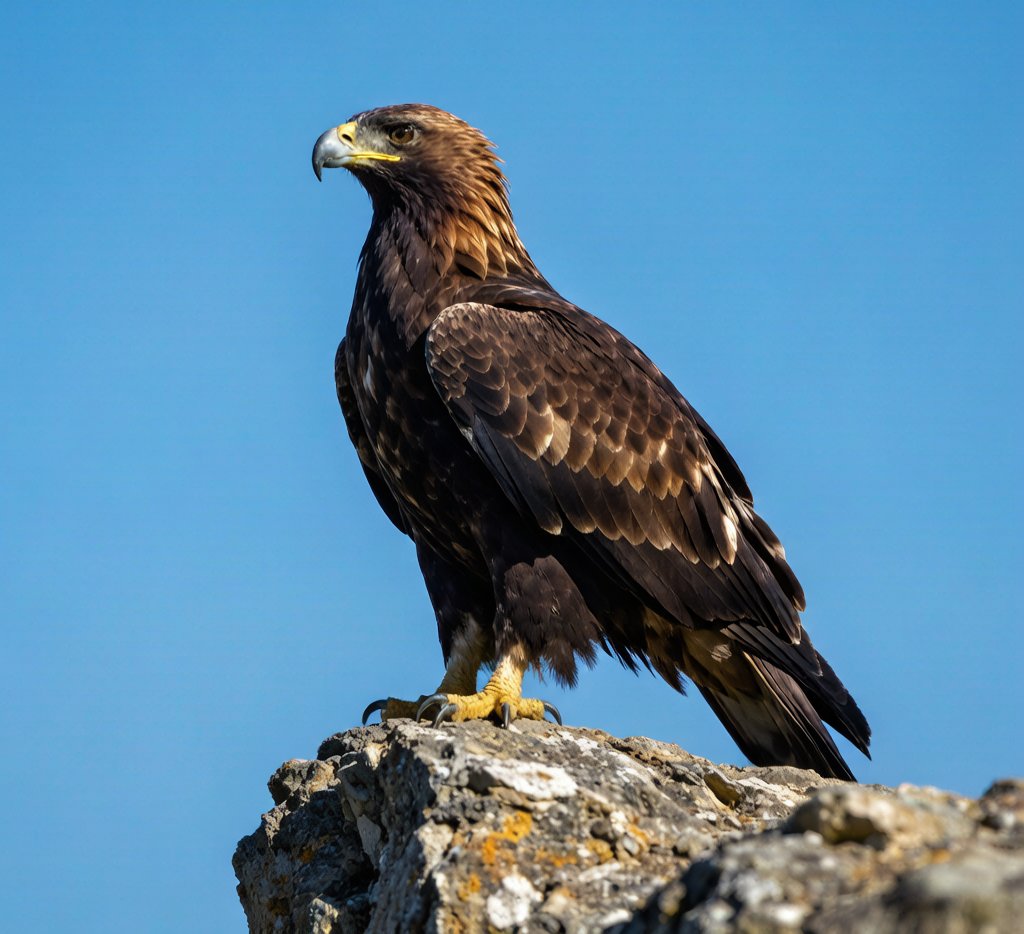
Introduction
The golden eagle, Aquila chrysaetos, is one of the most powerful birds of prey found across the Northern Hemisphere. With a wingspan that can exceed two meters, it is among the largest raptors in its range. Golden eagles inhabit mountains, open plains, and rugged highlands, where they soar on thermal currents in search of food. Revered in many cultures as a symbol of strength, the species has long captured human imagination. It is a skilled and patient hunter, capable of taking prey far larger than itself. Despite pressures, it remains widespread and is admired by birdwatchers and biologists alike.
Taxonomy
Aquila chrysaetos belongs to the genus Aquila within the family Accipitridae, which includes hawks, kites, and other eagles. The species was first described by Carl Linnaeus in 1758. The genus Aquila comprises several large true eagles distributed across Europe, Asia, Africa, and Australia. Golden eagles are distinguished by their size, dark plumage, and the golden nape feathers that give the species its name. Several subspecies are recognized across its broad range, differing slightly in size and coloration. Molecular studies have clarified its relationships with other Aquila species and with closely related genera. Taxonomy continues to be refined as genetic data reveal patterns of divergence among raptors.
Physical Characteristics
An adult golden eagle weighs between 3 and 6.3 kilograms and spans roughly 180 to 230 centimeters. Females are notably larger than males, a pattern common among birds of prey. The plumage is mostly dark brown, with a lighter golden-brown crown and nape. The beak is strongly hooked, and the legs are feathered down to the powerful talons. Those talons can exert tremendous grip force, allowing the bird to capture and carry heavy prey. Juveniles show white patches at the base of the tail and wings, which fade with age. Keen eyesight, estimated at several times sharper than human vision, helps it spot prey from great heights.
Habitat
This species favors open and semi-open country such as mountains, plateaus, grasslands, and desert edges. It is found across North America, Europe, North Africa, and much of Asia. Golden eagles require large territories with sparse human disturbance and abundant prey. They build massive stick nests, called eyries, on cliffs or in tall trees. In winter some populations move to lower elevations or migrate short distances. The species avoids dense forest but uses rocky outcrops for perching and hunting. Habitat loss and collisions with wind turbines pose localized threats, yet the eagle remains common across much of its range where open land persists.
Diet
The golden eagle is a top predator that feeds mainly on small to medium mammals and birds. Rabbits, hares, ground squirrels, and marmots form the bulk of its diet in many regions. It also takes birds such as grouse and cranes, and occasionally reptiles or carrion. Hunting style varies from high soaring surveys to low contour flight and sudden stoops. The eagle uses speed and surprise, striking prey with outstretched talons. A single pair may patrol dozens of square kilometers. Because it sits at the top of the food chain, changes in prey abundance directly affect its breeding success and territory size.
Reproduction
Golden eagles form long-term pair bonds and return to the same nesting territory year after year. The female lays one to three eggs in a large eyrie, with both parents sharing incubation duties over roughly six weeks. Chicks hatch at intervals, so the oldest often outcompetes younger siblings when food is scarce. The young fledge at about ten to twelve weeks but remain dependent on the parents for several more weeks. Nests are reused and enlarged annually, sometimes reaching enormous size over decades. Sexual maturity is reached around four to five years. Because they raise few young, populations recover slowly from losses caused by shooting or poisoning.
Conservation
The golden eagle is classified as Least Concern by the IUCN, with a large global population spread across the Northern Hemisphere. Historically it was persecuted by hunters and ranchers who blamed it for livestock losses, and some illegal poisoning persists. Legal protection in many countries has allowed recoveries, though localized declines occur where prey or nesting sites disappear. The species also faces risks from lead ammunition, electrocution on power lines, and wind energy development. Conservation groups monitor nests and promote practices that reduce accidental harm. Public appreciation of the eagle as a national symbol aids funding for habitat protection. With continued stewardship, this majestic raptor should remain a fixture of open landscapes.
Fun Facts
A golden eagle can dive at speeds over 240 kilometers per hour when stooping. Its eyesight is so sharp it can spot a rabbit from more than a kilometer away. Pairs perform dramatic courtship flights, locking talons in midair. The same nest may be used by generations for decades. Golden eagles have few natural predators as adults. In some cultures they were trained for hunting in a tradition called falconry..
[…] and the “Operation Nest Egg” initiative, have helped some populations recover. The eagle and other raptors face their own pressures, but the kiwi remains the focus of New Zealand’s […]
[…] have short, rounded wings suited to flitting between trees rather than long flight. Like the eagle, they are strong perchers but prefer hopping through […]